Safe, fast and simple: Daimler Truck and Linde set a new standard for liquid hydrogen refuelling technology
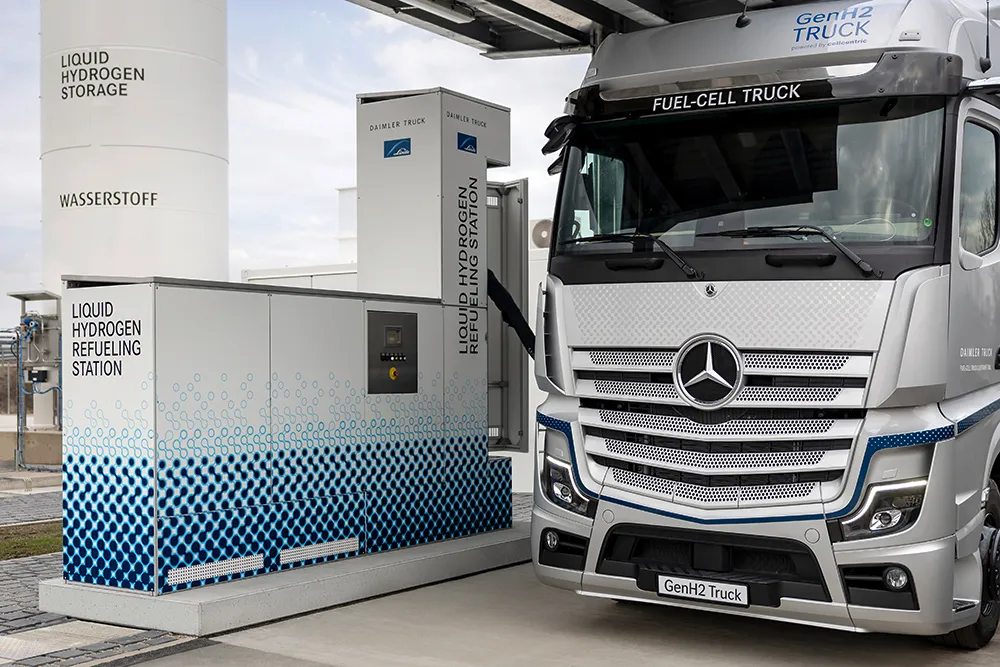
Daimler Truck and Linde Engineering, two leading industrial companies, have achieved a major infrastructure breakthrough on the road to decarbonising transport with hydrogen. In recent years, engineers from both companies have jointly developed sLH2, a new process for handling subcooled liquid hydrogen. Compared with gaseous hydrogen, this innovative approach offers greater storage density, longer range, faster refuelling, lower costs and superior energy efficiency. Refuelling a 40-tonne heavy-duty truck carrying 80 kg of liquid hydrogen takes around ten to fifteen minutes, giving it a range of 1,000 kilometres or more. At the same time, the new sLH2 technology halves or even reduces by a third the investment required for a hydrogen refuelling station, while operating costs are five to six times lower. Liquid hydrogen can now be reliably supplied throughout Europe.
Compared with conventional liquid hydrogen (LH2) refuelling technology, the new process uses an innovative sLH2 pump to increase the pressure of the liquid hydrogen slightly. This turns the hydrogen into subcooled liquid hydrogen (sLH2). Hydrogen in this state enables a highly robust refuelling process that also minimises energy losses during refuelling. In addition, no data transfer between the refuelling station and vehicle is required, further reducing the complexity of the solution. At the same time, refuelling capacity reaches new levels. The test refuelling station has a capacity of 400 kg of liquid hydrogen per hour. Compared with conventional liquid or gaseous hydrogen refuelling concepts, sLH2 is significantly simpler while delivering better performance.
With the aim of creating a common refuelling standard for hydrogen trucks, the technology is being made freely available to all stakeholders through an ISO standard. In the presence of Petra Dick-Walther, State Secretary for Economic Affairs of Rhineland-Palatinate, and international media, Andreas Gorbach, member of the Board of Management of Daimler Truck, and Juergen Nowicki, CEO of Linde Engineering, today opened the first public sLH2 pilot station in Wörth am Rhein to refuel a Mercedes-Benz GenH2 truck prototype.
Andreas Gorbach, member of the Board of Management of Daimler Truck AG, responsible for Truck Technology: “Zero-emission transport needs three things: the right battery-electric and hydrogen vehicles, the necessary infrastructure network and cost parity for ZEVs compared with diesel trucks. The transformation is well under way on the vehicle front. Today, we are reaching an important milestone in hydrogen infrastructure: with sLH2, refuelling with hydrogen is as convenient as refuelling with diesel. It takes around 10 to 15 minutes to refuel our Mercedes-Benz GenH2 Truck, giving it a range of more than 1,000 kilometres. We are now calling on other OEMs and infrastructure companies to follow our approach and work together to make this technology an industry standard.”
Juergen Nowicki, Executive Vice President of Linde plc and CEO of Linde Engineering: “Subcooled liquid hydrogen significantly increases the efficiency of hydrogen refuelling systems. The investment required is reduced by a factor of two to three, and operating costs are five to six times lower. These and other benefits make sLH2 a practical, CO2-neutral alternative to diesel in the heavy-duty vehicle sector. The technology we have developed together with Daimler Truck will pave the way for a robust refuelling network, which is essential to keep vehicles moving and supply chains intact.”
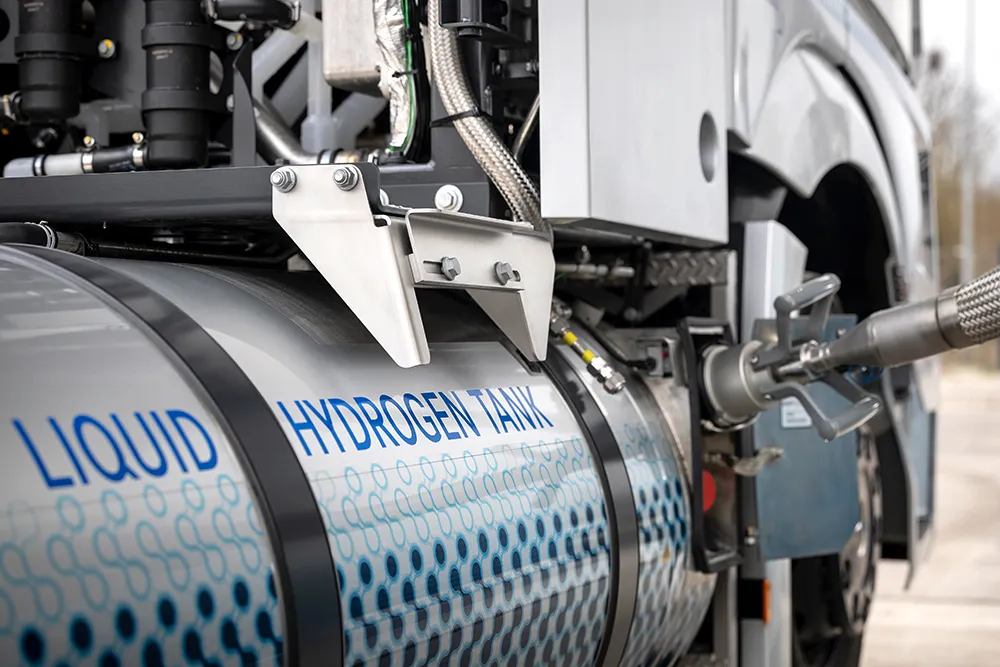
Linde Engineering’s sLH2 refuelling station sets the benchmark for efficiency
The new public sLH2 refuelling station in Wörth am Rhein, Germany, sets new benchmarks for energy efficiency and performance. With energy consumption of just 0.05 kWh/kg, it requires around 30 times less energy than conventional hydrogen refuelling systems. The station has a small footprint of just 50 square metres, excluding the dispenser, and can be configured with multiple dispensers for parallel refuelling of trucks, as well as back-to-back refuelling. The liquid hydrogen storage tank has a capacity of four tonnes, enough for around ten hours of continuous refuelling. Meanwhile, the sLH2 station’s capacity can be increased to more than eight tonnes per day by replenishing its supply. Lower initial investment and operating costs for sLH2 technology will ultimately result in a lower total cost of ownership.
Aim: to set the industry standard for liquid hydrogen refuelling
Daimler Truck and Linde Engineering aim to make sLH2 the leading hydrogen refuelling technology for heavy-duty trucks. Both companies are therefore offering a high level of transparency and openness around the relevant interfaces of the jointly developed sLH2 technology. The technology has been standardised through an open ISO process and is available to all stakeholders. Daimler Truck and Linde Engineering are now calling on other OEMs, infrastructure companies and associations to adopt the new liquid hydrogen standard and help establish a global mass market for the process.
Safe, fast and simple hydrogen refuelling
Unlike refuelling with liquid hydrogen (LH2), the sLH2 process is as straightforward as today’s diesel refuelling technology. Thanks to the robust insulation of the refuelling hose and the design of the interfaces between the filler neck and fuel tank, the process is safe and spill-free. As a result, the safety precautions required for sLH2 refuelling are comparable to those for diesel. During refuelling, cryogenic liquid hydrogen at minus 253 degrees Celsius can be delivered into two connected 40 kg tanks mounted on either side of the truck chassis, without the need for special protective equipment. sLH2 technology enables a high flow rate of more than 400 kg of hydrogen per hour, and refuelling with 80 kg of liquid hydrogen can be completed in ten to fifteen minutes. Finally, the new process avoids so-called cooldown effects and “return gas” (gas from the vehicle’s tank flowing back to the refuelling station). Only one nozzle is therefore needed to fill the tanks, making sLH2 technology simpler to handle. Linde supplies the new station in Wörth with liquid hydrogen and has the world’s largest liquid hydrogen production capacity and distribution network.
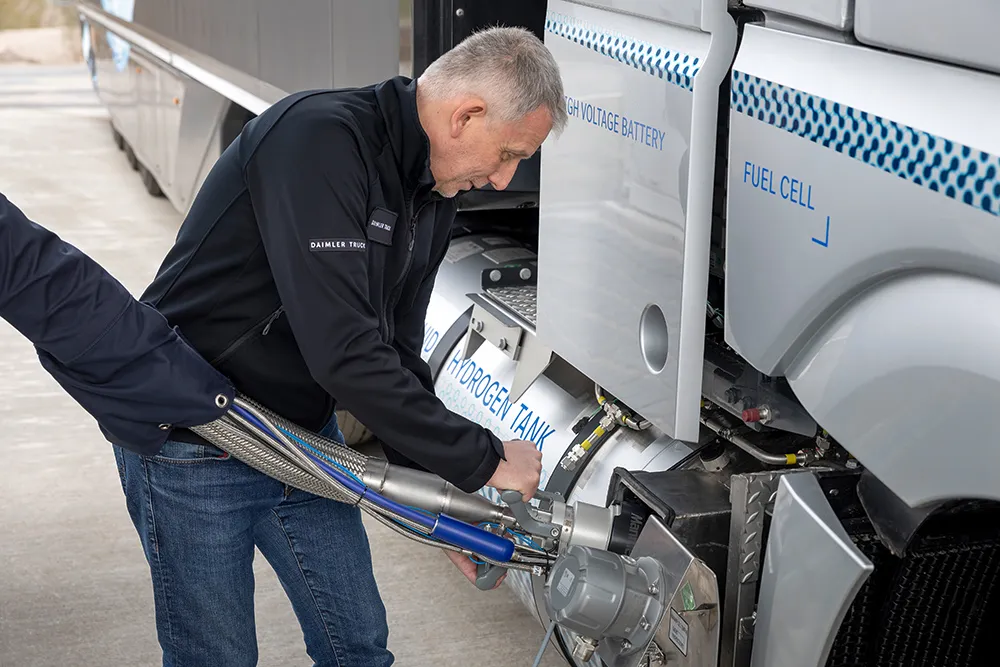
Liquid hydrogen enables a range of 1,000 kilometres or more
Daimler Truck prioritises liquid hydrogen in developing hydrogen-based drive systems. In this aggregate state, the energy carrier has a much higher energy density by volume than gaseous hydrogen. As a result, the tanks used in fuel cell trucks running on liquid hydrogen are more cost-effective than the carbon fibre tanks used for gaseous hydrogen. They are also significantly lighter because of the lower pressure. The technology therefore enables a higher payload, while more hydrogen can be carried, significantly increasing the trucks’ range. This makes the Mercedes-Benz GenH2 Truck suitable for flexible and demanding long-haul operations, just like conventional diesel trucks. This was demonstrated in September 2023, when a road-approved Mercedes-Benz GenH2 Truck prototype completed Daimler Truck’s #HydrogenRecordRun, covering 1,047 km on a fill of 80 kg of liquid hydrogen. The company aims to introduce the standard production version of the fuel cell truck in the second half of the decade.
sLH2 to be implemented in the Mercedes-Benz GenH2 Truck test fleet
From mid-2024, five companies are expected to take part in initial customer trials, gaining first-hand experience of CO2-free long-haul transport with Mercedes-Benz GenH2 Trucks. The tractor units will operate on selected routes in Germany for long-haul transport and refuel at the now-public sLH2 station in Wörth am Rhein and at a station near Duisburg. Daimler Truck and its partner companies are thus creating a flagship project to demonstrate that low-carbon transport with hydrogen trucks is already possible today. However, a successful transformation in the coming years will require the development of international refuelling infrastructure and an adequate supply of green liquid hydrogen.
Question about this story? Ask your question
Keep following this
Get an email when a new story is published. No account needed.
- SubjectTransport