Troax helps make warehouses safer with comprehensive safety concepts
Text Björn Crul Image Louwers Mediagroep
Technology is playing an increasingly important role in warehouses and logistics processes. Automation is growing, AGVs and AMRs move among employees, and goods flows are getting faster all the time. This can create new safety risks on the work floor. “Today, safety must be considered across the entire working environment. Securing one zone at a time is no longer enough,” says Sigrid Herbosch of Troax.
Data, automation and robotics are having a major impact on logistics: they boost efficiency and speed up goods handling, but also create new safety challenges. “Many warehouses have become smart, technology-driven environments,” says Herbosch. “This evolution is also changing the safety landscape, as people increasingly come into contact with fast-moving vehicles.”
No longer one zone at a time
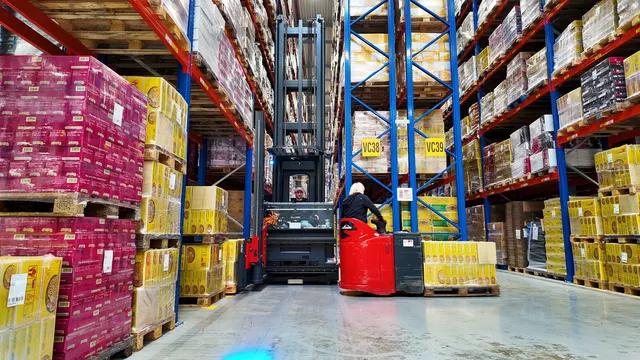
According to Herbosch, the areas where different movements converge are particularly critical. Think of junctions where pedestrians, manual forklift trucks and AGVs cross paths, or narrow warehouse aisles with limited visibility. “In the past, safety was often addressed locally: a machine would be fitted with safety fencing, pallet racking would have anti-collapse protection, and traffic flows would be managed at each location. But now, AGVs and automation connect all these zones. So you need to look at the bigger picture and develop a comprehensive concept that incorporates safety from the outset,” says Herbosch.
Troax has been known for its safety fencing and mesh partitions for many years, and now positions itself as a partner for comprehensive safety concepts. The company aims to get involved as early as possible in the design or redesign of a warehouse. “A risk assessment identifies where employees, machines and vehicles cross paths and what combination of measures is needed. This can still include conventional physical protection: safety fencing, perimeter guarding or anti-collapse protection. But dynamic zones require additional solutions,” says Herbosch.

Anticipating risks with Active Safety
A typical risk scenario is a blind spot. A forklift truck approaches from one direction while a pedestrian appears from the other. “That’s where our Active Safety range comes in: technological systems that detect risks in real time and warn users. For example, projectors that display pictograms or a pedestrian crossing on the floor, or tags worn by people and fitted to vehicles that emit light, sound or vibration signals. These solutions anticipate hazards and help prevent risks before anything happens,” explains Herbosch.
Active safety is therefore used where perimeter guarding reaches its limits. In a narrow passage, for example, an approaching forklift truck can be slowed automatically while a physical access point is temporarily closed. Once the vehicle has passed, a projected pedestrian crossing can indicate that it is safe for pedestrians to cross. “As soon as there is movement, you often need different measures from conventional protection. In such situations, physical and technological solutions work perfectly together to improve safety.”
Flexible and modular solutions
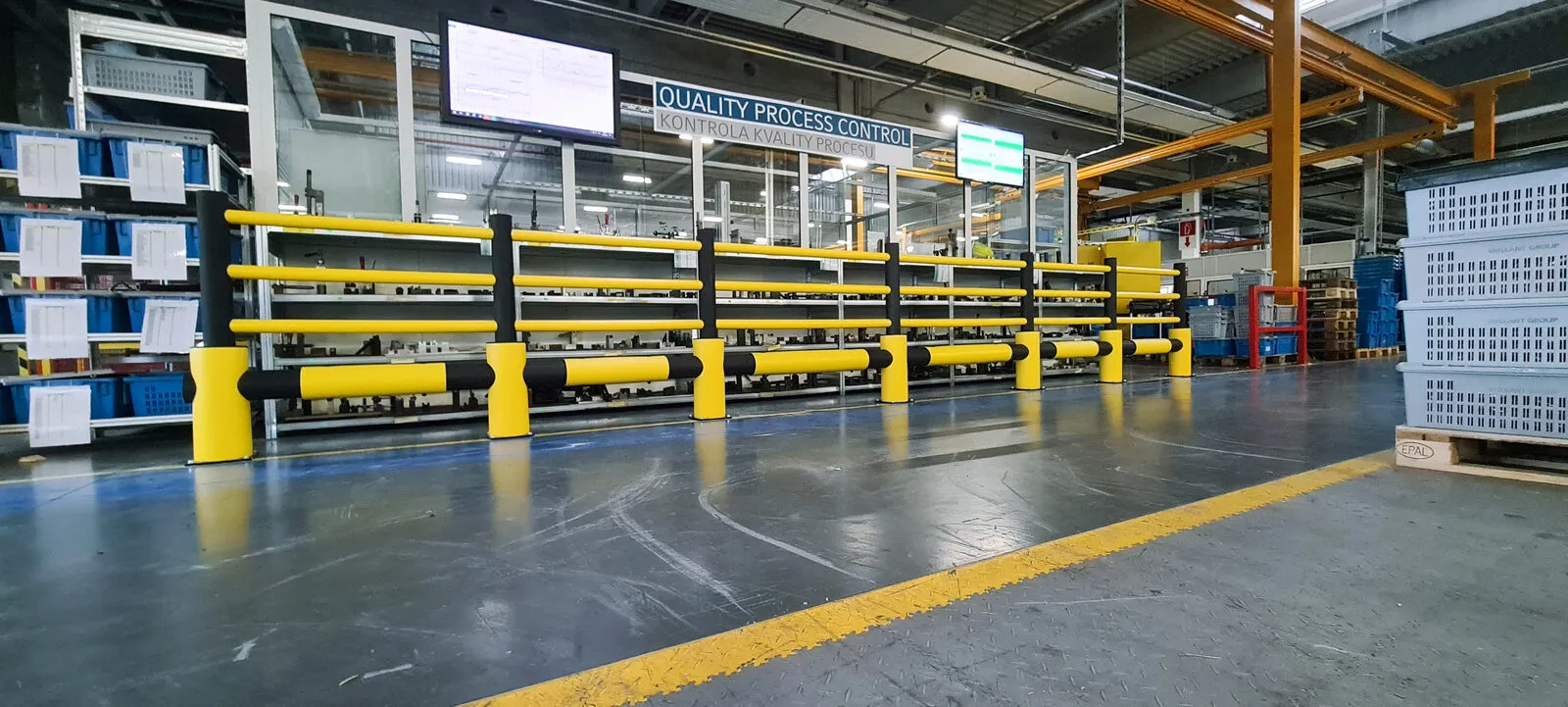
Protection in the event of an actual collision remains important, alongside prevention. To this end, Troax uses flexible impact protection, among other measures. Herbosch says: “A flexible polymer barrier has several advantages over conventional steel protection. There is less damage to the vehicle, the floor and the barrier itself. It absorbs the impact energy, allowing the barrier to spring back largely into shape after an impact. A steel barrier is more easily damaged and needs replacing sooner.”
Troax also builds modular solutions, so safety systems in a logistics environment can evolve alongside new machines, additional automation or changes to goods flows. “No zone stays the same for ten years,” says Herbosch. “Choosing modular solutions means investing in future-proofing. If an extension is needed, you simply add panels or another section of barrier.” This also means that after damage, it is not necessarily necessary to replace the entire system. Only the damaged component can be replaced.
Budget naturally remains an important factor in the choices companies make. But Troax advises companies to look beyond the initial investment. “You also need to consider the indirect costs: downtime after an incident, damage caused by a collision, damaged goods or injured people. That puts the safety budget in a very different perspective,” concludes Herbosch.
A business enquiry for TROAX? Get in touch
Companies in this story
Keep following this
Get an email when a new story is published. No account needed.
- ThemeAutomating goods flows
- SubjectLogistica Next
- CompanyTROAX