Warehouse automation with AutoStore and robotics: Element Logic on the warehouse of the future
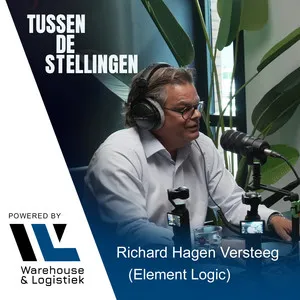
Warehouse automation is no longer the preserve of the biggest logistics players. In this episode of Tussen de Stellingen, Roel van Gils talks to Richard Hagen Versteeg of Element Logic about AutoStore, robotics and the growing role of automation in the warehouse. Why is automation becoming increasingly accessible to medium-sized businesses? When is the right time to invest? And how close are we to the fully automated ‘dark warehouse’? Richard Hagen Versteeg explains how Element Logic helps businesses make their warehouses more efficient, scalable and future-proof.
Interview with Richard Hagen Versteeg
Host: Roel van Gils
A business enquiry for Element Logic? Get in touch
Full transcript
All chapters (29)
- Warehouse automation and introduction
- How Element Logic was founded
- Establishing a presence in the Benelux
- Position as an AutoStore distributor
- Target market for automation
- Automation is becoming more accessible
- When automation starts to make sense
- Making the best use of space
- From AutoStore to systems integrator
- Concepts tailored to the customer
- Design and implementation
- After-sales service
- Triggers for automation
- Growing need for automation
- Start automating in time
- Element Logic at Logistica
- The experience at the exhibition stand
- Target audience and specialists at the stand
- Getting an initial picture of automation options
- Dark warehousing
- The warehouse as a fully automated system
- How close we are to full automation
- AI and self-learning systems
- Working with technology partners
- Automation for medium-sized businesses
- Growth means automation
- Get in touch and visit Logistica
- Interactive video wall
- Closing remarks
Warehouse automation and introduction
Roel van Gils Welcome to another episode of Tussen de Stellingen from Warehouse en Logistiek Benelux. Today we’re talking about warehouse automation: robotic arms, mobile robots and automated storage systems. Warehouses where goods find their way around almost independently. It may sound like something for the very biggest players in logistics. But is that perception still accurate? Joining me is Richard Hagen Versteeg from Element Logic. Richard, welcome. Please introduce yourself.
Richard Hagen Versteeg Thank you. My name is Richard Hagen Versteeg. I’m 57 and responsible for business development as Business Development Director. I’m also part of the management team at Element Logic Benelux. That’s our office for the Netherlands, Belgium and Luxembourg, based in Bemmel, between Nijmegen and Arnhem. That’s where our office is. Our customers are spread from the Wadden Sea to the south of Belgium.
Roel van Gils So the whole Benelux?
Richard Hagen Versteeg The whole Benelux, yes.
How Element Logic was founded
Roel van Gils Let’s take a look at Element Logic. The company has been around since 1985, I believe.
Richard Hagen Versteeg Yes, that’s right. Element Logic was founded in 1985. It worked on software for warehouses, which wasn’t very advanced. Then, at the start of this century, around 2002 or 2003, the founders, it’s a Norwegian company originally, came into contact with the inventors and founders of AutoStore. What we now know as AutoStore is a robotic storage system. They set out to develop software for it, carry out installations and project management, and become the distribution channel for its sale. That got under way just under 25 years ago. First in Norway, then more widely across Scandinavia. And after that it spread around the world.
Read the full transcriptCollapse transcript27 more chapters
Establishing a presence in the Benelux
Roel van Gils And when did you establish a permanent presence in the Benelux?
Richard Hagen Versteeg The Benelux office was set up about six years ago. We saw market demand growing. As part of that strategy, we decided at the time, I wasn’t part of the company then, to open offices in Europe from Norway.
Roel van Gils And I gather it’s been a success? You’ve grown considerably in recent years too?
Richard Hagen Versteeg We’ve grown significantly, yes. We currently have more than 30 installations in the Benelux. I mean full installations with AutoStore as the central solution. Around that, there’s all kinds of complementary technology, including conveyor technology, packaging machines and other robotic applications. And, of course, overarching software.
Position as an AutoStore distributor
Roel van Gils You said you’re also one of the largest distributors of AutoStore systems worldwide?
Richard Hagen Versteeg We’re one of the largest AutoStore distributors worldwide. There are about ten of them globally, I think. I believe we have a significant market position here in the Benelux, and worldwide too.
Roel van Gils What has given you such a strong position in that market?
Richard Hagen Versteeg First of all, our origins. We were the first. As I said, we started working with it around 2003. We were the first. We have the largest installation in the world, with more than a million bins. But I think our added value lies not just in practical matters like that. It’s also about really understanding the customer’s processes and how they can make their operation future-proof. That means more than simply proposing an AutoStore system. It means looking at the overall concept. How can a customer grow over the next 5, 15 years within the limits of their existing premises, or perhaps in a new building? And how can we apply a range of automation concepts to support that?
Target market for automation
Roel van Gils Yes, we’ll come back to that later. Your role as a systems integrator, for example. You mentioned the customer base, which is obviously very broad, from e-commerce businesses to the big players like bol.com. Where do you focus?
Richard Hagen Versteeg We focus on the mid-market and upper market segments. Our customers include very large global players in the 3PL market, as well as major companies in fashion, spare parts and automotive. In other words, businesses of that size where automation comes into the picture. The threshold for automating has come down considerably in recent years. It’s within reach for all kinds of companies. Even businesses that may not think they’re that large can make certain investments and automate their operations fully.
Automation is becoming more accessible
Roel van Gils What’s behind that? Have costs come down?
Richard Hagen Versteeg That’s part of it. The technology has become more mainstream. It’s accessible to medium-sized businesses too. But the need to grow is also a factor. The Netherlands is a major distribution country, a logistics hub in Europe and perhaps even the world. And we’re short on space, so we need to build upwards. That quickly leads you to solutions like these. And you have to do it, because otherwise your business probably won’t be able to grow sustainably over the next 5, 10 or 15 years.
When automation starts to make sense
Roel van Gils To give an example, from what turnover or volume does it become worthwhile? Can you put a figure on it?
Richard Hagen Versteeg Whether you sell cars or trekdurpen makes quite a difference. But if, say, you already have to fulfil 500 or 1,000 orders a day, you can start considering investing in solutions like these and taking steps towards automation.
Roel van Gils Perhaps it’s an obvious question, but what are the main benefits for a business owner?
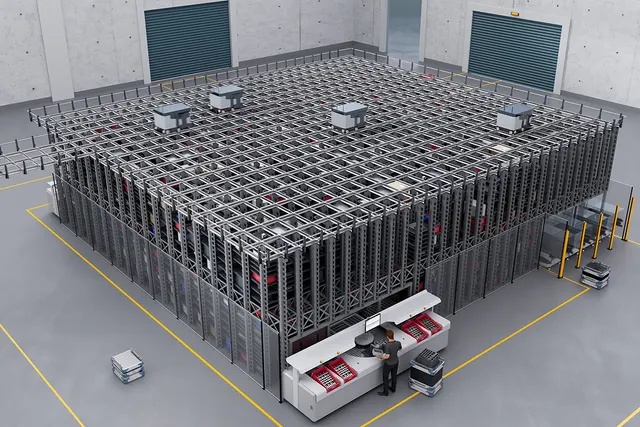
Richard Hagen Versteeg There are all kinds of benefits. We store items in totes, bins, whatever you want to call them. This means your inventory takes up much less space. The original idea was to move from a warehouse where there’s a lot of empty space around the goods to a more compact warehouse. The bins are stacked on top of one another, up to 16 high if you want. So you save a lot of space. Your staff no longer need to cover distances of 5, 10 or 15 kilometres a day to pick goods. They can stay at their workstations and pick goods very efficiently. There’s no risk of them picking the wrong items, because the right product is presented to them. So the process is more efficient.
Roel van Gils The error rate also comes down.
Richard Hagen Versteeg The error rate comes down dramatically. Productivity goes up dramatically. Those are obviously all very attractive benefits if you want to take your logistics automation further.
Making the best use of space
Roel van Gils And you can also build upwards?
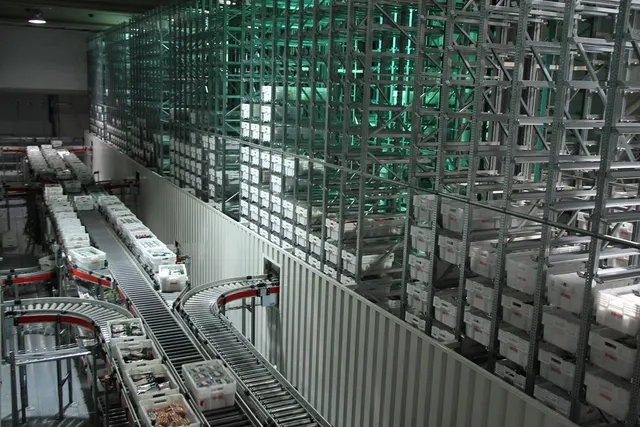
Richard Hagen Versteeg Yes, you can build upwards too. The bins are stacked on top of one another. The bins are inside what is known as an AutoStore system. That’s the core of one of our solutions. We add all kinds of other forms of robotics around it. The bins are stacked and a grid is built around them. They can be stacked to a height of more than six metres. This makes very efficient use of your warehouse space.
Roel van Gils And AutoStore is particularly suitable for existing buildings too, isn’t it?
Richard Hagen Versteeg Yes, you can configure an AutoStore solution pretty much as you like. You can configure it around corners and around posts or columns. So you can make it fit. It works in existing buildings, even older ones. And of course, in a new building you can use it to create very efficient concepts and ensure optimal use of your space.
Roel van Gils Why is that particularly relevant to the Dutch market? Does it offer so much potential?
Richard Hagen Versteeg The Netherlands is a small, densely populated country, so we have little space. One of the few ways to use space more efficiently is to build upwards. And that’s what we’re seeing happen.
From AutoStore to systems integrator
Roel van Gils People mainly know you for your AutoStore solutions. But, as you said at the start, you do a lot more than that.
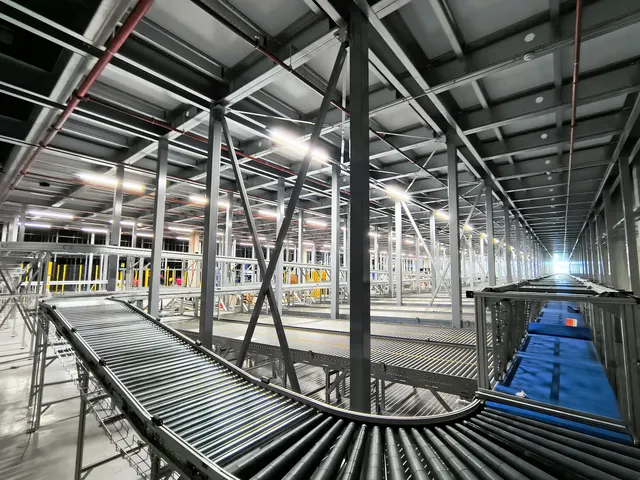
Richard Hagen Versteeg Yes, Element Logic originally started out focusing on AutoStore solutions. But in the meantime we’ve developed into a medium-sized to large systems integrator. We design concepts that often have AutoStore at their centre. Around it, we apply all kinds of technologies and solutions to deliver a complete concept. These include case erectors, case sealers, robotic picking arms and AMRs to move cases from A to B. And, of course, plenty of conveyor technology to move goods from A to B.
Roel van Gils So you’re a systems integrator, essentially?
Richard Hagen Versteeg We’re a systems integrator.
Concepts tailored to the customer
Roel van Gils And how do you decide which combination is right for a customer?
Richard Hagen Versteeg You start by looking at the situation. That’s when we take on more of a consultancy role. We’re not a consultancy firm, but we do have consultants. We work with the customer to understand their processes, problems and challenges, both now and in the years ahead. Then we work out how to come up with a sustainable solution. That brings a range of different technologies into play. The solutions needed and relevant in one situation may be different from those in another. We work this out at the drawing board, together with the customer, their processes and their employees, their people. They’re at the centre of it, because ultimately they still have to do the work.
Design and implementation
Roel van Gils And do you also produce the design?
Richard Hagen Versteeg We handle the entire design ourselves, and we do it fairly quickly. We create all kinds of 3D-style visualisations. This gives potential customers and business contacts a very concrete picture. They can literally see what their warehouse will look like in eight to 18 months or so, and approve the concept. We then make sure all the subcontractors and suppliers of the various technologies are brought on board. And as system integrator, we have overall responsibility.
Roel van Gils Well, then you’re almost literally in the role of a logistics consultant.
Richard Hagen Versteeg A kind of consultant. We’re consultants in a way, too. We’re not like the big consultancy firms, which start from scratch. But if we see a warehouse somewhere with a logistics challenge, we can go a long way towards devising really good solutions.
After-sales service
Roel van Gils Yes, and it doesn’t end when the project is handed over, because I understand you also have your own service engineers and service teams.
Richard Hagen Versteeg That’s right. We have our own people out in the field who can be on site within hours in the event of a breakdown or for scheduled maintenance. If it’s an emergency, they’ll be there very quickly, of course. Yes, they’re our own people. They also speak the same language as our customers, quite literally, including in Belgium. And of course, we do this worldwide. It also gives customers a familiar face. So if anything goes wrong, we’re on site. We’re available 24/7, of course. Our people are available too, and they’ll be in the right place when they’re needed.
Triggers for automation
Roel van Gils When should you actually start automating? What’s the trigger for saying, ‘Hey, I’ll get in touch with Element Logic’?
Richard Hagen Versteeg There are several triggers, of course. You might be short of space. You might no longer be able to handle your volumes within the existing time windows. Your number of SKUs might have grown too large, or your stock levels might be too high. That’s when you need to automate. Once you reach a certain level, you have to automate, because you can no longer get the work done on time with people, or within the capacity of your current warehouse. That’s when you need to automate.
Growing need for automation
Roel van Gils And what signs do you see at companies like that?
Richard Hagen Versteeg We’re seeing signs that automation has become accessible, and it’s now very accessible to a great many companies. Not just the large national or global players, but also a huge number of companies whose names we may not all recognise today, but which handle very high order volumes. There has also been a shift from physical retail to e-commerce. And in the B2B world, the business-to-business world, everything is now shipped online. Those volumes have become so large that carriers, courier companies and logistics service providers can barely keep up. That’s when you need to automate. To get a parcel through your letterbox the next day, as we all want, it really has to be handed over to carriers at 10 or 11 pm, or at 1 or 2 am, to reach the customer on time.
Start automating in time
Roel van Gils Yes, by the time you’ve reached that point, it’s actually already too late to start thinking about automation, of course.
Richard Hagen Versteeg Well, you often see this happening as peak season approaches, which traditionally starts around mid-October for most companies in our region. It’s coming up. It depends on what you do, of course. If you sell air conditioning, for example, it’s different. Or motorcycle parts. But traditionally, for many sectors, it starts sometime in October. That’s when companies often start running up against the limits of their growth. For example, they can no longer guarantee next-day or second-day delivery. That’s why demand for automation and solutions increases towards the end of the year.
Roel van Gils But then it won’t be there the next day, of course.
Richard Hagen Versteeg No, of course not. It’s a process that takes between six and 18 months. Yes, even a year and a half is a quick turnaround. Implementation is no small undertaking. It involves physical work. It can be done in a matter of months, but we’re still talking about three, four or six months fairly easily.
Roel van Gils Yes, but there’s a preparatory phase before that.
Richard Hagen Versteeg Yes, there’s the whole process of procurement and specification, followed by testing and installation. So it’s a long process. As you say, it can easily take around 18 months from the first idea to the…
Roel van Gils So you need to act in time, in that sense.
Richard Hagen Versteeg Act in time, yes.
Element Logic at Logistica
Roel van Gils Let’s talk about Logistica. You’ll be there again this year. The trade fair. I understand you’re planning a pretty impressive presence.
Richard Hagen Versteeg That’s right, we are. Logistica is an important event for the Dutch and Benelux markets, of course. And to some extent the UK and England. We also often get a few visitors from Germany. So it’s an important event for us. We’re going to make a big impression there. We have a fantastic interactive 3D video wall where people can experience a little robotics, digitally. Yes, entirely digitally.
Roel van Gils So you’re not bringing any machines?
Richard Hagen Versteeg No, we’ll have a robot there. But people are already familiar with the robot itself. So it’s more about the experience and the conceptual approach: where we are and where developments in warehouse automation are heading.
The experience at the exhibition stand
Roel van Gils And what’s the thinking behind that spectacular presentation?
Richard Hagen Versteeg The exhibition takes place in two halls at the Jaarbeurs. Traditionally, companies like ours are in the rear hall. You have to get people to come over there. You want to attract attention and get them talking to you, looking at who you are, what solutions you offer and what technology you have available. They want to look you in the eye, because they want to see who they’re investing in. What kind of companies are they? What kind of people work there? We can write all that down, but personal interaction is very important. And that’s very important to me in my role, too. In my experience, you can seek out and find that at Logistica.
Target audience and specialists at the stand
Roel van Gils So the focus there is on that specific target audience too?
Richard Hagen Versteeg Yes, the focus is on companies that have storage and need to process a lot of orders on a daily or weekly basis, then ship them across Europe or around the world. That depends on their niche. Those companies also come together there to see the latest technology, at Element Logic and at our colleagues’ stands, of course.
Roel van Gils What else can visitors expect at your stand?
Richard Hagen Versteeg Fresh coffee. And tea. No, we’ll have a team of genuine specialists there, including logistics specialists and data analysts, who are often available too. Visitors can have in-depth discussions about whether their operation is suitable for automation, as we do it and many others do. So it won’t just be a sales pitch. We’ll have knowledgeable people available to take a proper look at your operation. So, yes, that’s what I think.
Getting an initial picture of automation options
Roel van Gils And they’ll already get an idea of what’s possible.
Richard Hagen Versteeg If potential customers have some basic data about their operation, or bring it with them, such as how their throughput is structured, how their processes work and what their order lines and profiles look like, then, drawing on our extensive knowledge and experience, we can quickly give them an idea of how solutions could be developed conceptually, and which direction they could take.
Dark warehousing
Roel van Gils Well, that’s interesting, of course. Looking five, or perhaps 10, years ahead, what do you think a warehouse will look like?
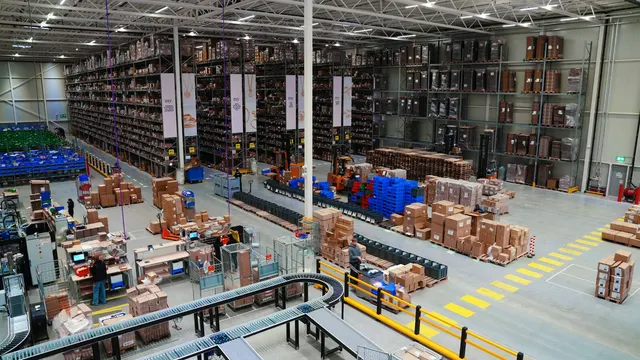
Richard Hagen Versteeg There are quite a few different opinions on that. I think we’re heading towards what I and others call dark warehousing. Ultimately, everything within companies will be automated, and ‘dark’ means there’s no one there, no human interaction, no people, so we can switch off the lights. That’s where the term ‘dark’ comes from. We can increasingly harness the capabilities of AI, robotics and computing power. We can unload goods from lorries automatically and store them automatically. Over the next 5 to 10 years, we can automate a much greater part of order picking using robotic arms, including six-axis robot arms. We can also automatically pack goods, bring them to market-ready condition, make them available for transport and load them. Ultimately, the operation will be one where human activity is reduced to a minimum, and hopefully we can switch off the lights.
The warehouse as a fully automated system
Roel van Gils So, in that sense, the warehouse becomes one big robot?
Richard Hagen Versteeg Yes, the warehouse will be fully automated through the use of all kinds of different robotics technologies, which together will form an automated whole.
Roel van Gils Yes, so what role will people still have?
Richard Hagen Versteeg A monitoring and supervisory role. But ultimately, we won’t need people to put goods back into boxes. We can leave that to systems. We don’t need people for that. And people are becoming increasingly scarce in the Dutch and Belgian markets. So I think automating that is a good thing.
How close we are to full automation
Roel van Gils But do you expect us to be there within five years?
Richard Hagen Versteeg Yes, we’re almost there already. There are already a great many operations where hardly any manual work is involved.
Roel van Gils In the Netherlands too?
Richard Hagen Versteeg In the Benelux too. This is especially true if you have a fairly homogeneous operation, with similar products and similar processes. We’re already seeing that you can automate to almost 100%. That will grow much further in the coming years, of course. But we can see that this shift is under way. It began almost 10 years ago.
AI and self-learning systems
Roel van Gils And which developments do you find most interesting?
Richard Hagen Versteeg The impact of all kinds of AI technologies, or artificial intelligence, is extremely important. It enables us to build systems that can learn and improve themselves more and more.
Roel van Gils Can you give a concrete example?
Richard Hagen Versteeg You can see that, particularly when it comes to robotic picking arms, the big challenge is this: if you have lots of identical boxes measuring 10 by 10 by 10 centimetres, each containing a Rubik’s Cube, they’re very easy to pick automatically. But if you have a highly varied flow of goods, you need technology that can adapt to that flow. How can it pick the right goods, in the right way, at the right time, and place them in the right box? Artificial intelligence plays an exceptionally important role in that.
Working with technology partners
Roel van Gils So, in a dark warehouse like that, can you build everything yourselves as Element Logic? Or are you also dependent on…
Richard Hagen Versteeg Well, that can only be done with the help of various subcontractors. As a systems integrator, you have a set of core technologies. You buy in all the other technological developments and technologies. It’s up to us to connect everything through software and make it work efficiently. So, as Element Logic, we can organise everything ourselves, come up with the ideas, develop them into concepts and actually implement them. But of course, we need a lot of partners to provide all the different technologies. As an organisation, we’re increasingly able to do that.
Automation for medium-sized businesses
Roel van Gils So you don’t actually have to be bol.com or a large company to start thinking about automation.
Richard Hagen Versteeg No, of course companies like bol.com are interesting. But you also see companies that can automate a large part of their operations with limited investment. They can already take that step in advanced software integration. We’re talking investments of a few million, which makes it achievable.
Growth means automation
Roel van Gils So what should business owners be looking at differently tomorrow? How can you convince them?
Richard Hagen Versteeg Business owners need to consider where they want to go and where they think the opportunities for growth lie. If they see that they can grow, they need to automate. They can’t keep doing everything manually with people. People get ill, people are absent, people simply aren’t available. That’s when you need to automate. And if a business owner has a sound business plan and thinks they want to grow over the coming years, whether at their current premises, at their existing site or perhaps in new warehouses they plan to acquire, then they need to automate.
Get in touch and visit Logistica
Roel van Gils And then people can get in touch with…
Richard Hagen Versteeg You can call Richard Hagen Versteeg at Element Logic, for example.
Roel van Gils Or, of course, visit Logistica.
Richard Hagen Versteeg We have a prominent stand in Hall 2.
Roel van Gils From 2 to 5 November at Jaarbeurs Utrecht.
Richard Hagen Versteeg Jaarbeurs Utrecht, 2 to 5 November. Easy to reach by public transport.
Interactive video wall
Roel van Gils One final first.
Richard Hagen Versteeg Well, we have a fantastic video wall that’s highly interactive. It actually gives the impression that you’re being lifted up by a robot arm. That’s quite exciting, and it doesn’t happen very often. But we do think it’s a fairly original way to give people an experience like that.
Closing remarks
Roel van Gils There you go. Richard, thank you very much. And listeners, perhaps we’ll see you at the exhibition.
Richard Hagen Versteeg Thank you very much, Roel. Thanks.
Companies in this story

Keep following this
Get an email when a new story is published. No account needed.
- ThemeAutomating goods flows
- SubjectAutomation
- CompanyElement Logic
- CompanyJaarbeurs B.V.