












Jan-Cornell van Ekris: not more AI, but better logistics
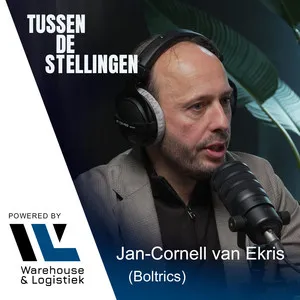
In this podcast, Jan-Cornell van Ekris of Boltrics discusses the role of AI in logistics. AI offers many opportunities to make processes more efficient, for example by automating manual tasks and automatically converting emails, PDFs and Excel files into logistics orders.
According to him, successful AI applications start with a specific problem, reliable data and knowledge of the logistics sector. Companies should start small, introduce AI step by step and maintain sufficient human oversight for the time being. Good security, clear governance and avoiding a fragmented range of AI tools are also essential.
The key takeaway: success is not determined by the number of AI tools, but by a strong IT foundation, high-quality data and flexible software that is ready for future developments.
Full transcript
Transcript: Boltrics, Tussen de Stellingen (Warehouse & Logistiek Benelux)
Guest: Jan-Cornell van Ekris (Boltrics)
0:00 Welcome to another episode of Tussen de Stellingen from Warehouse & Logistiek Benelux. Today we’re talking about software and AI in logistics. AI offers plenty of opportunities for logistics, but where does the real value lie? And how do you avoid using technology without a specific goal? In this podcast, we discuss with Boltrics how logistics service providers can use AI to improve processes, why data and industry knowledge are indispensable, and how to lay the foundations today for tomorrow’s applications. Because ultimately, it’s not about more AI, but better logistics. Joining me at the table is Jan-Cornell from Boltrics. Welcome. Tell us a little about yourself, Jan-Cornell.
0:37 Yes, I’m Jan-Cornell van Ekris, one of the owners of Boltrics. I started the company in 2010 with two others. I’d already been working in IT for a long time, but mainly in standard ERP environments. We actually started Boltrics in 2010,
0:59 with a completely new concept. Until then, software companies… well, this is a bit of an anecdote. I spent ten years working in the metalworking industry, in mechanical engineering, a very different industry. Then, in 2001, I switched to IT. I went to work for a software vendor. Perhaps I was a bit naive, but I thought a software vendor made its money by selling software. But after I’d been there for a while, it turned out to be quite different. They supplied the software, but ultimately made their money from providing services. As a consultant, I was judged on how many billable hours I had.
Read the full transcriptCollapse transcript
1:44 But no one was asking: are we actually adding value? Are we helping that customer move in the right direction?
1:52 No, the only thing they looked at was billable hours. We saw that, in the end, this meant that although you helped customers, in many cases you didn’t point them in the right direction. The result was bespoke solutions built entirely for a specific customer. That left them stuck and unable to keep up with new technological changes. And if you look at the world today…
2:20 AI is a very good example of that, of course. But over the 16 years we’ve been in business, we’ve seen IT in general innovate at an ever-faster pace. In the past, you might stay on the same version for ten years. Now we release updates every month. That’s the difference in speed. So it’s crucial to be able to move on to new technology. That’s what Boltrics is about: developing software for a specific target group, logistics service providers, that is always up to date and always uses the latest technology, so you’re always ahead of the curve and can be agile.
2:59 That means being prepared for new circumstances as they arise and being able to adapt to them. So how did you make the move into logistics service provision? That was a great story. As I said, we were already active in the ERP world as a Microsoft partner. We got our first customer, a cold store, a logistics service provider operating in temperature-controlled logistics. They were using standard Microsoft ERP software, but had added a lot of bespoke functionality. They had some problems, and we solved them. Then he said: I have a friend who also runs cold stores. He uses Microsoft Dynamics as a platform too.
3:42 They had problems as well, so we went in to solve them. But once again, we had to start from scratch. That’s how we got in touch with the chair of the Dutch association of cold stores. We met with him and realised that all the members had essentially the same problem. There was no standard software, or industry standard solution. That’s different from standard software. Standard software means something very rigid, one size fits all. And of course, that doesn’t work. It never works. The promise of standard software sounds great, but in most cases it doesn’t work. An industry standard is a different matter.
4:21 So we said: what if we develop a solution for this sector that all the association’s members can use, so they don’t have to reinvent the wheel? We sometimes compare it to a peloton. In a cycling race, you can ride in the breakaway group. That’s great. You might think you’re out in front. But the question is how long you can keep it up, because you have to put in all that effort. The peloton shares the workload. And often, I’d say in 95% of cases, someone from the peloton has the strongest legs for the final sprint. So the question is: where do you want to be? You need to conserve your energy, perhaps. Yes, exactly.
4:55 That’s more or less the idea. That’s how it started. We began development in 2010 and helped our first customers go live that same year, 2010, then continued developing the software. In particular, a series of acquisitions by American companies moving into Europe led us to expand internationally too. We now serve customers globally, around the world. But do you cover more than just cold stores? Yes, because cold stores are a specific niche within logistics service provision.
5:30 I always say they’re just a little more complex than a regular ambient warehouse. So our focus is on logistics service providers in general. From small to large? From small to large. We have customers with 2,000 or 3,000 pallet positions. We also have customers with more than 200,000 pallet positions in a fully automated high-bay warehouse. And, as I said, we operate in the Netherlands and around the world. We’re present on every continent. Do you serve them from the Netherlands as well? We do that through local Microsoft partners. We believe we can provide a global solution while implementing it with local expertise, so we’re close to the customer.
6:14 With local consultants who speak the local language and are rooted in the local culture. Ultimately, that’s what makes software work well. You can have the best software solution in the world, but if you don’t implement it properly for the customer, the project won’t be successful. That’s why having consultants on the ground locally is so important. But it’s still based on that so-called standard software. Exactly, that’s the industry standard solution. And that brings us to the next part of our concept. We believe you need to limit variables if you want to scale up. Bespoke software, with a specific solution for each individual customer, creates a lot of variables.
6:58 If you reduce those variables, in our case to a single-codebase solution, which means exactly the same code runs everywhere in the world, we can automate updates. In the past, an update took at least three months and required two logistics consultants and three developers to move a customer from one major release to another. Now we can do 30, 40, 50 or 60 overnight, fully automated, with one or two people on standby in case something goes wrong. Everything else is fully automated. That also means you can develop the software faster. Exactly, 100%.
7:32 It also means our customers don’t have to reinvent the wheel all the time or keep paying for new developments. When we add a change… Everyone benefits. Yes, because we roll it out around the world every month. So if one logistics service provider asks us to make an adjustment, it’s available everywhere the following month. So you can respond to trends and developments globally too. Yes, exactly. As a result, we’re inherently many times faster than any company developing software specifically for one business. And there’s another point here. You could say: that’s all well and good, but what if my competitor has exactly the same software as me?
8:13 Where’s my advantage then? Well, I have a straightforward answer to that: software is a commodity. It should run in the background. It should enable you to provide the best logistics services to your customer. That’s ultimately where you make the difference, not, in my view, with the software. So it has to be an enabler. But you should use as much of your people’s capacity as possible where your customer can see it. You can see that in the peloton I mentioned earlier too. There are different teams, and they work together to some extent. But they’re still competitors. And that brings us to the next point. We have a single codebase,
8:49 but right from the start, we didn’t develop the software in a rigid way, with predefined business processes. Instead, we made extensive use of workflow technology from the outset, allowing us to model business processes to meet customer requirements. We’ve added all the functionality developed over the past 16 years as small functions in function libraries. We can now take them and say: this customer has a specific problem, so we’ll link that function into their workflow. That’s how we tailor the software to customer requirements, while still keeping the standard consistent. Exactly.
9:29 OK. The theme of this podcast is AI in logistics too. When did AI come onto your radar? Well, actually, as soon as we started talking about generative AI. LLMs and the like have been around for much longer than just the past few years. But it has really taken off. And when we saw that models such as ChatGPT were becoming widely applicable too, we thought: hey, this is a major development and we need to make it our own. It’s simply a new innovation, like the ones we’ve seen over the years. And we need to make ourselves comfortable with it. We need to start using it in the right way for our business,
10:17 to remain competitive, but also for our customers, so that we can help them become even more productive and innovative. Right, OK. We’ve come up with a few propositions too. Our podcast is called Tussen de Stellingen. So here’s the question: do you agree or disagree? And of course, you can explain your answer. Should every logistics service provider start using AI now? Absolutely. If you’re not working on it yet, I think you’re going to have a big problem. And of course, you have to do it properly. From a security point of view, absolutely. But if you don’t do it, your competitor will. And otherwise, it simply won’t be sustainable. Look, and you really shouldn’t… I slightly played it down just now by saying:
11:01 it’s simply the next innovation. And I think that’s how you should look at it too, to help overcome some of the resistance and uncertainty around it. It’s simply a new innovation, like those we’ve seen throughout history. And you have to embrace it.
11:18 But at the same time, you have to put it in the right perspective. And I’d say:
11:25 language was the first major development in the distant past. The second was writing. Language lets us share knowledge faster than we could with gestures. Writing lets us store it too. Then came the printing press, which made it possible to spread it faster. Then the internet brought it into homes around the world. And now, with AI, you’re going to accelerate that many times over, make it more intelligent, and generate a lot more as well. This is such a major innovation, on that scale. So if you don’t get on board, if you don’t do something with it, believe me, sooner or later you’ll simply be left behind. Just to stay in the peloton. Right, so what’s the difference between experimenting sensibly and adding AI at random? Well,
12:15 that’s the next point, actually. One thing you sometimes see is that AI is, or was, a hype as well. And everyone thought: oh, this is a major innovation, we need to do something with it. And that can be a bit of a problem. People started using AI just for the sake of using AI. And just so they could say they were doing something with AI. Yes, we’re doing something with AI too. And, well, then you get situations like the one highlighted in that MIT report last year: 95% of AI projects deliver no ROI. But that’s because you’re turning to AI for AI’s sake. So what we’re really saying is: look very specifically at where there’s a problem in your organisation right now, when it comes to a lot of manual, repetitive tasks, and so on.
13:08 And keep the case small and just start small. Take small steps. So, first of all, get your employees to make maximum use of ChatGPT. Yes, give them a subscription. A subscription, exactly, and so on. And there’s another point here too: we built our software on the Microsoft Dynamics platform. We could have developed our own solution. That might have been technically interesting. But we realised that, given the way technology develops over time, it’s extremely difficult to keep up with all of it. And by using Microsoft Dynamics as our foundation, we don’t have to think about…
13:51 Well, when we started in 2010, everything was still on-prem. So moving to genuine SaaS solutions, multitenant SaaS solutions, was a fairly straightforward process for us because Microsoft… We could ride on their coat-tails, yes. Yes, Microsoft made the entire underlying platform fully SaaS-ready. And the same goes for AI, for example: Microsoft has infused Microsoft Dynamics with Copilot.
14:18 We don’t have to figure that out either. We build the application for logistics service providers. What Microsoft does is fairly generic. We translate that for logistics service providers. And so far, we’ve done around 450 installations worldwide. So we have quite a lot of knowledge. We know what’s going on. And that’s how we provide that translation. This also allows us to remain agile as a company. We only have to focus on what matters to logistics service providers. That means we can keep up with new innovations, stay ahead of the curve and continuously deliver a great deal of added value to our customers.
15:02 As AI gets closer to operations, logistics context and reliable integration become more important.
15:10 So you benefit from those 450 implementations. Exactly, because that brings us to the point you’re making. And you can already see it with software in general.
15:21 We’re talking about Tussen de Stellingen here, so let’s talk about the warehouse management system you need for that. There are countless warehouse management systems on the market. But there’s a big difference between a private warehouse management system and a public warehouse management system. Most warehouse management systems were initially focused on private warehousing. So, if you own the goods: you buy them in, or produce them, and then sell them. In other words, you make your money from trading. But a logistics service provider doesn’t do that at all. They don’t own the goods. They store goods on behalf of their customers.
15:58 So they have specific requirements such as multi-client warehousing, contract and billing. Things like pricing agreements, invoicing for storage charges and value-added services. Those features usually aren’t standard in warehouse management systems. Because we’ve focused 100% on logistics service providers from the very beginning, our WMS is designed entirely for them. And you see this even more with AI. Look, if you apply AI generically, that’s all well and good, but in logistics you’ll miss the mark. You have to add context and industry knowledge. Add it. Because generic AI models don’t know that. No, they don’t. And it’s the context… Look, if you don’t give AI information…
16:46 AI depends on data. So data is incredibly important. And the more data the AI model has that’s specifically geared to your industry, the more added value AI can deliver, and the more you can trust the accuracy of what AI does for you or helps you with. Right, and that’s the added value you provide as a software partner too. Yes, absolutely. When you look at the AI solutions we make available to our customers, we basically use the Microsoft Dynamics platforms, with Copilot and the like. But that’s more of a sidestep. Again, when you’re talking about software that enables you, you have the functionality, the business processes and so on.
17:36 But another very important thing nowadays is governance and security. Well, look at security: Albert Heijn two weeks ago, and so on. The week before that, somewhere in the Benelux or France, I think, a hack sent the temperature in all sorts of cold stores up to 50 degrees. That affects the sector too. Exactly, exactly. Temperature-controlled logistics and food logistics are particularly interesting to hackers, for example. Because they can cause real disruption. So, from a governance and security perspective, it’s really important to have your house in order at enterprise level, to put it bluntly.
18:25 You could reinvent the wheel there too, but we work as closely as possible with Microsoft on that as well. Their SaaS solutions are managed and secured by them,
18:35 at a level that we as an individual software company simply couldn’t achieve. And you see the same with Copilot, for example: if you have Microsoft 365 Copilot, Microsoft ensures
18:47 that the data stays within the tenant, within your tenant. So all sorts of things you’d otherwise have to worry about and spend a lot of time on are taken care of by default. You don’t have to think about them, so you can spend your time on your customers.
19:02 Those are some of the benefits of an integrated platform, then. Yes, 100%.
19:07 OK, here’s a proposition: we’re too afraid to give AI control. What do you think? I can certainly understand that. Because if you suddenly set an agent running from scratch, that can be quite nerve-racking. If you hire a new employee, you don’t let them do everything from day one either. Then
19:34 … And that’s why it’s so important to start working with AI straight away. To make it your own. And, as I said earlier, to take small steps. I also don’t think you should just jump straight to fully autonomous AI, where AI makes decisions and takes action on its own. But there’s a path to get there. So take small steps and let AI help you get things done. I mentioned this earlier, but I sometimes try to explain it by saying there are really three branches of AI: personal AI, hybrid AI and embedded AI. Personal AI is the use of models such as ChatGPT, Claude, Grok, Gemini and so on.
20:27 Simply for your own personal performance, to check and draft emails, and so on. But then there’s hybrid AI too. That sits at the intersection of personal use and business processes, and also at the intersection of unstructured and structured data. Generative AI is very good at reading and recognising unstructured data, then converting it into structured data. Can you give an example of that? Or illustrate it for logistics service providers? Well, we’ve used EDI for a long time to get systems to work together, and especially to avoid manual tasks.
21:13 But connecting and aligning everything like that takes a lot of work. Quite apart from that, larger customers often do it, but there are still plenty of customers who can’t work via EDI. They do send emails with PDFs, or just text in the body of the email. Or an Excel file attached, and so on. Until now, it’s always been difficult, or practically impossible, to transform that into structured data in a predictable way. And this is exactly what AI is very good at. And if you look at our Boltrics AI Assistant, which we offer integrated into Microsoft Dynamics 365 Business Central…
21:54 You can simply say: well, I get a file like this. It could be an email, an Excel file, a PDF, et cetera. Does the format matter? It doesn’t. Drop it in. AI reads it and recognises everything automatically. And in nine cases out of ten, it will already have created a warehouse inbound order, outbound order, transport order or freight forwarding shipment. Because we’re talking about warehouse management now, but alongside warehouse management, we also do transport management and freight forwarding. So we can support the entire business processes of logistics service providers. The Boltrics AI Assistant recognises and automates all of that. And if it doesn’t recognise something, it simply asks you a question. Then
22:35 it says: hey, I haven’t seen that before. Or: I don’t think I know this customer yet. Would you like to create them? Yes, tell me more. And when you say: yes, create them... well, it’s clever enough to find information on the internet itself. You know all that? So the entire customer record, the master data, is already complete.
22:55 So these are great solutions, you know, for turning unstructured data into structured data. And then there’s a smaller step, in that sense. Exactly, exactly. It’s easy to control, because the system isn’t yet operating entirely on its own. You can
23:08 ... And that means you can stay in control and see what’s going well and what isn’t. That then becomes a stepping stone towards more embedded AI or agentic AI. By embedded AI, I mean AI that’s fully integrated into your business processes, with an agent acting independently. For example, in the warehouse, when it comes to slotting or wave planning. Or, well, reducing truck journey times and things like that. But that’s considerably more difficult, when it starts working autonomously. Because look, when it comes to reducing journey times, for example, our solution has had all sorts of algorithms for that for a long time.
23:55 And they’re really very good, based on all that experience. They’re also very fast. So AI still has quite a way to go before it can make a genuine improvement there. And I think you should always be a little conservative about that. If something already works well and AI can’t improve it yet, then you simply shouldn’t do it. There are plenty of other areas where AI can improve all sorts of things. Yes. So when do you expect AI to take over all these tasks? What sort of timeframe are we talking about? Well, it’s happening incredibly quickly. If you ask me to give a view of the future, of where things are heading, then for logistics service providers, particularly when we’re talking about warehouses, there are two areas. There’s AI that will do intelligent things in the future, and there are automated warehouses.
24:47 If you look at those two areas separately, let’s start with automation. We’re already seeing a lot of fully automated warehouses, and they’re becoming more common. But I do think that logistics service providers will always have the challenge of working for customers. And their customer base changes over time too. That means they need flexibility. Fully automated warehouses can be a very good solution in some cases. We’ll certainly see more of them. But it’s not going to be a case of having only automated warehouses. Logistics service providers in particular need that flexibility as well. So I see a mix. Are there already examples of warehouses that operate fully autonomously?
25:30 Yes, yes, yes. There are. But as far as I know, you’re more likely to see them at companies that manufacture their own products and have their own warehouse, because there are far fewer variables. Logistics service providers have many more variables. That’s why you see more combinations at logistics service providers. So perhaps part of the operation is automated, with an AutoStore setup for robotic picking in one area, but another part is still manual, for example. That way, you can provide the necessary flexibility. But that’s the automation side of things. When it comes to AI and what it will do for businesses... I’ve already mentioned a few areas where AI will help and become more autonomous.
26:16 I’d say that, within your business, anything that doesn’t require physical effort or emotion will eventually be fully replaced by AI. And by emotion, just to clarify, I mean things like customer contact or contact with a supplier. So anywhere you need to deal with, well, a person. Yes, an actual person, you know. Because people say: AI, chatbots... That’s all well and good, but if I’m doing business with a supplier and I need to ask them a question, and I get one of those chatbots, well, you know... It’s irritating, and sometimes you get stupid questions. You just want to speak to someone on the phone.
27:07 Do you think that will change a bit for the next generation too? Well, I think some of that will indeed change. So if you look further into the future, you’ll see AI taking on more of that too. But in terms of speed, I expect the biggest changes to happen first in roles and activities that are more internally focused, where there’s no direct contact with the outside world. And I’m seeing that already, both among our customers and within our own company. Where do you see AI having a major impact first? In development. For the past 16 years, development capacity
27:51 has always been a concern for us, and sometimes it has affected when we could start a project for a customer. That’s no longer an issue. Thanks to AI, our developers have become ten times more productive, and we can add new functionality almost without limit. The only thing is that we need to check whether it’s an addition that benefits the logistics service provider market and whether it compromises that single codebase. Those are the checks we carry out, but beyond that, there are virtually no limits. We can do so much, we can add far more functionality than we could ever, so to speak, switch on for customers. And
28:28 the same applies at the front end, in sales, business development and customer service, as well as for our consultants who carry out implementations: that human touch is essential. But you also develop new functionality together, of course. Yes, 100%. Together with customers. Yes, 100%. Because that’s the next thing. I mentioned our Boltrics AI Assistant earlier. It doesn’t just turn unstructured data into structured data. It can also be asked by a customer or consultant: hey, I have an environment here with a particular configuration, and now we have a new customer who wants cycle counting, for example.
29:08 How do I set that up? I can simply ask the assistant, and it will give me an answer. It might say: well, you need to change this or that function in the scanning process, et cetera. So they no longer need to ask a consultant that question. The consultant’s role will change too. But because this concerns your business-critical, core processes, the very heart of your organisation, it will take a while before they are fully automated. And how do you avoid ending up with twenty separate AI tools operating alongside each other, or alongside the WMS or TMS? Well, that’s the next thing, because I think it’s one of the major risks with AI:
29:46 AI makes it much easier to develop new functionality. And that can mean logistics service providers think: oh, hang on, now the sky’s the limit. But we already have the saying, ‘garbage in, garbage out’. Well, with AI, you get garbage in, exponential garbage out.
30:11 Because it speeds things up, you know.
30:13 That’s why you need to pay very close attention to your foundation. In other words, how is your data structured? If it’s spread across all sorts of different applications, in separate silos with little data harmonisation, AI will have a very hard time making sense of it. So looking ahead, it will become even more important to ask: how is your data structured, and how clean is it? On top of that, you need to be very careful not to end up using a wide variety of different AI tools. Otherwise, just as with bespoke software in the past, you’ll end up with spaghetti made up of all sorts of tools that you eventually can no longer control. And
31:00 it will become almost impossible to manage that in terms of governance and security, and ultimately to keep control of the business process your company depends on. That question of control, and of maintenance... We might say: yes, but AI...
31:19 I can just tell AI to change it, and then you update the application, et cetera. That’s true. But things are accelerating. So the single-codebase approach I started with is still important when it comes to AI, and perhaps even more so in the future. You need to keep your foundation solid, build smart things on top of it, and do that in a structured way. We help customers work out which AI solutions to use. It’s not as though we only say: you must use this. No, customers still have room to experiment themselves. Yes, of course, of course.
31:57 But we help them with that and advise them. We also offer our own solutions, so they don’t have to shop around at all the AI software start-ups that are springing up everywhere. Yes, that might be a good conclusion: the winner in AI won’t be the one with the most AI features, but the one with the best foundation. Exactly, and that...
32:20 Because it’s all about your data. As I said, AI can only work if it has the right data. The one that struggles most to keep its data in good shape and its foundation solid will lose out. It won’t be the one that does or doesn’t have one or more AI tools.
32:43 What do you hope customers will notice in a few years’ time as a result of the choices Boltrics is making now? Well, look, what we guarantee our customers is that they’ll always be in the driver’s seat. We take care of things for them, as we touched on earlier: it’s a commodity. It’s an enabler. It’s the engine of the organisation. We make sure that engine keeps running, that it’s always running on the latest technology, and that our customers can always use the latest technology and connect it to our solutions. That makes them agile. Because that’s important too. Look, technological innovation is moving very fast. But we’re also seeing all sorts of developments in the world moving very fast.
33:30 Well, we have Hormuz, Iran, and so on. We had COVID, that kind of thing. Those are disruptive changes. So the question is: how do you deal with them? Well, that’s very difficult to say, because none of us has a crystal ball. We don’t know what changes lie ahead. But it does mean you need to make sure your organisation is agile and, once again, able to use the latest technology. Then it doesn’t really matter what changes come your way. In fact, things only get really interesting when there are lots of changes. Because when lots of changes occur, you’re better able to deal with them.
34:10 And you’ll make a bigger difference compared with your competitors. So a world in which a great deal of change and innovation is taking place is actually ideal, because it enables you as a logistics service provider to stand out. But you do need a platform that can handle it. And that’s what we provide. Right. I understand you also hosted a webinar about this earlier this year, about reducing complexity in logistics processes. Yes. Why is that particularly important right now? Well, because of those developments, of course. Yes, exactly. The more complex your foundations are, the harder it will be to build on them.
34:48 So, once again, we’ve completed 450 implementations to date, or more than 450 implementations worldwide. On the one hand, you have that single codebase, which reduces complexity. On the other hand, we have 450 customer-specific configurations in place at our customers’ sites, thanks to our workflow technology and all the functions we link together to automate processes. So, on the one hand, you reduce the number of variables to move faster; on the other, you get the flexibility to respond as fully as possible to your customers’ needs, so you can stand out. Right, great. Well, I think that’s a very good story, Jan-Cornell. Today we’ve talked about experimentation, the value of data and context, human oversight and the importance of a solid foundation.
35:35 What do you think is the most important question logistics service providers should be asking themselves now? And how can Boltrics support them? Well, I’d say the most important questions when it comes to IT, when you’re investing and preparing for the future…
35:51 What questions should you be asking? First: do you have a software solution designed for a specific industry? Because that means you don’t have to reinvent the wheel. Is that software based on a true SaaS application? That means all administration and management, availability and security are handled by the SaaS provider. And again, lots of companies say their software solution is in the cloud and that it’s a SaaS solution. But very often, it’s simply an IaaS solution hosted somewhere, perhaps on Microsoft Azure, Google Cloud or AWS. But that’s not what I mean by true SaaS. I mean a genuinely multitenant SaaS solution, managed by one of the five big tech companies.
36:36 Because they also take responsibility for security and so on. That means your technology is ready for the future. You don’t have to think about all the things your competitors have to consider if they’re not on a platform like that. So that’s the second point. The third is flexibility in configuration. You need to be able to adapt your business processes flexibly. That’s especially important for logistics service providers, particularly when you take on new customers with new requirements, and so on. The next point is open APIs. It’s very important to be able to connect with the rest of the world as effectively as possible. Because our supply chains are now fully integrated.
37:16 Or they’re moving increasingly in that direction. So that’s an important point. But open APIs are also important to prevent vendor lock-in, so you’re not forced to work only with that provider… With that provider, yes. Exactly. So that’s an important one. And yes, I’d say that if you have all those things in place, you’re ready for the future. Your IT is future-proof. Right. Great. Lots of information, Jan-Cornell. Finally, a quick mention of the ICT & Logistiek trade fair, where I understand you have a theatre session scheduled as well. Yes, that’s right. At the ICT & Logistiek trade fair, one of our architects, who works extensively on AI within our company and on how we develop solutions for our customers, will be there.
38:04 He’ll be giving a theatre session, where he’ll provide more insight from a governance and security perspective. I think that’s very relevant and interesting. So I’d definitely recommend going along. Okay, great. Thanks again. And thanks to our listeners for listening. Thank you. And thanks for coming. Yes, thank you.
Keep following this
Get an email when a new story is published. No account needed.
- SubjectGeneral







