Has the European Commission’s Mobility Package created a fairer playing field for transport companies?
Text Febetra and Geert Van Cauwenberge Image Febetra

Four years ago, the Mobility Package was published in the Official Journal of the European Union. With this extensive package of EU legislation and regulations for the transport sector, now in force for more than two years, policymakers aim to harmonise transport rules across EU member states, create a fairer European playing field and improve drivers’ social conditions. Have the new rules had any impact on the ground? Philippe Degraef, director of Febetra, weighs up the evidence.
A difficult birth
“For years, the old Europe and the new member states had heated discussions about the direction transport policy should take”, says Philippe Degraef. “There has never been such a clear dividing line in a transport dossier between supporters of a more liberal transport policy and those in favour of a stricter legal framework. The two camps were poles apart in their arguments. They had to make considerable concessions to reach a compromise that, as is usually the case, went too far for some and not far enough for others.”
“The requirement for vehicles to return to their country of registration every eight weeks caused the biggest uproar. Lithuania, Bulgaria, Romania, Hungary, Cyprus, Malta and Poland even took the case to the Court of Justice of the European Union, seeking, among other things, to overturn this provision, which they described as a direct attack on their business model. Of all the provisions challenged in court, the vehicle’s ‘return home’ requirement was the only one the Court of Justice of the European Union annulled in its ruling of 4 October 2024.”
A more level playing field?
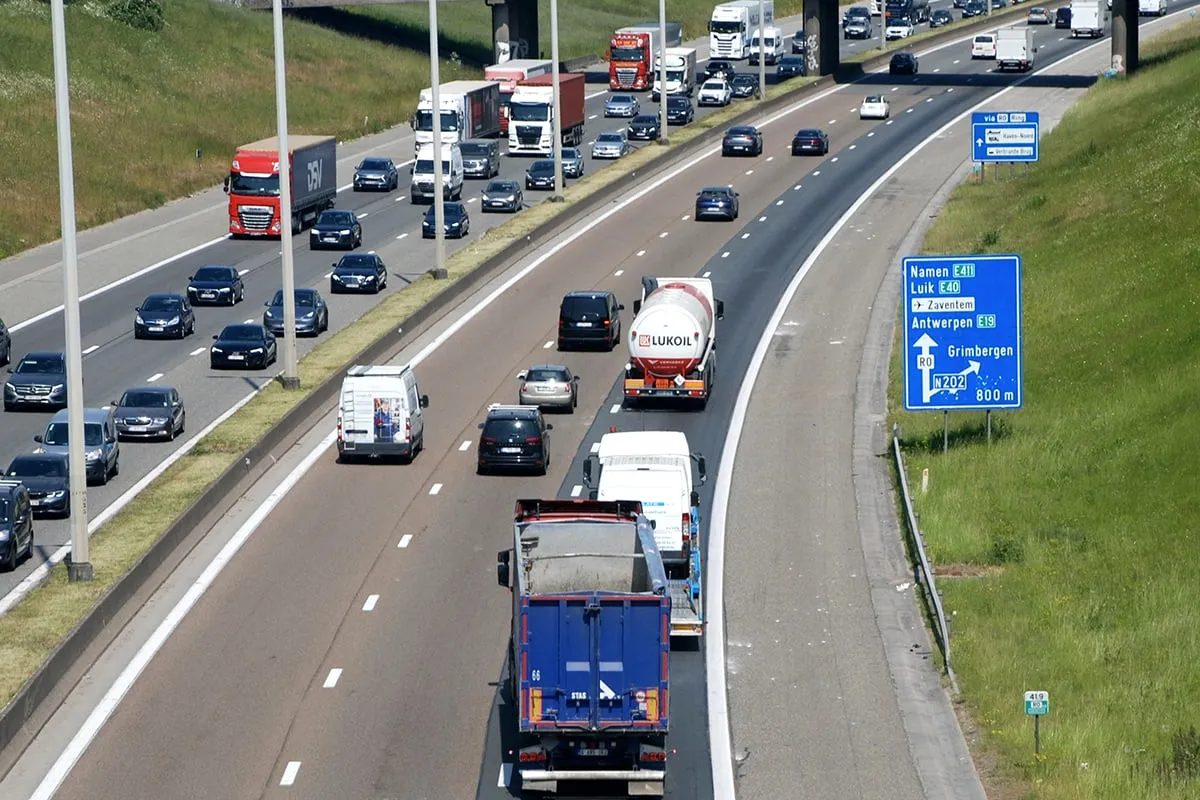
Philippe Degraef: “With the ‘lex specialis’, or specific posting rules for the transport sector, the four-day ‘cooling-off’ period for cabotage and the requirement for motor vehicles to return to their home country every eight weeks, Europe wanted to restore some balance to the power dynamics in the European transport landscape. Since the enlargement of the European Union, we have been living in a completely different Europe, and those power dynamics have changed considerably. Belgian hauliers, who around thirty years ago dominated the European Union alongside their Dutch counterparts, have since slipped significantly in the Eurostat rankings. Today, hauliers from the new member states consistently top those rankings. Eastern European number plates are no longer a rarity. They are even a prominent sight on our roads.”
There is no sign of a more level playing field on the ground. “The Mobility Package has certainly not weakened the strong east wind that has been blowing across the transport sector for two decades”, says Philippe Degraef. “That is the main conclusion we can draw from the latest Eurostat figures. The hopes of some and the fears of others that the European transport landscape would be dramatically reshaped have yet to become reality.”
The European transport landscape in practice
Philippe Degraef illustrates this finding with a few striking examples:
- Viapass figures show that the share of foreign lorries on Belgium’s toll road network has remained virtually unchanged.
- The top 5 cabotage operators have remained exactly the same since the new posting rules and the ‘cooling-off’ period were introduced.
- The top 10 countries for cabotage activity still consists entirely of Western European member states.
- Polish and Lithuanian hauliers account for 57% of all cabotage transport. It is also worth noting that Lithuanian hauliers continue their rapid rise. In ten years, they have recorded growth of no less than 1,300% and climbed from 15th to 2nd place.
- In cross-trade transport, meaning transport from country A to country B by a haulier from country C, Polish, Lithuanian, Romanian, Bulgarian and Slovenian hauliers still dominate. Hauliers from the new member states still account for 80% of the top 10 in cross-trade transport.
- With 88% of all cross-trade transport, hauliers from the new member states remain just as dominant as they were before the Mobility Package.
More work to be done
“It remains strange that the Mobility Package has had no impact on the transport market”, concludes Philippe Degraef. “On paper, the gap between Eastern and Western European hauliers could only have narrowed. Under the new posting rules, drivers are entitled to the pay applicable in the country where they work, both when cabotage is involved and when they carry out cross-trade transport.”
“In practice, this has meant extra costs for Eastern European transport companies, the undisputed champions of cross-trade transport and cabotage, for just over two years now. At least, if they comply scrupulously with the rules.”
“It is difficult to establish whether this is also the case in practice. The fact is that almost everyone has the impression that the provisions of the Mobility Package are barely being enforced.”
“Everyone knows the temptation is great to flout rules that are not enforced, so the near-absence of checks is a crucial issue that the new European Commission must absolutely address in its planned review.”
Question about this story? Ask your question
Keep following this
Get an email when a new story is published. No account needed.
- SubjectTransport