Closing event for LogiVille’s ‘Smart Vehicles’ Theme Tour focuses on smart, sustainable road transport
Text Geert Van Cauwenberge Beeld VIL / Log!Ville

In spring 2024, Log!Ville invited entrepreneurs and logistics professionals to its ‘Smart Vehicles’ Theme Tour. During the tours, they discovered a wide range of innovations that are transforming road transport. The closing event, ‘The road towards freight with brains’, took place on 24 June 2024. Industry experts reviewed the regulations and successful case studies.
More than 80 participants attended the closing event at the logistics innovation centre. In recent months, they had already discovered inspiring innovations in smart transport during a Theme Tour, including the Efficiency Champion XG from DAF Trucks, DHL’s latest e-cargo bike and electric van, Goodyear’s automated tyre monitoring and analysis, and NEXTdriver’s driver behaviour coaching app.
The event gave several thought leaders a platform to explain their vision for sustainable freight transport. After a welcome address by Paul Van Nuffel, manager of Log!Ville, Grisja Lobbestael, CEO of Flanders Make, explained how the Flemish strategic research centre for the manufacturing industry operates and the value it brings. His colleague Ellen van Nunen, Tech domain lead Autonomous & Senior project leader at Flanders Make, outlined developments in smart technologies for autonomous vehicles. In a panel discussion moderated by VIL project leader Gunther Storme, DHL Express, Pfizer, Zetes and FEBIAC discussed hot topics in sustainable road transport.
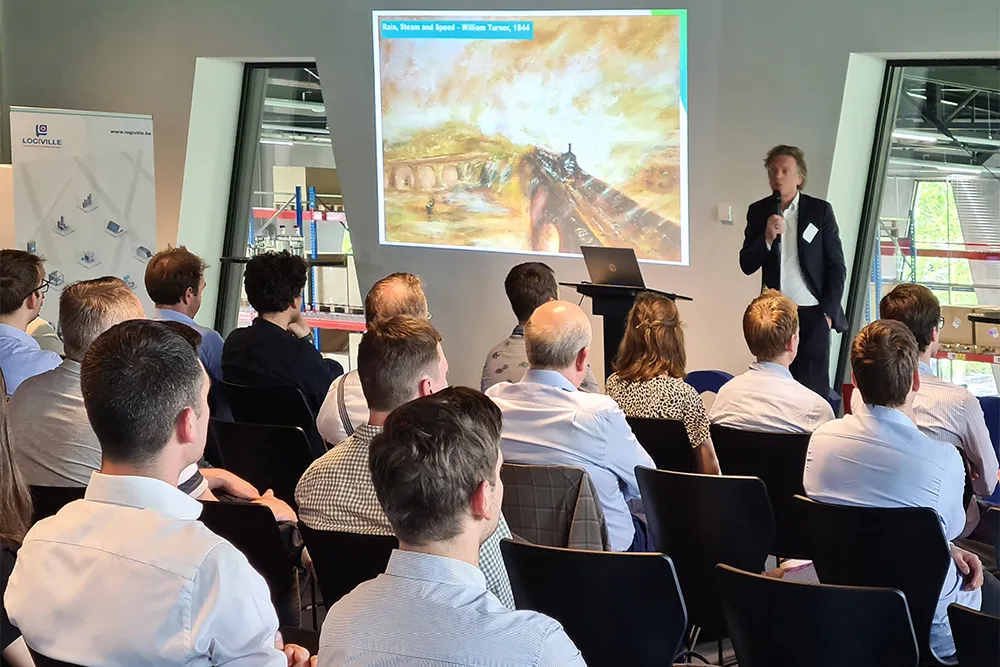
Flanders Make: fostering open innovation
With a team of more than 900 researchers and annual revenue of €100 million, Flanders Make has grown into a leading player in supporting product and process innovation in Flemish industry. It operates from three sites in Lommel, Leuven and Kortrijk. “Drawing on three pillars, research, tailored innovation, and testing and validation infrastructure, we contribute to the technological development of the vehicles, machines and factories of the future,” said Grisja Lobbestael. “Our high-quality research is often five to ten years ahead of what industry is able to absorb. Through tailored innovation, we work with manufacturing companies to develop innovative solutions. Our extensive testing and validation infrastructure, including a climate chamber for vehicle testing, helps bridge the gap to practical application.”
From SLAM to ‘platooning’
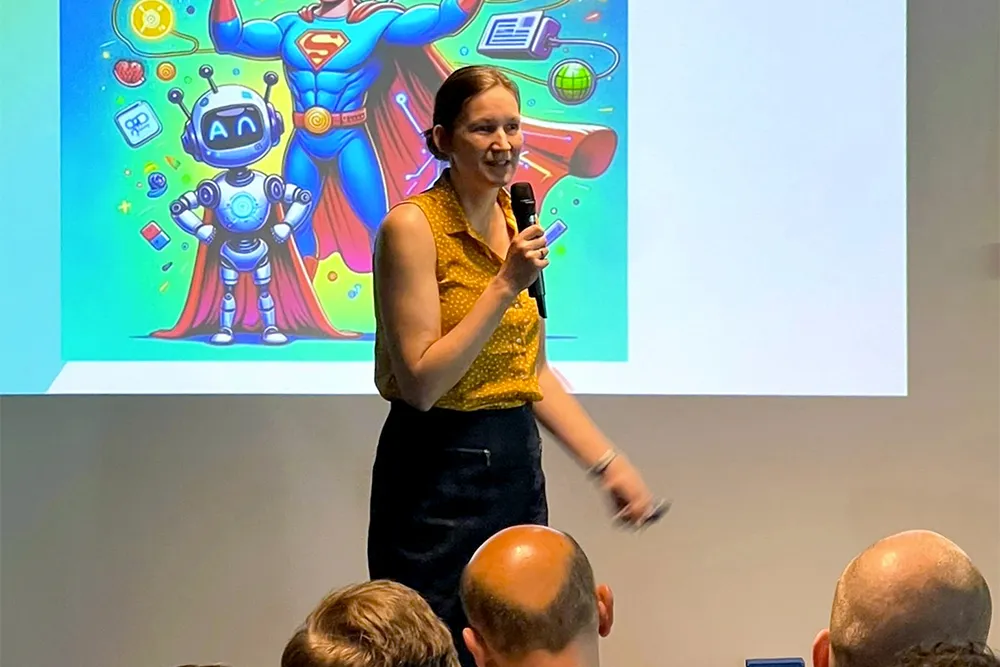
In her presentation, Ellen van Nunen began with a brief history of smart technologies in mobile vehicles. “Inductive Track Guidance was already in use in the 1950s, guiding vehicles around warehouses along inductive paths,” said the researcher. “Laser navigation, among other technologies, emerged in the 1980s and 1990s, providing greater flexibility. Since 2010, SLAM, or Simultaneous Localization and Mapping, has been used. Vehicles map their surroundings while determining their position at the same time, which is essential for autonomous navigation in dynamic environments.”
Ellen van Nunen also discussed the rise of AI algorithms and the classification of sensor data into object classes, with image pixels corresponding to people, racking or floors. “The use of pre-matrix information is also revolutionising the logistics sector, as analysing large volumes of data and predicting patterns allows logistics processes to be optimised proactively. Artificial intelligence also improves safety through pedestrian detection. Pedestrians in warehouses and distribution centres are identified and tracked accurately, reducing accidents and increasing efficiency. In transport, platooning is another promising technology. It allows lorries to travel in a convoy with minimal gaps between them, led by a lead vehicle.”
A promising future
A closing panel discussion sparked further interaction with participants. Ansfrid Vanlerberghe (Transport Manager at DHL Express), Sven De Bont (Manager Logistics & Customer Experience at Pfizer), Gilbert Wellemans (Country Manager at Zetes) and Kris Gysels (Director Public Affairs at FEBIAC) faced a series of challenging questions. How are their employers tackling electrification and the transition to sustainable fuels? What opportunities for sustainability do they see in the use of smart freight and packaging? What potential do self-driving or remotely operated lorries have in our country? And
what is sure to be a game-changer in the coming years?
In a nutshell, rapidly advancing battery technology, with better performance and lower weight, could offer market players fantastic opportunities. Pilot projects in autonomous driving are also promising, including in autonomous port areas, where the technology could be put to excellent use. Smart GPS tracking and sorting machines determine which sustainable mode of transport is used to deliver a consignment. And what about control towers for sea and air transport that consolidate and deconsolidate consignments, assembling them to suit transport routes?
Question about this story? Ask your question
Keep following this
Get an email when a new story is published. No account needed.
- SubjectTransport