












How TFOC is tackling criminal infiltration in transport and logistics
Text Armand Landman Beeld Ministerie van Justitie en Veiligheid
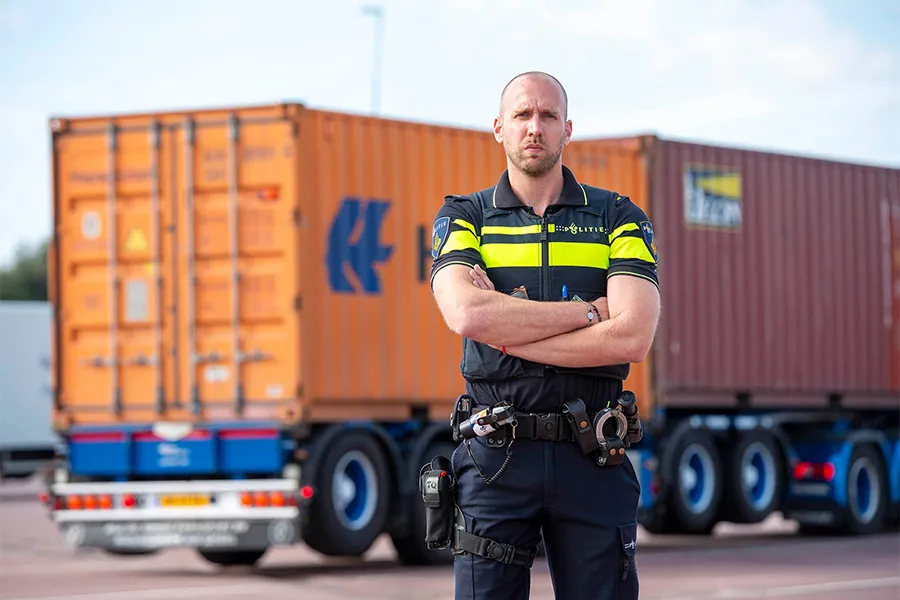
The transport sector plays a crucial role in the economy, but is also an attractive target for organised crime. Tom Torensma, who works for TFOC (Transport Facilitated Organized Crime) within the police, discusses the dangers of criminal infiltration in transport and logistics. He highlights the sector’s vulnerabilities and the measures that can be taken to prevent criminal involvement. “Every criminal needs transport,” says Torensma. “It is an essential part of organised crime.”
TFOC is a specialist police team focused specifically on tackling criminal infiltration in the transport and logistics sector. Torensma explains that the idea came from the observation that organised crime always relies on logistics networks to move illegal goods. “Whether it’s drugs, weapons, money or human trafficking, transport is needed to get these goods and people from A to B,” says Torensma. TFOC was therefore set up to make the transport sector more resilient to this kind of abuse. According to Torensma, the most visible forms of crime in the sector include the smuggling of drugs and illegal tobacco. “Import containers carrying cocaine are the most tangible example for the public,” he says. “But we look at every form of criminal abuse in logistics, across the four main modes of transport: air, water, road and rail.”
Unwitting involvement
Torensma stresses that transport companies often become involved in criminal activity without realising it, as criminal networks exploit their legitimate logistics flows. “We see criminal organisations piggybacking on legitimate logistics flows. The transport sector is vulnerable to criminal infiltration, mainly because goods have to be moved quickly, volumes are high and profit margins are low.” Torensma explains: “Margins are relatively low and competition is fierce. Companies want to work as efficiently as possible, which can sometimes mean that safety gets less attention. This makes it easier for criminals to exploit the system.” The shortage of good drivers also plays a part. “The shortage of professional drivers leads to high staff turnover. For example, we see workers from other European countries who may be less familiar with the risks. That makes it even harder to spot suspicious signs,” says Torensma.
Real-life examples
A driver found a strange note under the windscreen wiper of his lorry. It turned out to be an attempt by criminals to recruit him to transport illegal goods. TFOC stresses the importance of drivers reporting incidents like this immediately and not taking matters into their own hands.
In another case, a driver was approached by an unknown person who offered him a large sum of money in exchange for transporting an extra load. TFOC advises companies to give drivers clear guidance on how to handle situations like this and to always report them to a manager or the police.
Torensma also describes a case in which a business owner noticed something unusual about the loading location given by a new customer. The customer had no business address and paid only in cash. Reporting this observation enabled TFOC to intervene and expose a criminal network.
One example of unusual circumstances during transport was the use of duplicate tachographs to manipulate driving times. Situations like this make companies especially vulnerable to criminal infiltration. TFOC works with the Labour Inspectorate to detect and prevent these practices.
Starting a conversation
TFOC works closely with transport companies to raise awareness of the risks and train them to recognise signs of criminal activity. “We consider a proactive approach to be the most important thing,” says Torensma. “We talk to business owners and drivers, and alert them to anomalies that may point to criminal infiltration, such as new customers without a website or unusual loading and unloading locations.” He adds that awareness is vital and that companies should invest in vigilance and attention to detail in their business processes. TFOC also works closely with various partners, including Customs, the Royal Netherlands Marechaussee, the Labour Inspectorate and Platform Veilig Ondernemen. “We try to put barriers in the way of criminal infiltration. This also involves practical matters, such as how to deal with new customers, how to report anomalies during transport and whether drivers can always contact the company,” says Torensma. “We also work with organisations such as Transport en Logistiek Nederland (TLN) to raise awareness and talk to employers about safety. The success of our approach is not just about intercepting kilos of illegal goods. Above all, it is about strengthening the sector by helping companies become more resilient to criminal infiltration.”
TFOC’s tips:
Report suspicious situations to a manager, the police or Meld Misdaad Anoniem. Working with the right organisations can be crucial to preventing criminal infiltration.
Keep an eye out for suspicious consignments, such as goods without documentation or goods originating in countries with a high risk of excise duty fraud. These may be indicators of criminal activity.
Check container seals regularly and look for damage or irregularities in the load. These may be signs of tampering.
Discuss with drivers what to do if they are followed or asked to do something unusual, such as leaving a container somewhere else.
Make sure drivers always report suspicious situations, such as unfamiliar vehicles on site or unusual loading and unloading times. These signs may point to criminal activity.
Use available resources such as serious games to train staff to recognise suspicious situations. Awareness and training are essential for prevention.
Illegal tobacco
One of the success stories Torensma shares is a report that ultimately led to the seizure of 800,000 euros’ worth of illegal tobacco. “The business owner who reported it had noticed an anomaly in their business process and contacted us. We made sure they suffered no harm as a result of their cooperation, and managed to stop the criminal activity. A win-win situation.”
Despite the challenges, Torensma believes TFOC’s approach is producing results, although he stresses that it must continue to evolve. “Criminal organisations adapt quickly,” he says. “We have to keep responding to new developments in the logistics sector. Ultimately, our aim is to keep the transport sector as clean as possible and make sure business owners know where to turn when they spot suspicious situations.” TFOC’s work is focused on protecting the transport sector from criminal influence and helping companies become more resilient. “The aim is to prevent criminal infiltration as much as possible,” Torensma concludes. “By working with the sector and supporting it, we can ensure a safe and fair transport chain.”
Follow this link to play the online game ‘Operatie Zelos’. You will learn how to recognise signs of suspicious situations and what to do next.
Follow this link to watch more informative videos from TFOC: https://www.youtube.com/@stronglogistics7391/featured
Question about this story? Ask your question
Keep following this
Get an email when a new story is published. No account needed.
- SubjectGeneral







