












Harmony between people and machines
Text Armand Landman Beeld René de Koster, Adobe Stock
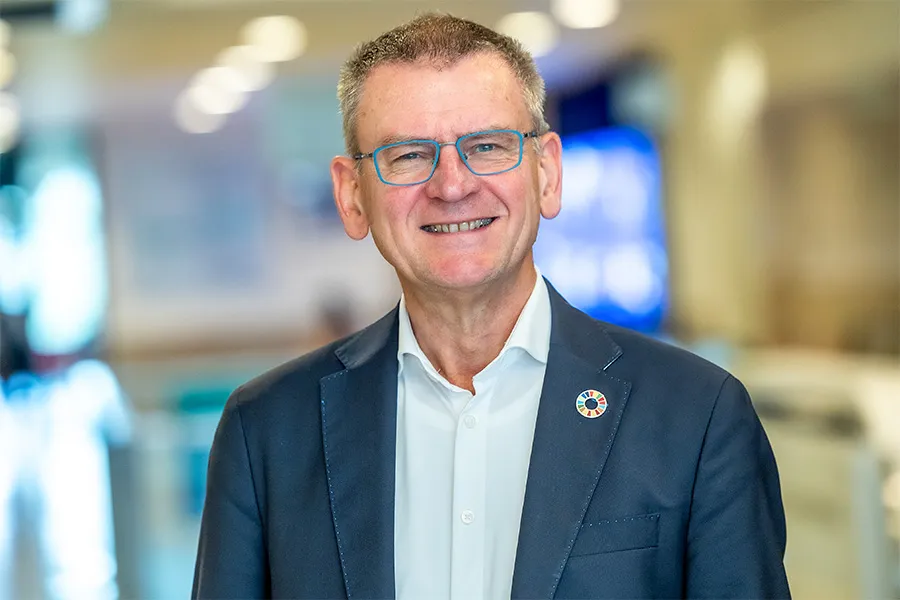
As the logistics sector undergoes rapid change, Professor René de Koster, Professor of Logistics and Operations Management at Rotterdam School of Management, Erasmus University, remains an influential voice. Drawing on decades of research and a keen eye for the future, he offers a nuanced perspective on the challenges and opportunities in the world of transport and logistics. “How can people and machines work together optimally?”
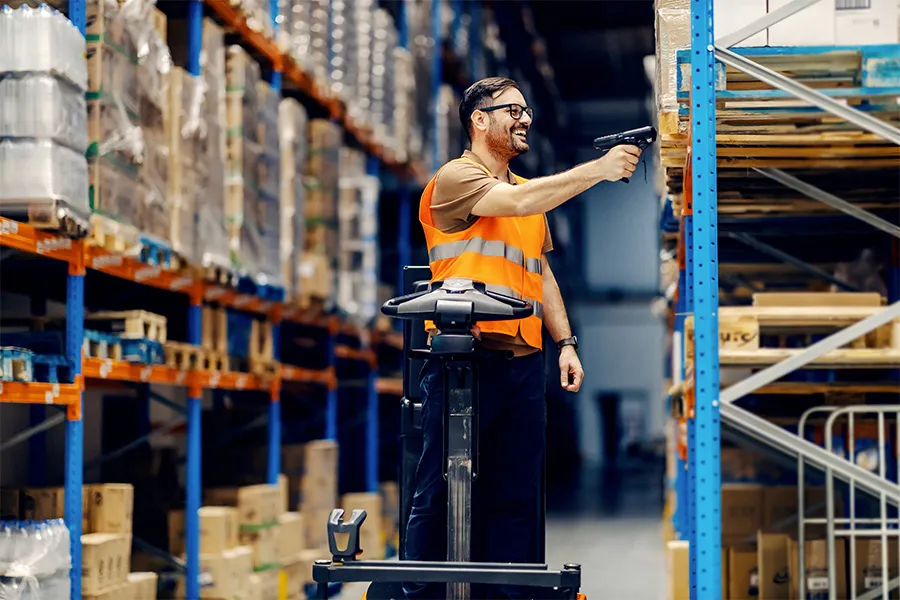
Automation and robotics in distribution centres have fundamentally changed the logistics sector in recent years. Professor De Koster, who has long been a leading figure in warehousing research in the Netherlands and beyond, emphasises the pace of these developments. “The use of automation and robotics in distribution centres has accelerated,” he explains. “What we are seeing now is that warehouses are increasingly being built around new technologies, leading to highly scalable solutions.”
Technological progress offers countless opportunities, but also raises important questions. De Koster’s research focuses in particular on the balance between technology and human labour. “How are tasks divided between people and robots, and will there still be interesting jobs for people?” he asks. In a sector where labour shortages and the need for 24/7 operations are increasingly becoming the norm, this question is more relevant than ever.
Although automation is often seen as the answer to growing complexity and labour shortages in warehouses, De Koster warns against focusing too narrowly on technology. “I don’t see robots fully replacing people in the next ten to fifteen years,” he says. “The costs are simply too high, and human flexibility and decision-making will always be needed in warehouses.”.
Working together
De Koster stresses that the key to success in the logistics sector lies in people and machines working together. His research has shown that optimising this collaboration leads to better results, both in terms of efficiency and job satisfaction. “When employees are given the opportunity to choose which tasks they perform, satisfaction rises significantly, and productivity often increases too.”
His insights are valuable at a time when companies are often forced to choose between full automation and retaining human labour. De Koster advocates a middle ground in which technology complements and enhances human labour rather than replacing it entirely. “It’s not just about deploying robots, but about how we can get people and machines to work together in harmony. That is the real challenge for the future of logistics.”
Research
De Koster’s scientific approach to warehouse management and logistics has led to several practical applications. His work includes optimising picking activities and improving working conditions for warehouse staff, including through automated storage systems and the use of AGVs (Automated Guided Vehicles). “My research group investigates how automated systems can be deployed optimally, analysing both storage strategies and the role of people,” he says.
One example is his research into the strategic positioning of products in warehouses, for instance by placing items so that employees have to bend or stretch less. “The best comfort can be achieved by placing certain products elsewhere, which not only increases productivity but also improves employee satisfaction.”
De Koster has also contributed to developing methods to optimise the turnover of dock doors in warehouses. This project, which was applied at Albert Heijn among others, led to significant operational improvements. “We developed a method for increasing the turnover of those dock doors, meaning they don’t have to expand as quickly. That was a good result.”
Mission
De Koster’s commitment to the logistics sector goes beyond scientific research. He sees it as his mission to share knowledge and improve the sector. “I realised early on how important the field was and how much there was still to do,” he says. “I worked out what the most important things were that needed to be done, and then I did them all.”
At the start of his career, warehousing was something of an isolated subject in academia. “For a long time, I was one of the few people in the Netherlands teaching the subject at universities,” he recalls.
Logistics, and warehousing in particular, received little attention at Dutch universities at the time. “Dutch universities still pay almost no attention to warehousing,” he says. Despite the strategic role the Netherlands plays as a logistics hub in Europe, academic research into the discipline remained limited. De Koster regrets this, as he believes the field offers essential insights into the country’s economic and operational structures.
“I think that’s a shame. It’s an important field, but there’s little I can do beyond passing on my knowledge and hoping my students will take up the baton. My motivation has always been to develop the field further, because I realised how important it is and how much there is still to discover.”
Question about this story? Ask your question
Keep following this
Get an email when a new story is published. No account needed.
- SubjectGeneral







