Towards smart and efficient workforce planning in warehouses with ORTEC Workforce for Warehousing
Text Geert Van Cauwenberge Image ORTEC

In logistics, efficiency is not a luxury, it is an absolute necessity. Especially in warehouses, where staff shortages, peak workloads and last-minute changes are part of everyday life. Yet workforce planning in many warehouses remains surprisingly manual and fragmented. ORTEC is changing that with ORTEC Workforce for Warehousing, an innovative, web-based solution. “You get more out of your people while also reducing operating costs and increasing flexibility on the shop floor,” says Jeroen Vangrunderbeeck, Industry Leader Workforce at ORTEC.
The challenges of warehouse planning are considerable: fluctuating demand, ad hoc changes and departments that often operate in their own silos. “One department may be waiting for staff while another has people to spare,” explains Jeroen Vangrunderbeeck. “ORTEC makes it possible to distribute that capacity intelligently across departments, fully automatically.”
Using an advanced optimisation algorithm, the system generates shift schedules for large groups of employees simultaneously, across multiple teams and departments and for an entire site. This makes it possible to make the best use of your permanent staff first, and only then bring in agency workers. “That prevents unnecessary costs and overloading your employees.”
This centralised approach not only brings greater stability to planning, but also creates scope for more strategic work. Instead of firefighting, planners can focus on continuously improving processes.
Task planning at the right time
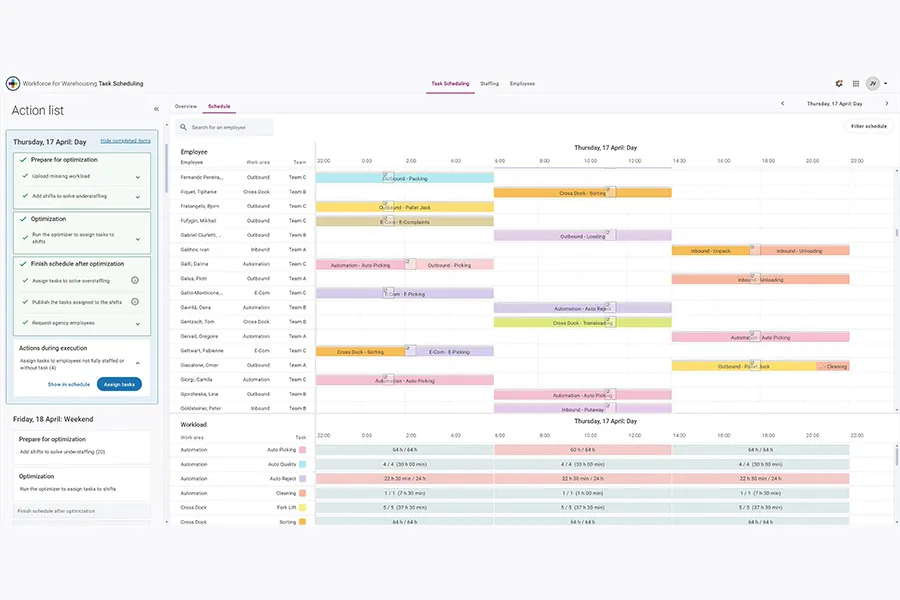
ORTEC provides insight not only at shift level, but also down to task level. The system analyses the expected workload and proactively identifies shortages or surpluses. This allows planners to adjust capacity before tasks are actually assigned. “You no longer have to allocate tasks manually, which saves a great deal of time and reduces errors,” says Vangrunderbeeck. “And you can wait until the last moment to plan, using the most up-to-date data.”
This just-in-time approach prevents schedules from becoming outdated before the working day even begins. It also ensures a better match between task and employee, boosting both efficiency and staff satisfaction.
Seamless collaboration with employment agencies
In many warehouses, using agency workers is essential. ORTEC supports this collaboration with a built-in platform where employment agencies can manage their pool of workers. Both short-term and long-term contracts are coordinated through the platform. “You can easily select the right agency worker based on the requirements, and keep everything in one system,” says Vangrunderbeeck. “That makes both ad hoc arrangements and ongoing collaboration much more efficient.”
The platform also provides transparency: planners can see agency workers’ availability and the terms of the collaboration. “All without endless email exchanges or Excel spreadsheets,” he adds.

Tangible results and measurable impact
The benefits of ORTEC are clear and measurable. Jeroen Vangrunderbeeck: “Companies that implement our solution report, among other things, the following impressive figures: a five per cent increase in productivity thanks to better planning and task allocation, ten per cent fewer overtime hours through a better match between workload and available capacity, three per cent lower labour costs by centralising and making more efficient use of in-house staff, and no less than eighty per cent less time spent creating schedules, thanks to automated processes. The impact is therefore huge, especially when moving from decentralised to centralised planning: fewer planners, less manual work and therefore greater control.”
Leading real-world case studies
Major players such as Katoen Natie, Nike, Colruyt Group and DSV are already convinced. Not just because it saves costs, but also because it makes them more resilient in a sector that has to respond ever more quickly. ORTEC gives managers more control, employees greater satisfaction and companies a clear competitive edge.
“Flexibility, insight and efficiency, that’s what matters today,” concludes Vangrunderbeeck. “Those who invest in smart planning now will be better prepared for the future.”
Question about this story? Ask your question
Keep following this
Get an email when a new story is published. No account needed.
- SubjectSoftware