Making logistics smarter and more resilient to crises
Text Valérie Couplez Image Lenze
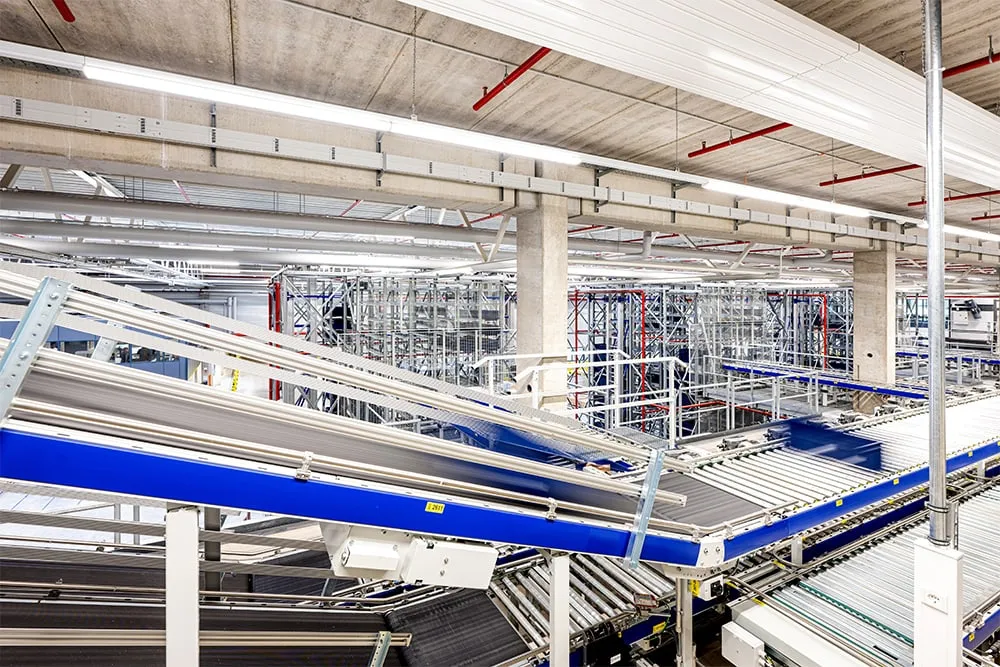
A succession of crises has brought intralogistics increasingly into focus. But the challenges (and opportunities) are considerable. More goods are being held in stock, new distribution channels are emerging, costs have fallen, consumers expect more sustainable supply chains, factories run 24/7, long maintenance shutdowns are no longer an option, there is a shortage of staff, and delivery reliability is crucial… In short, intralogistics is a key differentiator in the market. Combining automation, drive technology and digital engineering, Lenze’s technology rises to the challenge of optimising processes and developing new business models. The goal? A smart warehouse.
Let’s start at the beginning. Moving goods through production is a job for horizontal conveyor belts. They are used in every sector and come in all shapes and sizes. Lenze’s new generation of decentralised servo drives, the i series motec, is ideal for this purpose. It meets the demands of modern systems: shorter engineering times through minimal variations, alongside maximum energy savings. With the EASY System Designer, you can design the perfect drive system, which operates up to 30% more efficiently. This newly developed component can be mounted either on the motor or on the wall, and has an output power of 0.37 to 45 kW.
The integrated regenerative unit delivers additional savings. Regenerative energy is not wasted in braking resistors, but fed back into the electricity grid, with no extra hardware costs. The servo drive can also control synchronous motors without sensors.
The drive system as a sensor
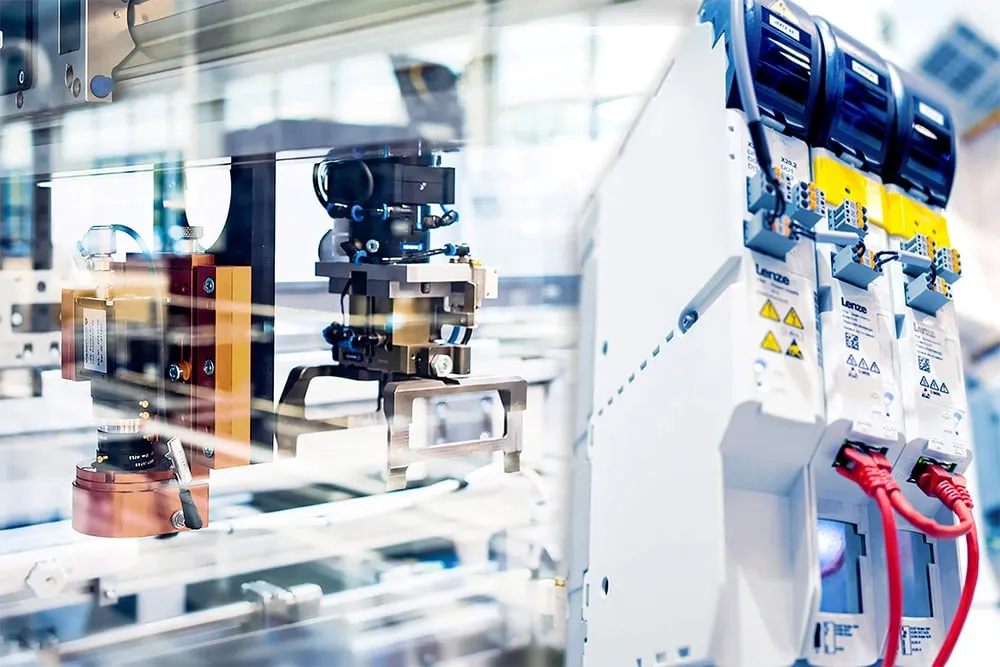
IO-Link master functionality reduces the amount of cabling required. Users can also capture data from the servo drive and pass it on to a higher-level system. Scanning the digital nameplate gives users quick access to product data and the Lenze Information Hub. Thanks to its integrated oscilloscope function, the drive system effectively acts as a sensor in conveyor technology. Motor current is recorded at high resolution. This data gives companies a precise picture of what is happening in the system.
The next step is to find out why it is happening, with the longer-term aim of predicting what will happen and when. To achieve this, Lenze combines the IT and OT worlds, drawing on IT expertise and intralogistics experience. This makes it possible to optimise production lines, reduce costs and establish new digital business models.
Greater machine availability
One further outcome of the interaction between IT and OT is an asset management and ticketing system that increases machine availability. Lenze has developed a dedicated portal for this purpose, connected directly to the machines. If a fault occurs, the machine can automatically generate a ticket to notify the maintenance technician. The ticket shows which component is involved, its model and variant, its serial number, and exactly where the part is installed in the machine topology. This eliminates the risk of incorrect information or outdated documentation. The information comes directly from the PLC, which always provides the most up-to-date status. As the platform is independent and built on open standards, it can also include products from manufacturers other than Lenze. The sensors from specialist SICK, for example, are already part of this solution.
Making machines modular
Another digital solution that simplifies engineering is FAST. Lenze’s FAST software engineering modules allow automation specialists to combine ready-made functions for applications such as the latest-generation warehouse cranes. Lenze FAST helps developers build machines from modular components.
This saves engineering time and takes systems to a higher level, as users now have an expandable basic framework for machine applications. The most important control commands can be executed independently of the higher-level controller, and the graphical user interface makes commissioning particularly straightforward. Customer-specific know-how and additional functions can be integrated thanks to the open IEC 61131 environment.
Question about this story? Ask your question
Companies in this story
Keep following this
Get an email when a new story is published. No account needed.
- SubjectMaterial handling
- CompanySICK