












Weaving diamond interchange tested virtually in advance
To keep traffic flowing on the N206 during work on the RijnlandRoute, the traffic situation at the Leiden-West interchange has been changed since 27 May. Construction consortium COMOL5 has used the so-called “weaving diamond interchange”. This traffic solution has been used in the United States for some time, but this is the first time it has been applied in the Netherlands.
For a period of 2.5 years, traffic will travel on the left-hand side of the road for a short distance, with traffic lights, road markings, signs, barriers and screens between the lanes helping to guide it safely. There are fewer crossing movements, allowing traffic to continue flowing safely and smoothly during work on the RijnlandRoute. The A44 will remain open during the works.
Prioritising maximum certainty
In theory, the weaving diamond interchange should work well. To be on the safe side, the team called in Soltegro. The brief was: “Create a simulation of the proposed weaving diamond interchange to support the decision-making process.” We spoke to Soltegro employees Franc Fouchier, manager systems engineering & innovatie, and Alexander van der Kolk, technical innovation lead, about this unusual simulation and its results.
The weaving diamond interchange from above.
“It is indeed very difficult to assess the situation based on a static, paper-based 2D design,” Fouchier begins. “Soltegro specialises, among other things, in creating 3D traffic simulations, which are ideal for this situation.” Van der Kolk adds: “The process with the stakeholder was facilitated by traffic solutions manager Angelo van Turenhout. The DDI (Diverging Diamond Interchange) principle, the weaving diamond interchange, had to be shown in the simulation to actually reduce disruption to traffic. Soltegro opted for a straightforward solution: transferring the road model from BIM into the 3D simulation, and adding the traffic situation based on a traffic model. The traffic flow being simulated, which drivers could travel through, was a forecast of what things would look like in 2030.”
A sharp focus on what is needed
Van der Kolk: “We set up the simulation in less than 12 weeks, with a sharp focus on what was needed. Soltegro developed an application that uses BIM. Based on the simulation, COMOL5 made improvements to the road design. All changes were ultimately incorporated into the BIM model.” Fouchier adds: “Less information makes the situation easier to understand, while of course taking account of laws and regulations.”
The simulation was tested by ‘special groups’. “These included a group comprising the competent authority and the police, as well as a test group of regular road users from the immediate area.
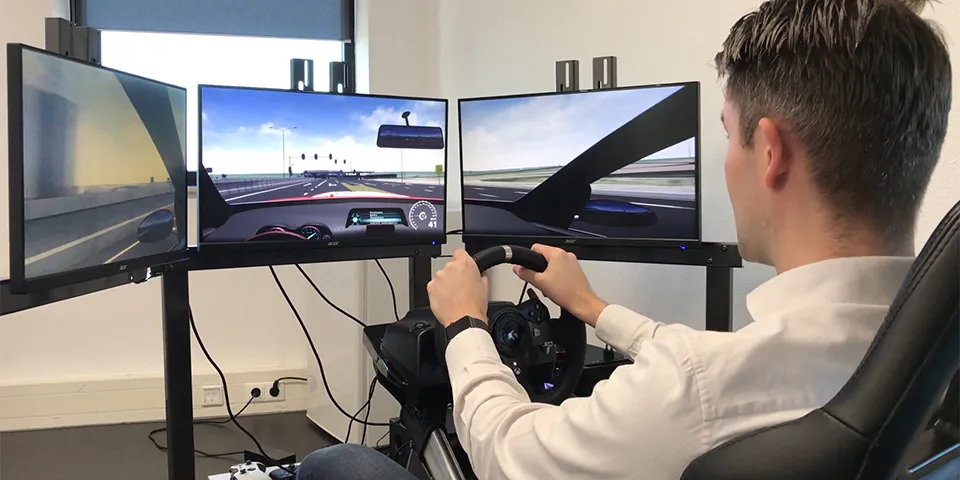
We looked at what would ensure optimum safety. The tests were carried out in highly realistic conditions, either in a driver’s seat with three screens or using a 360˚ VR headset,” Fouchier explains. “Digitally demonstrating how things work prevents rework costs later on, even if the improvements are ‘spin-offs’. The tests proved conclusively that everyone in the simulation automatically drove in the right direction. COMOL5’s temporary solution has therefore been tested virtually in advance.”
Question about this story? Ask your question
Keep following this
Get an email when a new story is published. No account needed.
- SubjectGeneral







