












WATERQUEST 2019: one step closer to a solution to urban flooding?
We have previously covered WATERQUEST 2019, a competition launched by Nering Bögel with the aim of bringing a group of bright minds together in a think tank. The goal is to develop new solutions to urban flooding.
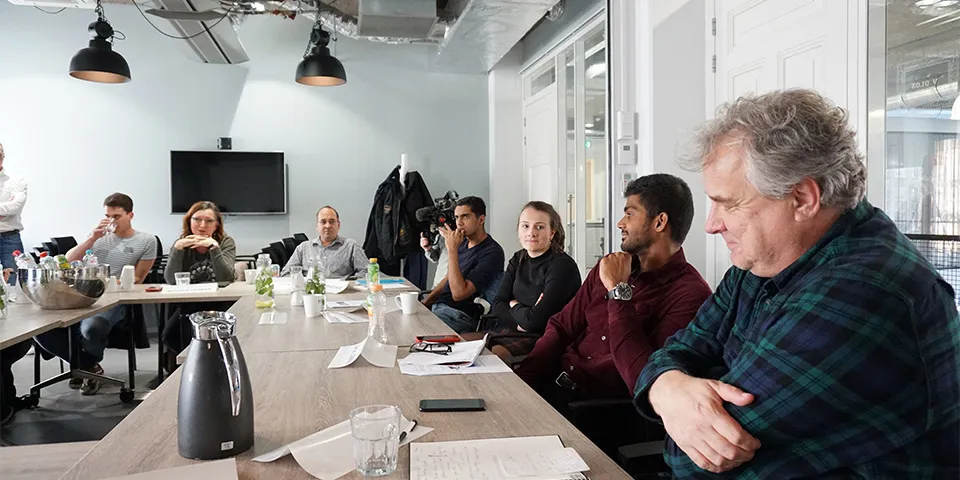
Richard Janssen, owner of Nering Bögel and the competition’s initiator, talks about the process and the latest developments. “Last year, with Infratech on the horizon, we approached a number of universities, universities of applied sciences and other important knowledge institutes. Entries from students at TU Delft, Leiden and Twente came in. The first think-tank session has now taken place.”
Students from TU Delft, Leiden and Twente at the first WATERQUEST 2019 session. Listening attentively as Richard Janssen of Nering Bögel explains the project.
Inspirer
One of the driving forces behind the WATERQUEST process is Nick van de Giessen. An international expert, he is sought out by companies and government bodies around the world to advise on water-related challenges. Janssen immediately sees that the students have enormous respect for Van de Giessen and are keen to work with him. “The first session was therefore mainly intended to explain the idea in more detail and outline what is expected of them. For example, one student from India talked about his experience of flooding there. After watching a number of film clips and listening to his story, you could sense a shared sense of social responsibility emerging: ‘this is where we need to focus’, the students were thinking. ‘Something must be done about the misery people in villages and cities experience because of flooding. And we are going to try to do that. Something is expected of us here’.”
Bright minds
Janssen says he was surprised by the make-up of the group. “Students from every discipline that deals with, or may deal with, water-related challenges are sitting around the table: civil engineering, construction, research, water management, mechanical engineering, international business and architecture. How great is that?” At first, some were hesitant and needed a nudge to really dare to think outside the box. “Of course they have to abide by the laws of physics, but beyond that, we wanted them to let their imaginations run wild. Rather than thinking about limitations or money, we wanted them to brainstorm about those other, futuristic ideas. And then you see a number of people spontaneously dare to make huge leaps in their thinking, which is exactly the idea.”
Nick van de Giessen, inspirer and driving force behind the facilitation of the WATERQUEST process.
Jury
“At the end of May or beginning of June, the jury will assess the submitted ideas and announce the prize-winners. After that, the choice is clear: do you want to share your idea with the think tank or not? Because we’ll start working on those ideas after the summer.” Janssen concludes: “We want to create a genuine inventors’ club, but not become engineering consultancy 2.0. The group needs to be able to think at a high level and run calculations on models, but above all, it must be free to unleash its creativity. Nering Bögel is simply in the background, organising, facilitating and, above all, encouraging the process so that it takes shape. And I think it’s fantastic that TU Delft has said we can use its facilities for this project. The students went home full of enthusiasm and ready for the next step.”
Question about this story? Ask your question
Keep following this
Get an email when a new story is published. No account needed.
- SubjectGeneral







