












Van Aalsburg: traditional expertise, modern working methods and a commitment to sustainability
The climate agreement is having a huge impact on housing, commercial construction and the civil engineering sector. The Supreme Court ruling at the end of May has brought the country to a standstill. Thousands of projects, and the businesses behind them, are affected by the nitrogen crisis.
“Even we are feeling the effects,” says Dick burg, one of the six brothers who run the large and dynamic family business Van Aalsburg BV. “We are a specialist willow and coppice timber business that has been working hard for many years to reduce CO2 emissions and create a sustainable working environment.”
Timber in civil engineering
“By reusing available raw materials as efficiently and to as high a standard as possible, we reduce CO2 emissions. Timber and plastic are widely used in the civil engineering sector for fascine mattresses and bank protection.” Van Aalsburg explains that willow is a good alternative to less environmentally friendly products in applications such as these. “We have also developed a patented system for building islands (floating reed beds) from willow branches and dredged material sourced nearby. Only natural materials are used throughout the construction. A major advantage is that water authorities can combine dredging work with the achievement of several policy objectives, as well as landscape development and recreational goals.”
Craftsmanship
The timber used by Van Aalsburg is traditionally and sustainably grown in the Biesbosch and on its own 150 ha nursery. The craft of coppicing has been passed down from father to son. “We are renowned in the Netherlands and abroad for our knowledge and experience in fascine mattresses, fascine bundles and bank protection.” It is clear that traditional expertise, modern machinery and working methods go hand in hand at Van Aalsburg, in a socially responsible way.
Van Aalsburg: an impressive 4-hectare business site.
International markets
“We are finding that we can also meet specific needs abroad, for example in Germany, France and Poland, where we work in water engineering on strengthening dykes and protecting banks.” Van Aalsburg also serves the private market in Belgium and Germany. “This means we are not dependent on the Dutch market. The parties involved say they want to procure sustainably, but unfortunately, all too often, contracts are still awarded on the basis of the lowest price. Van Aalsburg is setting the trend in sustainability, and that really does not have to cost more. But now everything is being held back by PAS and PFAS. There is very little we can do to fight that.”
Small environmental footprint
Van Aalsburg is doing everything it can to keep its own footprint as small as possible: “The wood-burning stove, which runs on wood chips, heats the entire business. We generate electricity using the 550 solar panels on our roof. We use LED lighting and have an EV charging point. We also use low-emission fuel, and 25 of our 50 chainsaws are battery-powered. We are proud of the CO2 reductions we have achieved!” However, Van Aalsburg believes that the water engineering sector will need to allow a year or two to overcome the nitrogen crisis and PFAS. “That is, provided there is clarity soon… but uncertainty is already undermining all confidence. Once projects get moving again, the opportunities will follow quickly
and we will be able to develop great designs that can be delivered sustainably and benefit nature. But that means we need to make choices now. And sometimes that calls for flexibility from your employees. “Our people are the most important part of our business! We want to make sustainable use of their skills too, for example by making smarter use of new technologies such as the new high-tech contra winch system.”
New floating crane
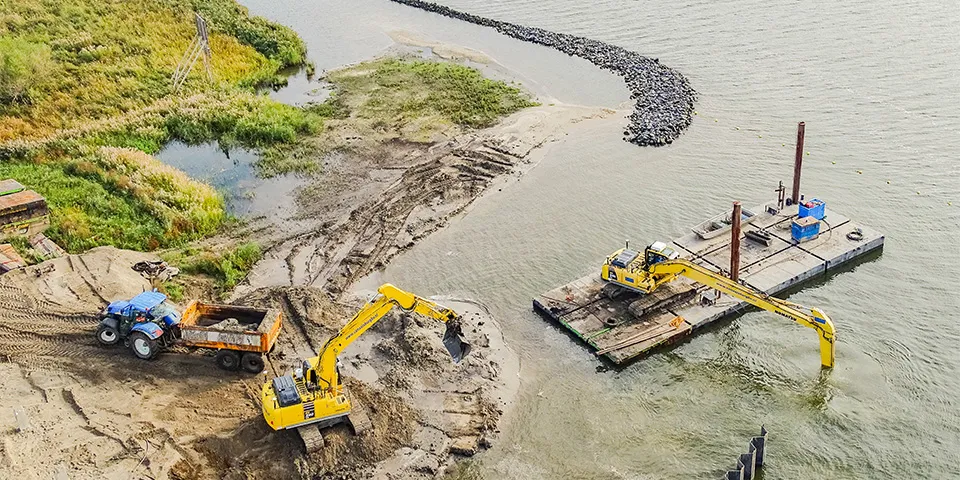
“In November, we will put a new floating crane, built specifically for us, into service. The bespoke crane is versatile, for example on nature development projects involving floating reed beds or islands. It can also be used to build wave-buffering structures and restore traditional narrow strips of land.” Van Aalsburg mentions Giethoorn and the area around the Weerribben, where the crane can be used in the Wieden wetlands. It will also be used for sod-cutting work in the reed beds in Alkmaar. With its long boom and special GPS system, the crane can even be used as a reed mower in the Biesbosch. “The crane can be transported by road on a low-loader without having to be dismantled. During waterworks, its width can be adjusted easily and stably using hydraulics, allowing it to pass through marshland or narrow waterways. And thanks to the unique capabilities of this crane, we will disturb the soil and banks less, or not at all.”
Van Aalsburg concludes: “We invest in smart, sustainable machinery, as well as in our people and their expertise. This allows us to grow our turnover by making sustainable use of our own structures in projects. We are ready for a sustainable future with everyone!”
Van Aalsburg BV
Paalgraaf 11, 4174 LC Hellouw
T +31 418 729101
F +31 418 581167
www.vanaalsburgbv.nl
Question about this story? Ask your question
Keep following this
Get an email when a new story is published. No account needed.
- SubjectGeneral







