












Unloading piles even more safely with new working method
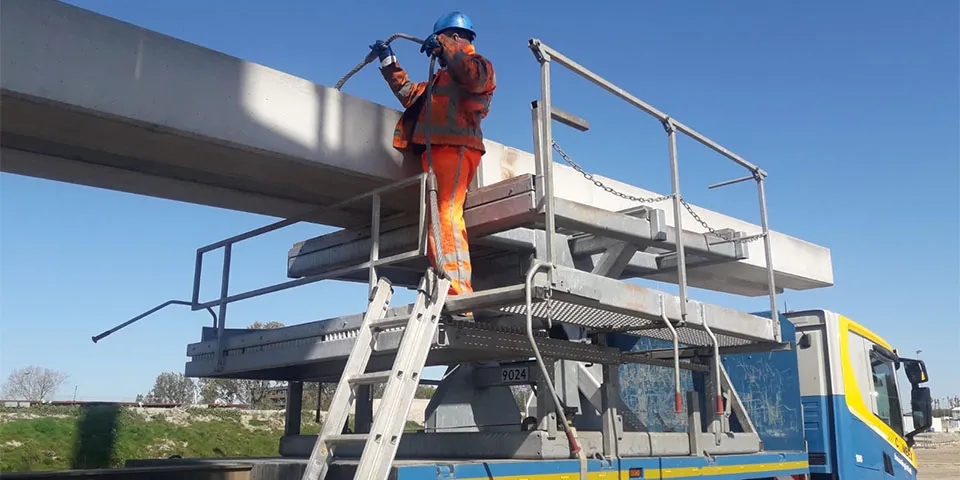
Piling contractors, hauliers and manufacturers, represented respectively by NVAF, TLN and the Palenplatform of Betonhuis Constructief Prefab, have joined forces to draw up a declaration of intent and a practical standard working method for unloading piles. At the end of April, Ton Groeneweg, NVAF chairman and Director of Tubex, Jan Boeve, Managing Director of TLN, and Ron Peters, Director of Betonhuis, signed the declaration of intent.
POD transport
Concrete piles are prefabricated in the factory under ideal conditions. The piles then have to be transported from the factory to the construction site. Prefabricated concrete piles can be transported by road at lengths of up to 39 metres. From around 23 metres, supports or cradles are used during transport. The piles then extend over the cab roof. This is known as piles-over-cab transport, or POD transport.
Until now, there have been no clear, uniform agreements on unloading POD loads.
Practical standard working method
That is why piling contractors, hauliers and manufacturers, represented by NVAF, TLN and the Palenplatform of Betonhuis Constructief Prefab, have joined forces. Together, they have drawn up a declaration of intent and a practical standard working method. This makes the rules for unloading POD piles clear to everyone. Under the new method, the division of tasks and responsibilities between the manufacturer, haulier and recipient is clearly defined. All parties must agree in advance how the piles will be transported and unloaded. For POD piles up to 30 metres long, unloading with a wheel loader or from a platform is preferred. For longer piles, if the driver cannot attach them from the platform, ladders or mobile elevating work platforms can be used, provided that safe working at height requirements are met.
This method has been implemented step by step since April 2020. The parties recognise that its use increases costs as a result of additional investment and the vehicle's increased weight.
Question about this story? Ask your question
Keep following this
Get an email when a new story is published. No account needed.
- SubjectGeneral







