












TETRA VEooX project: digital twins in logistics and manufacturing
Text Laureline Vansteenkiste Beeld HITLAB Howest
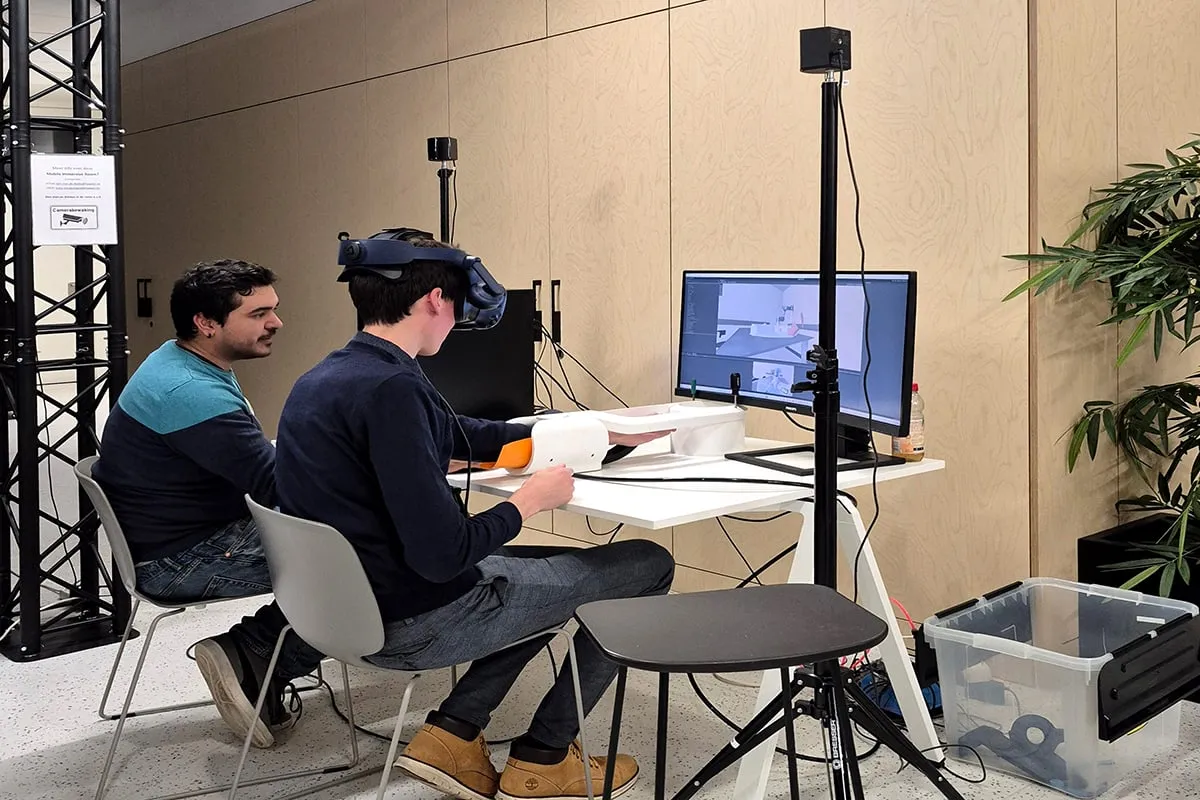
What if you could create a virtual replica of a business environment and cost-effectively test different scenarios without affecting your current production and logistics? In a nutshell, that is the aim of the TETRA VEooX project, an initiative by FlandersMake@UGent, ISyE and HOWEST University of Applied Sciences. At the kick-off event, UGent professor Johannes Cottyn and HOWEST researcher Charlotte Larmuseau explained why companies should get involved in the project.
The kick-off of the TETRA VEooX project took place in Kortrijk on Thursday 7 November. The TETRA programme is a VLAIO initiative for practice-oriented research. Its aim is to facilitate the transfer of technology-driven knowledge between universities of applied sciences and universities, on the one hand, and companies and non-profit organisations, on the other. The VEooX project is a collaboration between FlandersMake@UGent, ISyE and HOWEST University of Applied Sciences. Companies including Daikin, Actemium, Engico, Dewilde engineering, Vandewiele, Octoo, Pattyn, Talumis and Vintiv attended.
With VEooX, a combination of virtual engineering and user experience, the researchers aim to use digital tools to create virtual replicas of the physical reality of production and logistics environments, and to (re)design, control and/or optimise them. The project aims to apply digital twins, virtual prototyping and virtual training in the manufacturing industry, enabling innovations, techniques and products to be launched without affecting existing processes. Companies can take part in the project by joining the user committee to provide input and feedback, and potentially get one of their own cases under way.
Synergies between engineering and experience
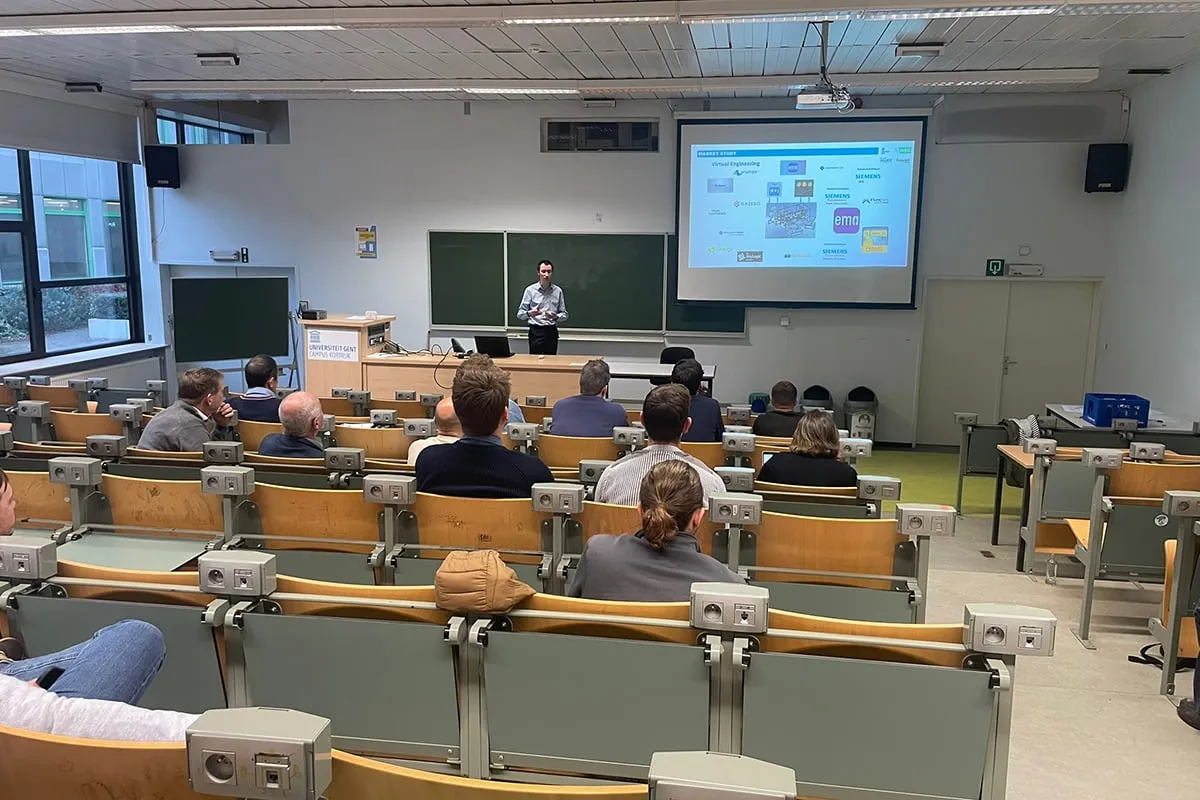
At the kick-off, Johannes Cottyn, professor of industrial automation at UGent and head of the Manufacturing Knowledge and Automation Engineering competence domain at FlandersMake@UGent, ISyE, outlined the ambitions of TETRA VEooX. The project brings together two fields: virtual engineering and virtual user experience. The first involves using 3D models to dimension a production process and commission it virtually. The second allows employees to work through realistic production scenarios in a 3D environment, tailored to their role. Both fields are interesting in their own right, but it is the synergy between them that puts VEooX on the map.
Using virtual engineering platforms in production and logistics offers many opportunities, but also comes with a number of challenges. One is choosing, setting up and maintaining the right tool. Another is the need for human interaction when testing scenarios, which most tools do not currently support. Virtual experience platforms, meanwhile, require an extremely high level of detail to develop realistic logistics and/or production scenarios. VEooX aims to bring both methods together for more effective and cost-efficient results.
Detailed market study
Although the VEooX project has only recently got under way, the team has already carried out a market study of the software tools available for virtual engineering and experience. Matthias Schamp, a postdoctoral researcher at UGent, explained how the team classified sixteen tools against around fifty criteria and then ranked them. This comparative overview is compiled in an online database, accessible to members of the user committee. The database will be expanded with other tools and/or additional information from suppliers.
Simulating the human factor
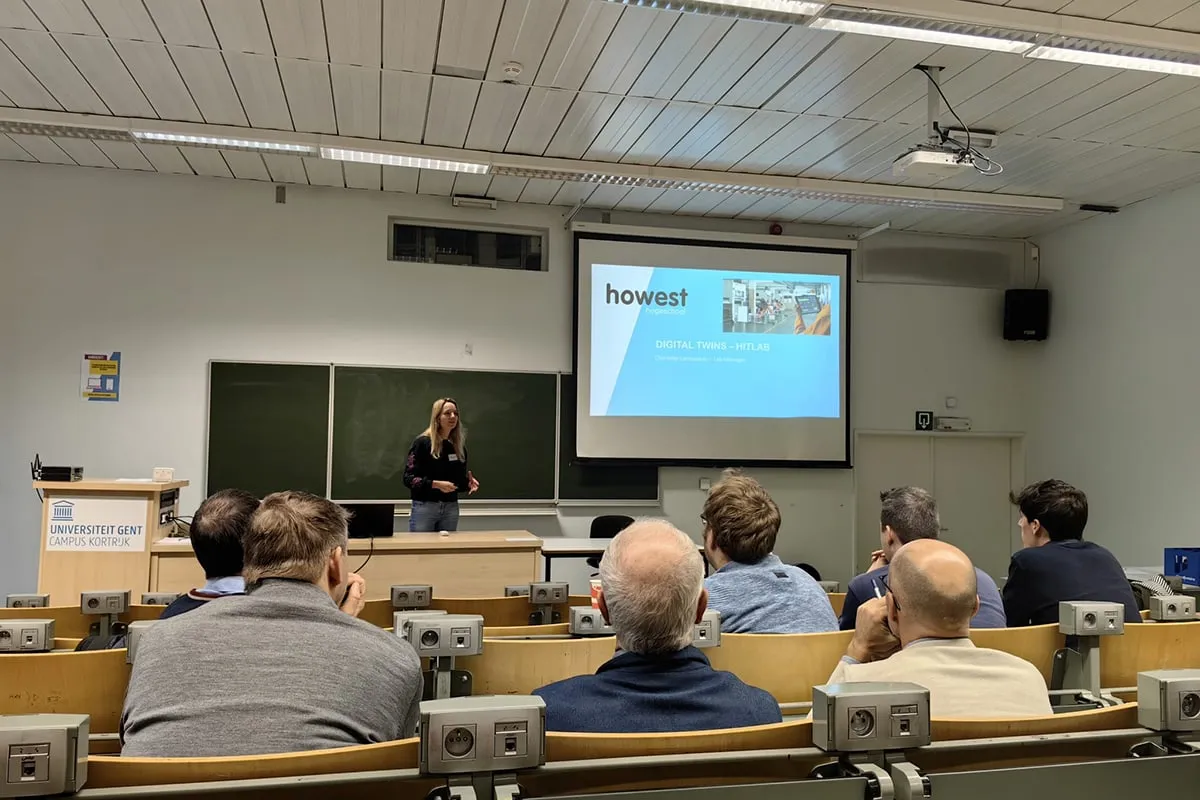
HOWEST researcher Charlotte Larmuseau demonstrated the value of user experience applications for gathering feedback on virtual prototypes, without the high development costs of a physical prototype. They also make it possible to incorporate human actions into test scenarios for engineering projects, including those focused on safety and ergonomics. Engineering tools, in turn, help create scenarios for different types of employees in a cost- and time-efficient way. As well as providing standard workflows and developing a test environment, the VEooX project supports interested companies in guiding and documenting an industrial case. VEooX is aimed at manufacturing companies, machine builders and system integrators. Its focus is on SMEs, as well as technology suppliers and consultancy firms specialising in simulation and emulation tools and AR/VR applications. The project runs from 1 October 2024 to 30 September 2026. More information is available on the ISyE website.
Question about this story? Ask your question
Keep following this
Get an email when a new story is published. No account needed.
- SubjectGeneral







