












Temporary pumping stations deployed as the Meuse hits record low flows
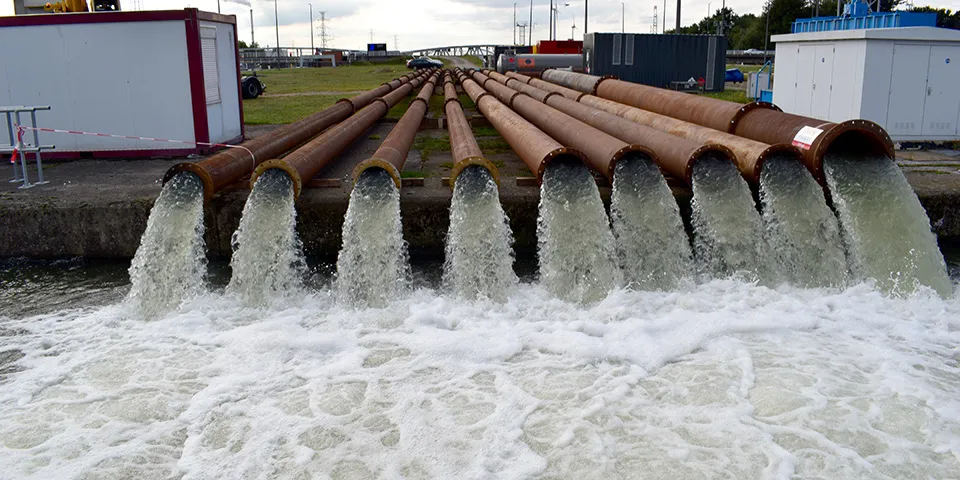
Persistent drought has caused flows on navigable waterways in the Netherlands and Flanders to fall steadily since spring. The rainfall of recent weeks has done little to change the situation: the Meuse is still recording record low flows. This is causing various problems, including for navigation. Rijkswaterstaat and De Vlaamse Waterweg have therefore joined forces to take action.
The Meuse is a typical rain-fed river: depending on how much rain falls, particularly in the Ardennes and north-eastern France, its flow can be very low or very high. The average flow of water through the Meuse is 250 m3/s, equivalent to 250,000 litres per second. After months of persistent drought, the flow at Liège, where water branches off towards the Albert Canal, is barely 35 m3/s. This has a huge impact, and not only on the navigability of the waterways. The water is also used for drinking water production, energy generation, process water for industry, agricultural irrigation and watering nature reserves.
Three large emergency pumping stations
Because of the intensive use of water across the Dutch and Flemish waterway networks, Rijkswaterstaat and De Vlaamse Waterweg have been taking preventive measures in consultation for some time, to distribute available water as effectively as possible and avoid draught restrictions as far as possible. “One of these measures is installing emergency pumping stations to pump back water lost when locks are operated,” says André van der Tuin of Eekels Pompen. “At the beginning of September, we installed large emergency pumping stations at three locations on the Albert Canal in a very short time. They continuously pump large volumes of water from the downstream side back to the upstream side. The installations consist of large submersible pumps, steel pipework and their own power supplies. At two locations, each pumps 5,000 m3/hour; at the other location, no less than 10,000 m3/hour. It was a genuine emergency job for us. We received a call on Friday, and it was treated internally as an emergency so we could get the installations ‘up and running’ in a very short time. The emergency pumps will remain in operation until enough rain has fallen. We have also installed emergency pumps at various locations in the Netherlands, primarily to secure the supply of cooling water to industry.”
Question about this story? Ask your question
Keep following this
Get an email when a new story is published. No account needed.
- SubjectGeneral







