












Successful first TETRA VE∞X (Virtual Engineering and eXperience) Discussion Forum
Text Stephanie Demasure Beeld TETRA VE∞X
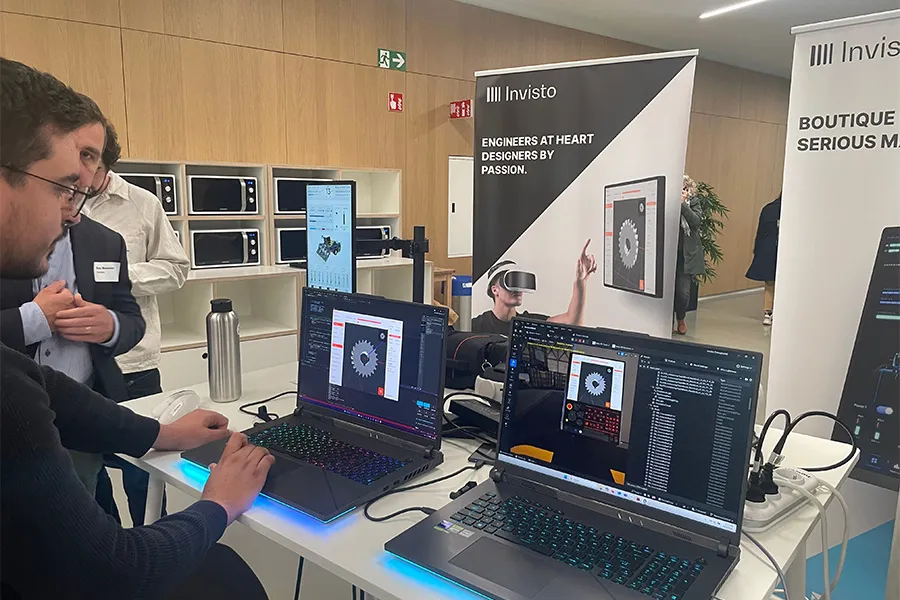
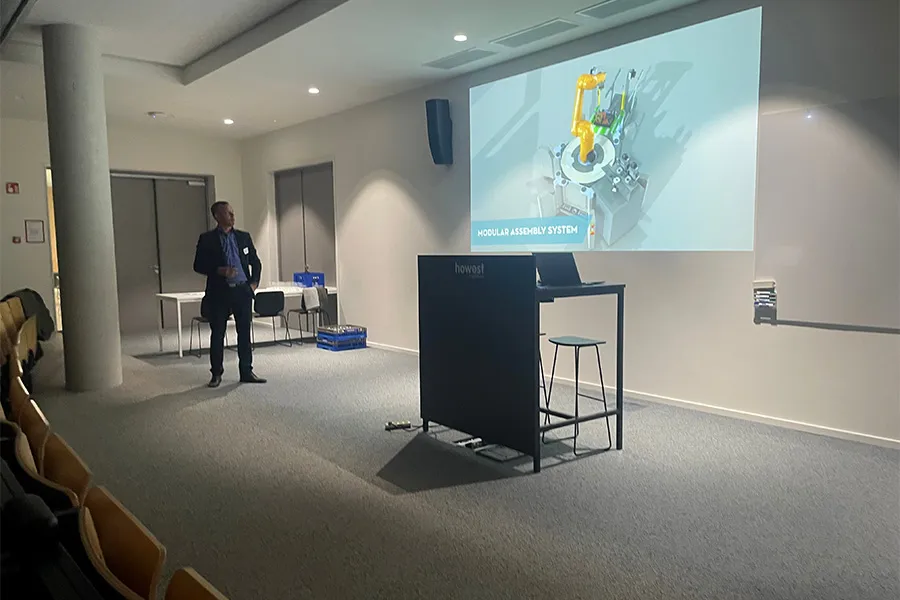
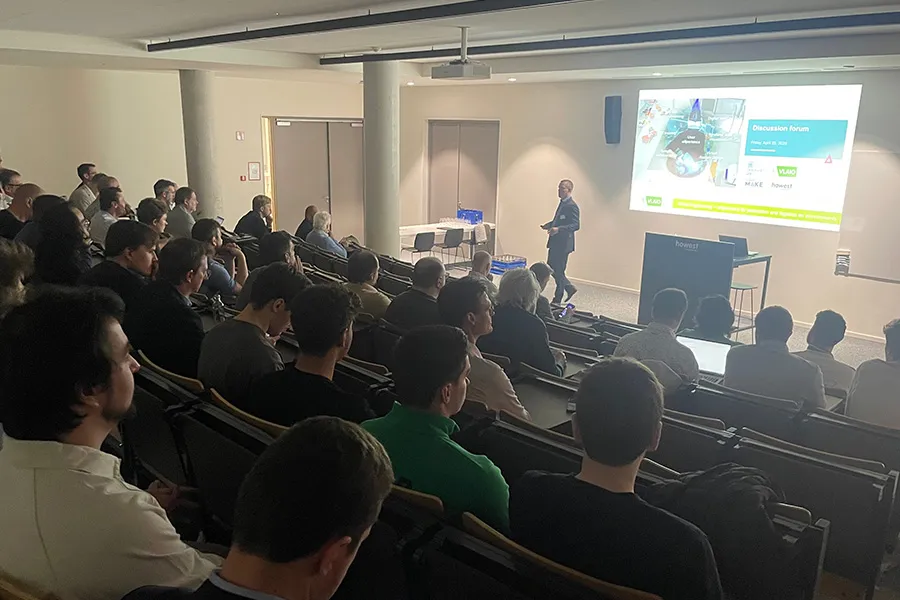
The first TETRA VE∞X (Virtual Engineering and eXperience) Discussion Forum took place in Kortrijk on 25 April. Around 50 manufacturing professionals, technology suppliers and researchers from the manufacturing industry came together to discuss the challenges and opportunities presented by digital twins for optimising production and logistics processes. Expert presentations alternated with practical business cases and interactive demos. Naturally, there was also time for networking.
The first Discussion Forum originated from the TETRA VE∞X project. VE∞X stands for Virtual Engineering and Experience. The premise? There is huge potential for using digital twins in production and logistics environments. This TETRA project therefore has two specific aims. For manufacturing companies, machine builders and system integrators, with a focus on SMEs, it aims to provide an overview of the opportunities for using virtual engineering and experience in production and logistics environments. For technology suppliers and consultancy firms, the focus is on sharing knowledge about a range of simulation and emulation tools and AR/VR applications.
Connecting developers and users
To realise the full potential of digital twins and VR experience, supply and demand need to come together. Participants’ input helps shape the development of digital engineering and digital experience, ensuring they meet industry needs. Gertjan Vermeire, who was responsible for the practical organisation of the event, considers this a success: “Valuable things were shared and discussed, both during the plenary session and at the networking reception,” he says, pleased. “We look back on the Discussion Forum with a very positive feeling.”
Virtual models: nice-to-have or must-have?
In the morning, a project steering group meeting was held with the regular partners in the TETRA VE∞X project. It took a closer look at the project’s initial results and discussed progress and next steps. Those who joined in the afternoon were given a clear research framework by Prof. Dr Johannes Cottyn (FlandersMake@UGent-ISyE). “Do we actually need virtual models, or are they just a nice-to-have?” Johannes immediately piqued the audience’s curiosity with this question. “These tools are ideal, for example, for comparing different concepts and making the right choice for the real industrial environment. Or they allow you to validate the control logic and identify errors virtually, so you can make the changeover quickly in the physical environment,” he explained, outlining a few scenarios.
Several other project researchers took part to explore the opportunities and challenges in more depth, and discuss how to decide which virtual tools to choose. Dr Charlotte Larmuseau (Howest-HITlab) and Willem Bataillie (FlandersMake@UGent-ISyE) gave a presentation and demo on virtual engineering and virtual experience. They discussed how benefits such as time savings, flexible design and risk-free testing compare with drawbacks such as high initial costs, the considerable computing power required and the complexity of integrating human actions into a virtual model. Dr Matthias Schamp (FlandersMake@UGent-ISyE) then presented an online comparison tool for a range of software and hardware. Developed as part of the TETRA project, it is freely available to everyone at https://vextool.isye.be/.
The engaging afternoon session was rounded off with a networking reception featuring food, drinks and plenty of good conversation. A fitting end to a successful and well-received first TETRA VE∞X Discussion Forum.
Real-world stories
Theory becomes even more relevant when linked to real-world experience. A range of industry experts shared their stories.
Here is a brief overview:
> Thierry Jourquin, CEO of XRintelligence, gave an insight into the adoption of XR by industrial companies, with case studies from Wallonia.
> Jan Peelaerts from ViManPro explained how to set up a digital twin.
> Bob Messiaen from Invisto spoke about their digital shadow and TwinStage framework for simulation and training, and for monitoring and operating machines in real time.
> Stijn Staelens and Kenny Depraeter from Dewilde Engineering presented their robotics, automation, camera technology and digital twin solutions for order picking and conveyor systems.
> Jochen Van Lysebettens from Vintecc explained how they use digital twins and simulations to handle the enormous volume of car transport at Europe’s largest car terminal operator.
> Andreas Meersseman and Robin Vandenberghe from Actemium showed how simulations and digital twins help create new factory designs or optimise existing ones.
Question about this story? Ask your question
Keep following this
Get an email when a new story is published. No account needed.
- SubjectGeneral







