












Strong container throughput drives growth at Port of Antwerp-Bruges despite challenging market conditions
Positive container throughput trend continues, while geopolitical situation weighs on growth in other cargo categories.
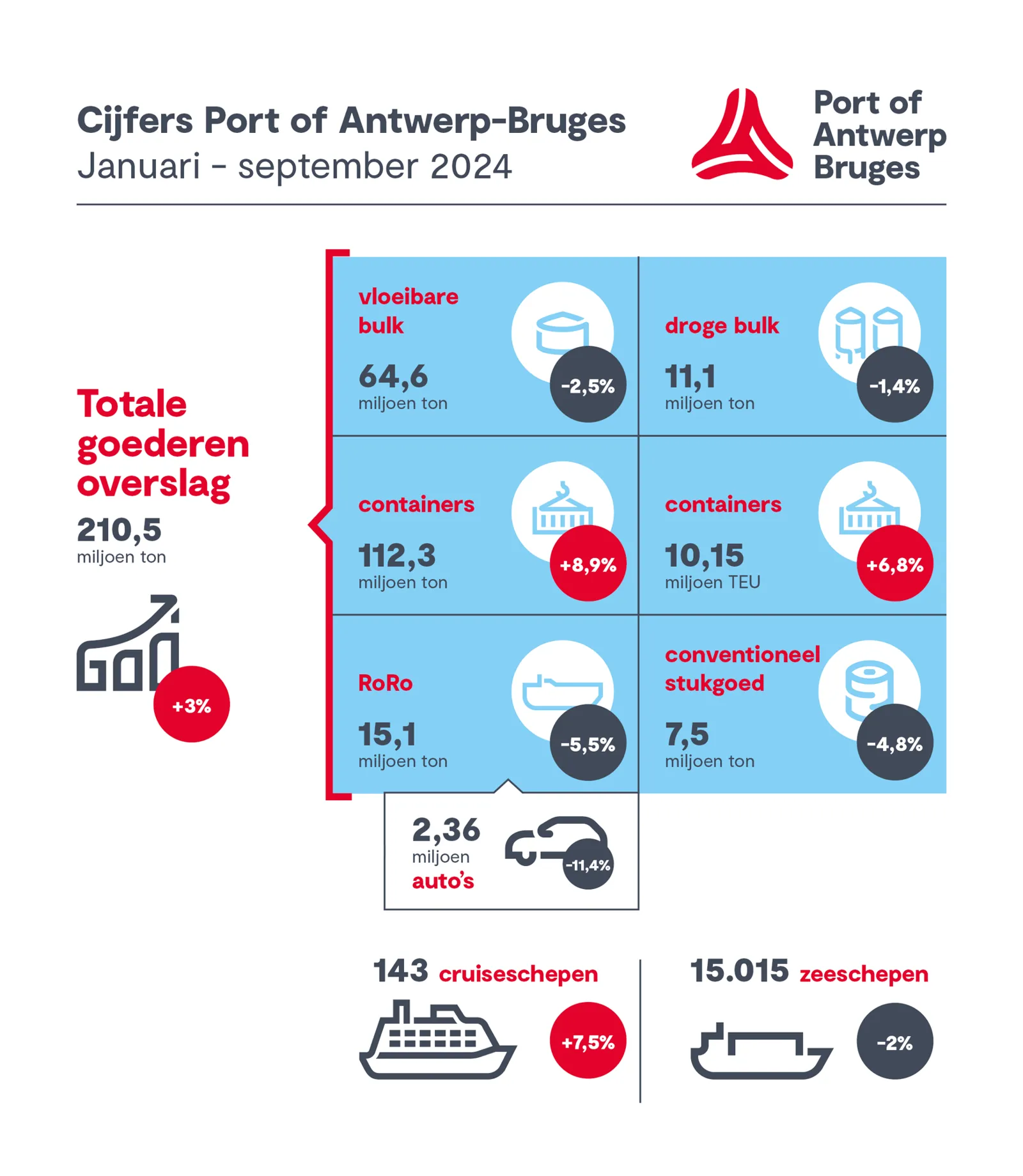
After nine months, Port of Antwerp-Bruges recorded total cargo throughput of 210.5 million tonnes, up 3% on the same period last year and stable compared with the second quarter. Demand for container transport continues to rise, while ongoing geopolitical and economic instability is affecting other cargo flows. Despite the challenges, the port continues to invest in sustainable and innovative projects focused on the energy transition and industrial growth.
Container throughput by weight rose by 8.9%, with inbound volumes up 10.2% and outbound volumes up 7.9%. Growth in the first half of the year continued into the third quarter, with 12.3% more containers handled in TEU than in the same quarter last year. Over the first 9 months, total container throughput rose by 6.8% to 10,152,000 TEU.
In the first half of this year, Port of Antwerp-Bruges increased its share of container handling in the Hamburg to Le Havre Range by 0.8 percentage points compared with 2023, to 30.7%.
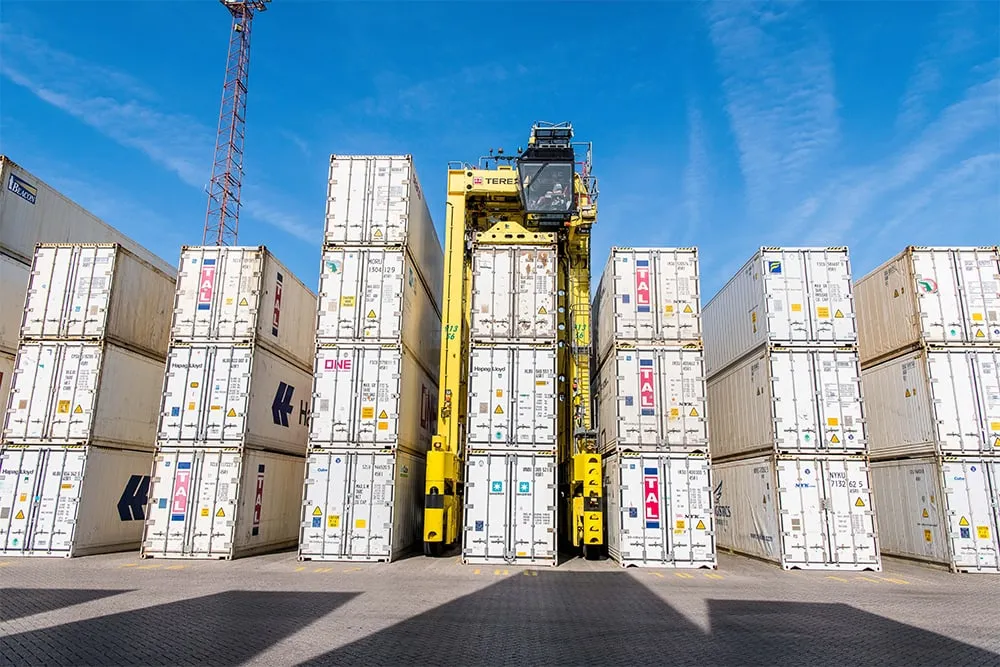
Almost 1 in 10 containers handled is a refrigerated container. In the first 9 months of 2024, the number of full refrigerated containers (reefers) rose by 9.7%, accounting for 8.5% of total container traffic. These temperature-controlled containers carry products such as fresh fruit, vegetables, meat, fish, pharmaceuticals and chemicals. Thanks to its strategic location, fast maritime connections and specialised terminals, Port of Antwerp-Bruges continues to hold a strong position in the reefer segment.
Although conventional breakbulk performed strongly in the second quarter, throughput fell in the third quarter, leaving total throughput for the first 9 months of 2024 4.8% lower than last year. Iron and steel fell slightly by 0.6%, with outbound volumes (+4%) partly offsetting the decline in inbound volumes (-3.5%). This decline is due to lower demand from steel-consuming sectors such as construction and the automotive industry. Products such as timber (-32.9%), paper and cellulose (-22.6%) and construction materials (-36.9%) also declined, while non-containerised throughput of fruit, vegetables and other refrigerated cargo rose by 4.1%.
Roll-on/roll-off traffic fell by 5.5%. Pressure on car terminals eased, but this was due to lower inbound volumes rather than faster dispatch to customers. Throughput of transport equipment fell by 13.3%. Throughput of high & heavy cargo (-23.5%) and lorries (-10.3%) declined, as did throughput of used cars (-42.6%). After a strong increase in 2022 and 2023, new car traffic fell by 11.4% in the first 9 months of this year.
Throughput of unaccompanied freight, excluding containers, on RoRo vessels in Zeebrugge rose by 2.8%. The decline in traffic to and from the United Kingdom (-4.1%) was more than offset by increased throughput to and from Spain and Portugal (+35.7%), Scandinavia (+16.7%) and Ireland (+2.2%).
Dry bulk throughput fell by 1.4%, mainly due to a sharp decline in coal throughput (-55.3%). Dry bulk excluding energy products such as coal and wood pellets grew by 9.5%. Fertilisers, the largest product category in this segment, continued to grow (+30.6%) after a sharp decline in 2022 due to sanctions and high gas prices. Other construction materials and non-ferrous ores also grew by 7.3% and 4.8% respectively, while sand & gravel (+0.1%) and scrap (-0.7%) remained broadly stable.
Liquid bulk throughput fell by 2.5% over the 9 months, as a result of lower volumes of liquid fuels (-8.9%) and LNG (-10.2%). Diesel throughput in particular fell (-23.1%) due to weak demand, while LPG (+8.8%), fuel oil (+8.4%), naphtha (+2.9%) and petrol (+2.3%) showed growth. Chemical throughput rose by 9.3%, partly thanks to a strong increase in biofuel throughput (+52.5%). Even without this effect, there was growth (+7%). Chemical gases (+9.5%) and basic chemicals (+8.6%) also recorded positive figures. Despite this recovery, the European chemical sector remains under pressure from high energy, raw material and labour costs, combined with low global demand.
In the first nine months of 2024, Zeebrugge received 412,774 cruise passengers (+17.5%) on 143 cruise ships. This was 10 more cruise ships than last year.
In the first nine months of 2024, 15,015 seagoing vessels called at the port, a decrease of 2%. Their gross tonnage fell by 4.8% to 472.45 million GT.
Focus on both the energy transition and industrial growth
Despite ongoing geopolitical and economic challenges, growth at Port of Antwerp-Bruges is stabilising. The figures once again underline the resilience of the port, which continues to pioneer and invest in a future-ready port where sustainability and economic growth go hand in hand, even in complex times. The expansion of Zuidnatie, which began construction of a new warehouse for handling steel coils this summer, and the acquisition of Luik Natie by Lineage confirm the port’s importance in specialised segments. Recently announced investments, such as fossil-free plastics production by Vioneo and Plastics-to-chemicals by Indaver, which converts polystyrene (PS) and polyolefins (PO) into recycled naphtha, further strengthen the port’s position in the energy transition and sustainable innovation.
Port of Antwerp-Bruges continues to focus on strengthening infrastructure and offering sustainable logistics solutions that support the industry’s efforts in CO₂ reduction and digitalisation. Following the installation of one of Europe’s largest public charging facilities for electric lorries in Antwerpen, the first pile was driven in Zeebrugge for a lorry park with charging infrastructure. In addition, the CHERISH2O project, which focuses on treating and reusing industrial wastewater, contributes to the port’s development as a circular hub.
Jacques Vandermeiren, CEO of Port of Antwerp-Bruges: “Despite the complex times in which we operate, with geopolitical tensions, rising energy prices and global competition, our growth is stabilising, partly thanks to our strong position in container throughput. Diversions around the Cape of Good Hope, cyberattacks and other challenges require us to remain flexible and resilient. Together with our partners, we continue to build a future-ready port where innovation supports both sustainability and economic growth. Investments such as those by Vioneo and Indaver reflect confidence in our port and in the future of European industry.”
Johan Klaps, City of Antwerpen alderman for the port: “Our port is the economic engine of Flanders. Being able to announce strong quarterly figures on my very first working day as alderman for the port is a moment of professional happiness. These strong quarterly figures, despite the continued and particularly challenging times, underline the resilience of our port. We therefore continue to pioneer and invest in a future-ready port. My thanks go to the entire port community for continuing to show that resilience, and to Annick De Ridder, Minister for Mobility, Public Works and Ports, for her hard work as alderman for the port and chair of Port of Antwerp-Bruges over the past few years. Together with the port community, I am now committed to further delivering the strategic ambitions of Port of Antwerp-Bruges, with a strong focus on sustainability, innovation and strengthening our international position.”
Dirk De fauw, mayor of the city of Brugge and vice-chair of Port of Antwerp-Bruges: “The stabilisation of the growth figures shows that our resilience enables us to turn challenges into opportunities. With our strategic location, excellent services and two complementary port platforms, we are both consolidating and strengthening our market position, as in the reefer segment. The sustained growth of this segment attracts investors, as demonstrated by the acquisition of Luik Natie by Lineage, the world’s largest cold storage operator.”
Question about this story? Ask your question
Keep following this
Get an email when a new story is published. No account needed.
- SubjectGeneral







