












Questions over service life and circularity in civil engineering
reducing consumption. The use of timber in civil engineering can play an important role in this. ‘Service life’ and ‘circularity’ are often…
To meet our climate and circularity goals, we need to take decisive action. Substantial
changes, investment and fundamental choices are needed to work in a genuinely sustainable, circular and
bio-based way, thereby limiting CO2 emissions and reducing raw material
consumption. The use of timber in civil engineering can play an important role in this. ‘Service life’ and ‘circularity’ are often used as arguments against choosing timber, but research shows that the reality can be rather different from what people expect.
Timber sheet piles and revetments last longer
Timber sheet piles have been used in the Netherlands since Roman times. The use of tropical hardwood for walkways took off in the 1960s. There is therefore extensive experience with this material. In practice, timber sheet piles are often assumed to have a service life of 25 years, even though many much older projects are known. To gain a better understanding of the service life of timber sheet piles in practice, a recent study was commissioned by Centrum Hout/VVNH1). Using its asset management system, the engineering firm analysed the underlying records for 2,390 projects, with a combined length of more than 445 kilometres, and determined their average service life. The conclusion is that sheet piles and revetments made from timber species with natural durability class 1 (NEN-EN 335) have an average service life of 36.6 years. This is well above the design life of 30 years required by many clients. There is certainly variation, and some projects perform less well, but projects up to 60 years old were also found. This also shows that the widely quoted average service life of 25 years should be revised upwards.
The study also examined the factors that affect service life. Good detailing and the use of a capping beam were found to significantly extend service life, to an average of 43 years. Geographic location, soil type and water quality do not appear to have a significant effect. The impact of verge management requires further investigation, as this data is not included in the asset management system.
Save the forest
Another reason timber is not used is that buyers, policymakers and consultants often do not know where it comes from or whether its use contributes to deforestation. This concern is understandable, but unfounded. Sustainable timber procurement rules have even been drawn up for (semi-)government projects. When these are applied, forests, particularly in the tropics, benefit from the use of timber sourced from them. Timber certified by FSC, PEFC, Keurhout or STIP comes from sustainably managed forests and is monitored from ‘forest to shelf’. These certifications meet the Dutch government’s sustainable procurement criteria (TPAC). In the Netherlands, more than 86% of all imported timber carries these certifications and therefore comes from sustainably managed forests. Forests not managed sustainably are at high risk of destruction because they generate little or no income. Agricultural commodities such as soya, palm oil and cocoa generate much more hard currency, much faster. If we want tropical forests to survive and biodiversity to be maintained, using sustainably produced timber from these forests is the sensible choice. It generates the income needed to carry out management, combat poaching and support local communities: ‘Save the forest, buy sustainably produced timber’.
Get started with CirculairPlus
Circularity is an important way to achieve environmental benefits, prevent shortages and waste, and contribute to climate targets. The government-wide programme ‘The Netherlands Circular by 2050’’ sets out the goals for achieving a circular economy. Rijkswaterstaat, the Ministry of I&W and CB23 are working hard with civil society organisations to make the circularity of projects and buildings measurable. The focus is primarily on fossil and mineral raw materials, as these have the greatest environmental impact and are most likely to become scarce. The emphasis is on reuse, recycling, value retention and design for disassembly. Bio-based materials from sustainably managed sources are renewable and, provided this condition is met, will not become scarce. They are also already part of a closed (bio)cycle because they are biodegradable, and are therefore already circular. Timber applications in civil engineering also fit into the technical cycle of ‘hard’ materials, as they can often be reused and recycled, and are ultimately suitable for energy recovery (bio-refining, thermal recycling). They can also often be fully disassembled. Sheet piles, for example, are already widely reused by cutting them down and/or reinstalling them the other way round, or by sawing them up and using them again at the waterline in combination with a softwood lower section. Bridges are dismantled and their components used to build new bridges, as in Westervoort, Almere and Nijmegen. Mooring piles are in high demand for use in the B&U sector, for example as columns or cladding. Timber can therefore be part of both the biological and technical cycles, making it CirculairPlus.
Timber sheet piles last more than 30 years on average. Photo: Centrum Hout/EdM.
Timber bridges can be modular too
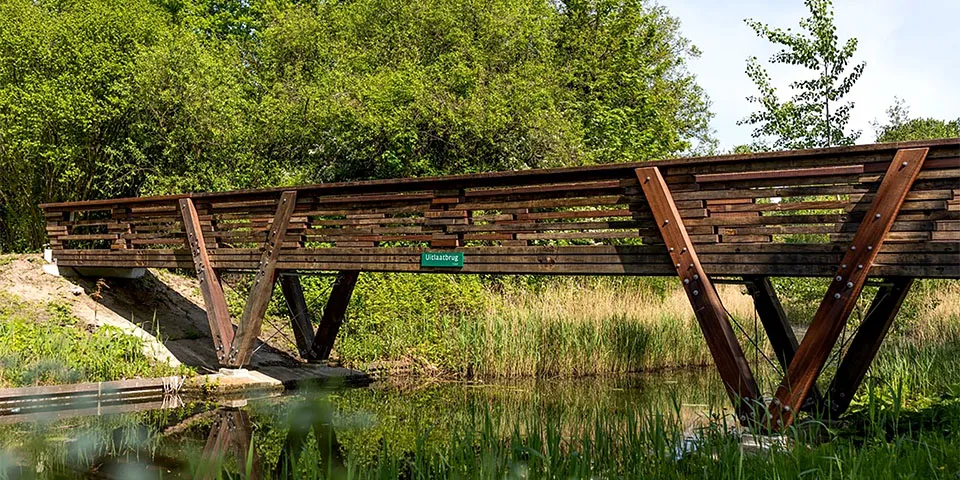
Extending the service life is another way to contribute to circularity. Making civil engineering structures modular can help, as they are then easier to maintain and replace, and less tied to a specific location. This also applies to timber bridges: research into modular timber bridges shows that they offer many possibilities. Two students from Hogeschool Windesheim analysed the dimensions of Dutch timber bridges as part of their graduation project at engineering firm Westenberg. They also spoke to various local authorities and other stakeholders, including contractors and Centrum Hout. After identifying the critical factors, they designed a standard timber bridge. They developed a construction kit with solutions including spacers and a click system for the deck elements. The students expect that good detailing and durability treatment will extend the average service life of a standard modular timber bridge from 40 to 60 years. Further research is needed to test whether the modular concept works well in practice.
Environmental performance is about more than circularity
A structure may have many circular properties, but if its overall environmental impact is high, it will not contribute to climate, raw material and waste management goals, or to circularity targets. That is why it is important to consider environmental impacts (MKI) as well as circularity criteria. Life cycle assessment (LCA) (1) helps determine circularity (Modules C and D in MPG and DuboCalc), while also providing a better picture of total environmental impact. For this reason, the timber sector has commissioned LCAs (2) of sheet piles, revetments, decking, safety barriers and road portals. These can be found at www.houtindegww.nl.
1) The study into the service life of sheet piles was funded by the Ministry of Agriculture, Nature and Food Quality under the policy-supporting research theme ‘Climate Envelope: Climate-Smart Forests, Nature and Timber’.
2) The LCA study of revetments, decking, safety barriers and road portals was carried out in collaboration with Rijkswaterstaat.
Question about this story? Ask your question
Keep following this
Get an email when a new story is published. No account needed.
- SubjectGeneral







