












Pumps are the beating heart of the Dutch water market
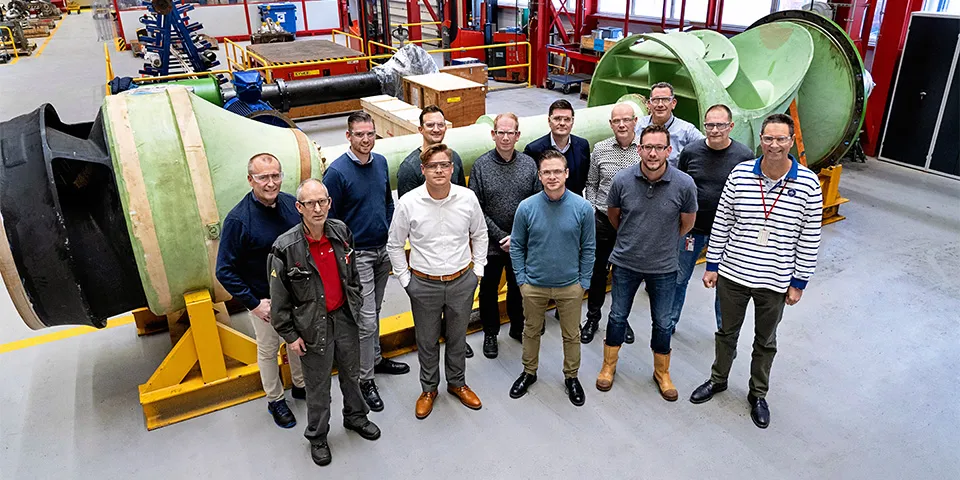
We need look no further than two important current issues to understand the importance of pumps: changing water management as a result of climate change, and growing demand for clean drinking water. In the Netherlands, we have always lived with water and fought against it. Inextricably linked to this is Flowserve’s unique heritage: its expertise in pump technology. In a conversation with Bart van der Slik, Sales Manager Netherlands, and Jan van Diesen, Project Management Manager, we find out how the company came to lead the field in pump technology.

Flowserve fish-friendly concrete volute pump CVPS-F85.
Owner of intellectual property and heritage
“Flowserve is generally associated with pumping oil and gas. The Dutch arm of the originally American company also has a clear specialism in the water market,” says Van der Slik, opening the conversation. Van Diesen adds: “Stork was split into several parts at the time, and Flowserve acquired Stork’s pump division in Hengelo. This made Flowserve the owner of the intellectual property and heritage of Stork Engineered pump technology. We then continued under our own banner, drawing on this knowledge and expertise. Flowserve should therefore not be confused with the Stork brand, which still exists.”
A strong presence in the water market
Flowserve has several ‘strike zones’, or markets, in which it operates with a strategic focus. Water is one of them. “Specialising in water transfer and drinking water is strategically a distinctly Dutch activity for Flowserve,” says Van der Slik. “That does not prevent us from deploying our local expertise on a global scale. We even have a Global Business Developer for that purpose.” Flowserve Netherlands’ global reach is illustrated by an example from Van Diesen: “The hurricane-battered southern United States and the resulting risk of flooding prompted the American city of Dallas to buy large-capacity pumps from us. A notable detail is that Flowserve’s head office is in Dallas: a fine example of the reach of Flowserve as a multinational.”
Installation of prefabricated concrete volutes.
What does the strategic vision mean at local level?
We learn that Flowserve has a stringent legal profile. Van Diesen explains: “However, the UAV contract conditions in the Netherlands did not align with this legal profile. Flowserve therefore held extensive discussions with customers, carried out risk assessments and benchmarking, and on that basis decided to translate its global risk profile into a local one, taking account of the specific needs of this market.” Van der Slik adds: “Our customers sometimes felt that we had adopted a strict stance in recent years, but the new risk screening means we can once again compete in the market. We have also adjusted our organisational structure to put our words into action. We now have a dedicated Water Unit, including two sales engineers, Jan Vervoort and Ronald Lammerink, who focus 100% on water. With this organisational structure, and teams specifically focused on the market for both customer contact and operational delivery, we can once again serve the water market to the full.”
Different entities under one roof
Flowserve’s strategy is cleverly translated to the local level. The Flowserve Campus is based in Etten-Leur: “It brings together several entities under one roof: the Seal Manufacturing Hub, the Seal Quick Response Center, the Pump Parts Manufacturing Center and the Pump Quick Response Center (QRC). It is an aftermarket operation. The Pump QRC specialises in upgrading and repairing existing pumps. Consider that the Netherlands is full of pumps once supplied by Stork, and you can understand the importance of this unit,” says Van Diesen.
The Flowserve Campus is also home to the International Field Service group, which specialises in installation and maintenance. “The Central Engineering group also works from our Campus, serving the various entities. It leads product engineering and development for Flowserve worldwide. Even installations abroad are carried out by our own teams,” says Van Diesen. “Add to that the fact that we have our own test centre, where we can test up to 18 megawatts, and are connected directly to the electricity grid at 150 kV. We also test for third parties. Finally, Flowserve has another Pump Quick Response Center in Hulst, providing fast and effective repairs. Hulst is set up, among other things, to serve the drinking water market.”

Cross-section of the Den Oever sluice and pumping complex, source: Levvel, Project Afsluitdijk.
Fish safety guaranteed
Van der Slik: “Flowserve is known for its fish-friendly pump solutions. These have been extensively tested. We have conducted a great deal of research into this, and our experts even helped develop a NEN standard for the water market.” But Flowserve’s commitment to sustainability does not stop there. “A good example of one of our applications that sets us apart in the market is our special bearings, which require no grease lubrication. That means zero emissions, as fewer harmful substances are released into the water,” says Van Diesen in conclusion.
Flowserve B.V.
Parallelweg 6, 4878 AH Etten-Leur
T +31 76 502 8100
+31 76 502 8200
www.flowserve.com
Question about this story? Ask your question
Keep following this
Get an email when a new story is published. No account needed.
- SubjectGeneral







