












Port of Antwerp-Bruges quarterly results reflect resilience
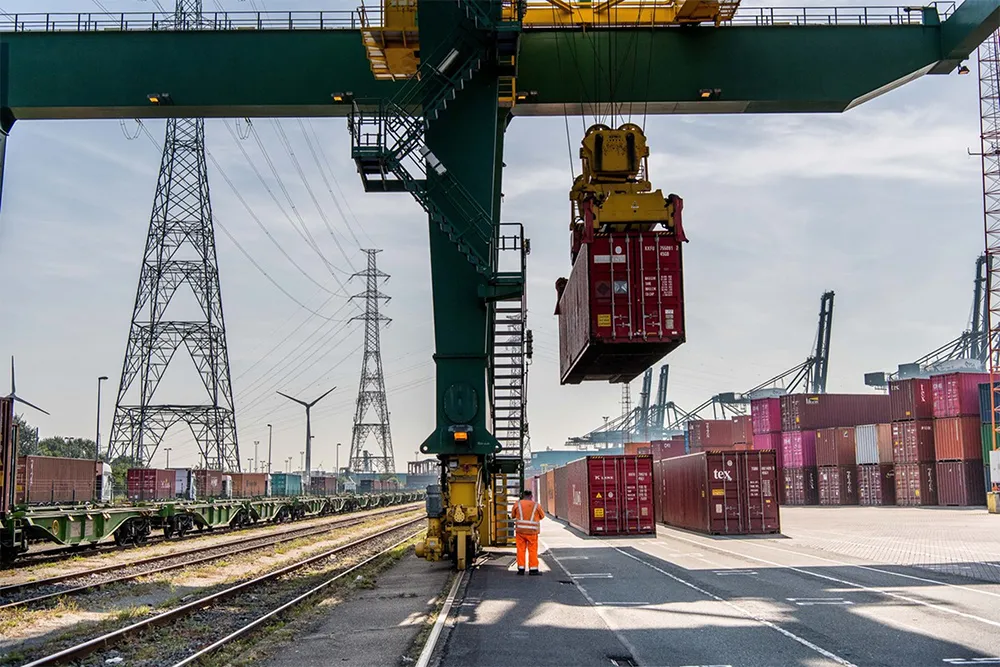
Container throughput picks up again
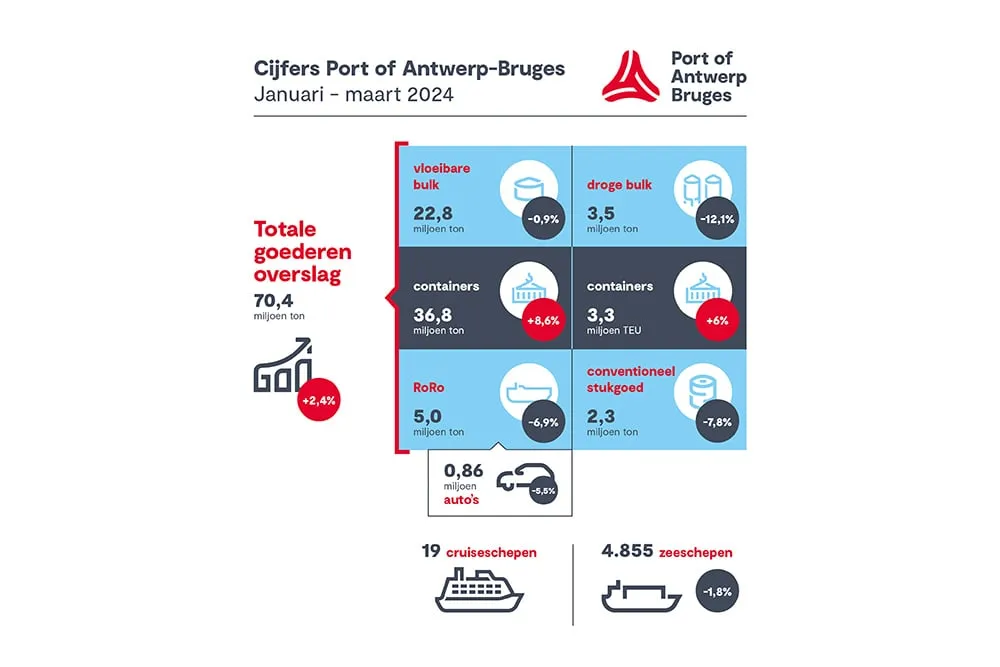
Total cargo throughput at Port of Antwerp-Bruges reached 70.4 million tonnes in the first quarter of this year, up 2.4% on the same period last year. Against a still complex geopolitical and macroeconomic backdrop, this growth, driven by a renewed rise in container throughput, confirms the port's resilience.
After economic uncertainty and inflation slowed global demand for container transport in 2023, container throughput began to pick up again from February, with March recording the best monthly throughput since March 2021. This resulted in an increase in total container throughput of 8.6% in tonnes and 6% in TEU (3,287,000 TEU), compared with the first quarter of 2023. In 2023, Port of Antwerp-Bruges increased its share of container handling in the Hamburg–Le Havre Range by 0.3 percentage points to 29.9%.
Throughput volumes of conventional breakbulk are also trending upwards again. Although throughput fell by 7.8% compared with the same period last year, it rose by 6.9% compared with the final quarter of 2023.
Iron and steel throughput remained unchanged overall, with inbound volumes growing (+1.4%) while outbound volumes fell (-3.8%). Most other goods saw a decline compared with the first quarter of 2023.
Roll-on/roll-off traffic fell by 6.9% in the first quarter of 2024. Continued congestion at the RoRo terminals resulted in a decline in throughput of all transport equipment (-8.7%). This was mainly due to lower throughput of second-hand cars (-52.5%), as well as high & heavy cargo (-25%), trucks (-23.9%) and new cars (-5.5%). Throughput of unaccompanied freight, excluding containers, carried on RoRo vessels rose by 1.7%. The decline in throughput to and from the United Kingdom (-4.4%) was offset by an increase in throughput to and from Spain and Portugal (+31.5%), Ireland (+6.4%) and Scandinavia (+13.5%).
While outbound dry bulk volumes increased by 9.7%, inbound volumes fell by 24.4%, resulting in a 12.1% decline in the dry bulk segment. With the energy crisis less acute, demand for coal has fallen sharply again (-68.6%). Fertiliser throughput, the largest product category within dry bulk, has picked up again since the final quarter of 2023 (+33.9%), particularly for inbound volumes. Throughput of non-ferrous ores (+47.3%) and scrap (+5.7%) also grew. Lower demand from the construction sector weighed on sand and gravel throughput (-12.5%), while more grain is once again being transported in containers (-43.7%).
Liquid bulk throughput held up relatively well, falling slightly by 0.9%, with outbound volumes up 4.2% but inbound volumes down 4.1%. Throughput grew for fuel oil (+25.2%), petrol (+12.1%) and LNG (+10%). Although the competitiveness of the European chemical industry remains under pressure due to high energy, raw material and labour costs, a recovery in demand increased throughput of chemicals and naphtha by 5.2% and 12% respectively. Diesel throughput fell (-40%), as did LPG (-11.5%) and liquid fuels (-11.4%).
In the first quarter of 2024, 4,855 seagoing vessels called at the port, a decline of 1.8%. The gross tonnage of these vessels fell by 2.4%.
In the first 3 months of 2024, Zeebrugge welcomed 99,211 cruise passengers on 19 cruise ships, 10.7% fewer than in the record first quarter of 2023.
Resilient and future-proof
The growth shown in the quarterly figures despite the weak economic climate confirms the resilience of Port of Antwerp-Bruges, which continues to pioneer and invest to future-proof the port, even in challenging times.
For sustainable growth, the port must be able to accommodate the very largest container ships. The 16-metre draught required for this was recently achieved by the first container ship. In March, a new record was also set for the largest container volume handled on a single vessel, with 26,201 TEU on MSC China.
The first methanol bunkering of a deep-sea vessel was another milestone in the ambition of Port of Antwerp-Bruges to become a multi-fuel port and accelerate the energy transition in the maritime sector. Shore power also plays an essential role, and with the shore power facility for cruise ships in Zeebrugge available from 2026, the port is moving ahead of European regulations.
The first demonstration projects confirmed for NextGen Demo, the innovation hub that is part of NextGen District, will make an important contribution to the energy transition and circularity in the port. So too will Warmtenet Antwerpen Noord, the first ‘open access’ heat network in Belgium to supply carbon-free heat.
Jacques Vandermeiren, CEO Port of Antwerp-Bruges: “The past quarter once again made it clear that, as a global port, we are at the centre of continuing challenges. For safety reasons, the problems in the Red Sea forced container shipping lines to divert east-west services via the Cape of Good Hope, disrupting supply chains and causing peaks and troughs in container ship arrivals. This required all parties involved to adapt, but the diversions quickly became the ‘new normal’. The fact that we can nevertheless achieve growth again demonstrates our resilience in unpredictable times.”
Annick De Ridder, chair of the board of directors of Port of Antwerp-Bruges: “The increase in the quarterly figures, with March recording the best container throughput in three years, proves that our port is a resilient global port. One that continues to innovate and invest despite challenging times. Port of Antwerp-Bruges is an ambitious pioneering port. As an economic engine of Flanders, we are fully committed to sustainable growth together with our businesses. Last quarter, this was reflected in, among other things, the first methanol bunkering of a deep-sea vessel, a new record for the largest container volume handled on a single vessel, and the announcement of new initiatives at our innovation hub NextGenDemo.”
Dirk De fauw, mayor of the city of Brugge and vice-chair of Port of Antwerp-Bruges: “These figures and the container segment's continuing growth in market share relative to the other ports in the Hamburg-Le Havre range are the best proof of the added value of the merger and the two complementary port platforms. As a merged port, we continue to take essential steps in the energy transition together with industry, on the way to a climate-neutral port in 2050. The shore power facility due to be operational at our cruise terminal in Zeebrugge by 2026 is a good example of this.”
Question about this story? Ask your question
Keep following this
Get an email when a new story is published. No account needed.
- SubjectGeneral







