












Port of Antwerp-Bruges annual figures show growth despite challenging times
Resilience, sustainability and collaboration drive growth
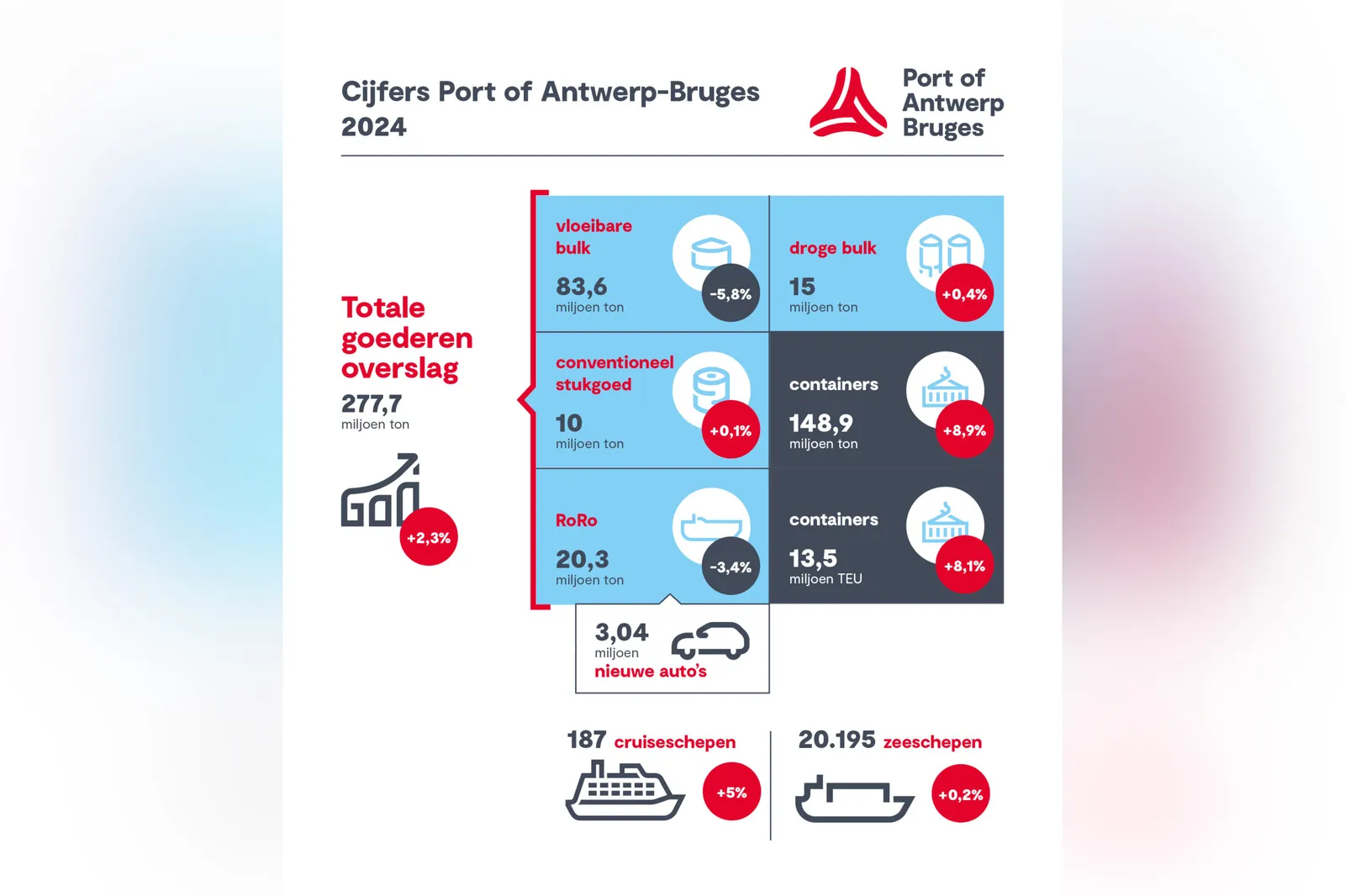
Port of Antwerp-Bruges closed 2024 with a 2.3% increase in total cargo throughput, reaching 278 million tonnes. Despite geopolitical tensions and economic uncertainty, the port has shown resilience, with strong growth in container throughput as the main driver. Ambitious plans are in place for 2025 to further strengthen the port’s pivotal role in international trade, operations and the energy transition.
Strong container throughput drives growth amid turbulent times
Despite a turbulent economic climate, with rising energy prices, geopolitical tensions and increased international competition, Port of Antwerp-Bruges achieved total cargo throughput of 278 million tonnes in 2024, up 2.3% on 2023.
Containers were the main driver of this growth, with tonnage up by 8.9% and throughput up by 8.1% in TEU terms. Reefer container throughput rose by 9.2%, accounting for 8.6% of total container traffic. The port’s market share in the Hamburg-Le Havre Range rose by 0.7 percentage points to 30.6% in the first nine months of the year. The loss of almost half a million TEU of traffic to and from Russia in 2021 has now been fully offset by growth in other trade lanes.
Other segments felt the impact of challenging market conditions. Geopolitical tensions and conflicts around the world are causing markets to change rapidly. Instability in the Red Sea and geopolitical tensions led to longer sailing times and uncertainty in international shipping. The chemicals sector is experiencing its worst years since 2009, while sectors such as construction and the automotive industry came under pressure from high energy and raw material prices and weak demand.
Conventional general cargo remained stable (0.1%), the result of peaks and troughs across the different subsectors. Iron and steel throughput rose by 3.7%. RoRo throughput, meanwhile, fell by 3.4% in 2024, driven by a decline in new car throughput (-9.4%). Dry bulk grew slightly (0.4%). Coal fell sharply (-35.4%), but fertilisers offset this with growth of 22.9%. Liquid bulk fell by 5.8%, mainly due to lower demand for diesel (-22.3%) and LNG (-21.9%). Chemicals, by contrast, grew strongly (+14.8%), partly thanks to an increase in biofuels (+60.1%), despite continued pressure on the European chemicals sector.
In 2024, 20,195 seagoing vessels called at Port of Antwerp-Bruges, a slight increase of 0.2%. Zeebrugge welcomed 187 cruise ships and 557,000 passengers in 2024.
A port in transition
In 2024, further significant steps were taken towards the ambition of becoming a climate-neutral port by 2050, a priority that will remain central in 2025. The focus on the circular economy is taking shape in NextGen District and the innovation hub NextGen Demo. The CHERISH2O project, which aims to purify and reuse industrial wastewater, and Warmtenet Antwerpen Noord, Belgium’s first open-access heat network, are also contributing to the port’s circular ambitions.
In the maritime sector, the first methanol bunkering of a seagoing vessel marked an important milestone in developing Port of Antwerp-Bruges as a multi-fuel port. Shore power projects in Antwerp and Zeebrugge play an essential role in reducing emissions and noise pollution. The installation of one of Europe’s largest public charging hubs for electric trucks makes the port area a crucial link in sustainable freight transport. The port authority also continued to make its own fleet more sustainable with innovations such as the Volta 1, Europe’s first fully electric tug, and the Methatug, the world’s first methanol-powered tug.
Infrastructure: the basis for sustainable growth and competitiveness
With the official introduction of a 16-metre draught in 2024, the port significantly strengthened its competitive position. The record draught of 16.3 metres in Zeebrugge underlines this progress. At the same time, the ICO RoRo terminal in Zeebrugge is being further developed to meet the platform’s growing demand for capacity. Construction of the new Antwerp Coordination Center will also provide a strategic hub to optimise the nautical chain and further improve the port’s efficiency.
These infrastructure developments are crucial not only to the port’s operational performance and sustainable growth, but also to its appeal to innovative investors such as Vioneo.
Alongside infrastructure, safety remains a priority. Certified Pick Up was successfully rolled out in January 2024, and more than 1 million containers have now been securely released through the system.
Collaboration as the foundation for success
Port of Antwerp-Bruges has a clear ambition: to continue playing a pivotal role in the energy transition and international trade. To strengthen this role, the port combines its position as a catalyst for investment with strategic investments of its own. Collaboration is essential. Through partnerships with a range of local and international stakeholders, the port connects economic growth, innovation and sustainability, and remains an essential link in international logistics and trade.
For a full-year review in words and pictures, visit here.
Een zakelijke vraag aan port.brussels? Get in touch
Companies in this story
Keep following this
Get an email when a new story is published. No account needed.
- SubjectGeneral
- Companyport.brussels







