












Owner-driver Cliff Janssen: ‘Glad I chose Scania’
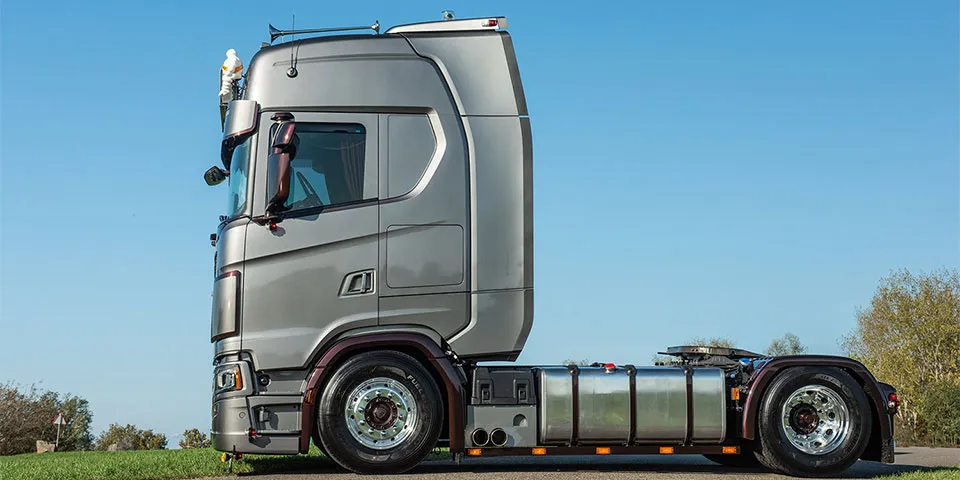
When we speak to him, he is still waiting to take delivery, but newly established owner-driver Cliff Janssen from Wijchen is glad that, after giving it some thought, he chose Scania after all. “While I wait for my new Scania 450S 4×2, I’m driving a Scania Rental with the same engine. And I’m pleasantly surprised by its fuel consumption.”
At 21, Cliff Janssen is one of the younger owner-drivers in the Netherlands. But he may well be the most driven. “I started at a small haulage company in Bergharen as soon as I’d got my driving licences. I enjoyed working there. But almost a year ago, I moved to Van Sambeek Transport in Escharen (near Grave) for another six months. By then, though, I’d already made up my mind to start my own business. Since Van Sambeek runs 100 per cent on the other Swedish brand, I thought I should buy one of those trucks too. But I’m not fanatical about brands: I go for what makes the best business sense for me. So I also sat down with the Scania dealer in Nijmegen. I noticed three things: 1. They really wanted to help me, 2. They made a fair and good offer and were 100 per cent on board with my plans, and 3. The account manager and I got on well.”
Together with the dealer, Cliff put together a comprehensive specification for his new 450S, with full air suspension and the high-roof cab. “Let’s just say it’s very well equipped: I ticked almost every box,” laughs the young entrepreneur. Even so, he hasn’t gone over the top. “I deliberately had the truck painted in metallic Urban Grey. It’s a Scania colour. A grey truck goes with pretty much any trailer. For accents such as the grille and mirror covers, I went for a dark metallic Cherry red. The great thing was that Scania could paint those for me at the factory, saving me a trip. They could have fitted the other items for me too. But I had the lighting, extended sun visor, air horns, light box, Michelin mascots and a few other accessories fitted elsewhere, at Van Kessel Truckstyling in Vinkel.”
The side skirts were a different matter. “It’s a truck with a Fuel Fighter package, and the skirts normally come with that. But I don’t want them, for two reasons. First, we almost always load and unload from the side. Without the skirts, you can get about 10 centimetres further in with a forklift. That may not sound like much, but it often makes just the difference you need. Second, I wanted the tank mounts painted to match and the tanks polished to a shine, nice and OldSkool.”
We’ll never know which of those two reasons really comes first. But one thing is certain: this truck looks like a contender for the Most Beautiful Truck competition. “I’m not sure about that,” Cliff backtracks a little. “The coronavirus crisis meant everything took longer than expected. So I’m really grateful that Scania helped me out so well in the meantime with a Rental. It has the same engine as my new truck, except that it’s already properly run in. Its figures are excellent, and that matters. You work everything out in advance to see whether your plans are viable, and fuel consumption is obviously a key figure. Now I also have a good reference point for what to expect.”
Cliff paid a lot of attention to additional safety features, opting for a retarder and ACC. “I think they’re an important addition to the standard LDW and AEBS.” Cliff also knows what his truck, equipped with a Driver, Leather and LED package, will be put through on its Alcoa wheels. “We always run heavy and usually carry block loads through the Netherlands, Belgium and Germany. So I have a pretty good idea of what’s coming. In principle, I’m home in the evenings, but some weeks you can be away for three days in a row. That’s why I had just one bed and an extra row of cupboards fitted at the back of the cab, a really sleek cupboard unit that Scania could also supply from the factory. Then I’ll always have everything to hand. Add climate control for when I’m parked, and what more could you want?”
For the 125-130,000 km Cliff expects to drive each year, he has taken out a flexible maintenance contract. This means the connected truck has no fixed service intervals. Instead, it indicates when maintenance is needed and what work is required, based on actual day-to-day operating conditions.
Question about this story? Ask your question
Keep following this
Get an email when a new story is published. No account needed.
- SubjectGeneral







