












Noordzij achieves >95% reuse of bitumen joints alongside tram tracks.
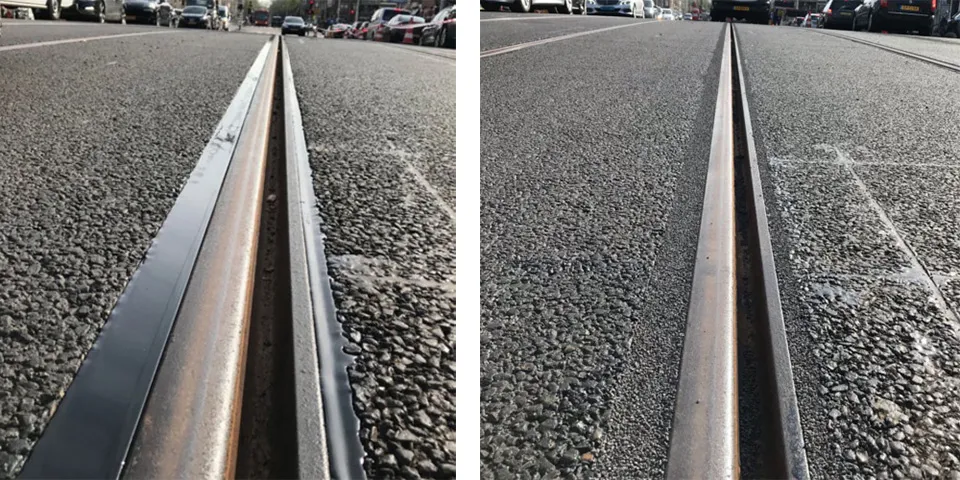
Noordzij Bitumenverwerking BV of Gorinchem has developed a method that allows more than 95% of the bitumen joints alongside tram tracks to be reused. These joints are currently considered waste and are disposed of and incinerated as such. Noordzij wants to raise awareness among local authorities and the tram and road construction sectors of this opportunity for circular construction and reducing CO2 emissions by reusing bitumen joints alongside tram tracks.
Reuse is essential
The Paris Climate Agreement established the need for a zero-waste economy. It set a target for the Netherlands to become 100% circular by 2050. Resources must be used more efficiently. The government has made € 80 million available for projects that contribute to the transition to a circular economy and the CO2 reduction target. This underlines the urgency of doing business in a circular way.
Noordzij recognises the importance of reducing CO2 emissions and wants to contribute to a circular economy. “Bituminous joints alongside tram tracks are only a small part of an infrastructure project, but working with bitumen accounts for 100% of our business,” says Marion Noordzij, co-owner of A. Noordzij Bitumenverwerking BV. “I realise that we work with a material that is a by-product of petroleum. Unfortunately, there are still no good, sustainable alternatives to bitumen in road construction. That makes it all the more important to use bitumen sparingly and prevent waste.”
Reducing CO2 emissions
Bitumen joints alongside tram tracks are currently considered waste and are disposed of and incinerated as such. New bitumen then has to be extracted and processed for use in new joints. No exact figures are available, but the Emission Factors List from www.CO2emissiefactoren.nl provides a consistent set of key figures on CO2 emissions. It states that incinerating bitumen produces 3,381 kg of CO2 per kg of bitumen. This is in addition to the emissions from extracting and processing bitumen. Recycling bitumen is not entirely CO2-neutral either, but it significantly reduces CO2 emissions compared with current practice.
A responsibility for local authorities, tram operators and contractors
Every recycling process for bituminous joints alongside tram tracks begins with a renovation or new-build requirement from a local authority or tram operator. The asphalt alongside the tram tracks needs replacing, or the tram tracks need to be renewed or renovated. “Not all clients and contractors are yet aware of the opportunities for reusing bitumen joints alongside tracks,” Marion Noordzij continues. “Ultimately, they decide whether a bitumen joint becomes waste or is recycled. We hope to inspire them to opt for reuse in future projects.”
Approved method
Noordzij begins the recycling process by routing out the bitumen joints alongside tram tracks. The bitumen is then collected and transported to the recycling site. It is melted, screened and stored again. More than 95% is suitable for reuse. The remainder (<5%) is sent to a waste management company. In a legal opinion, the Ministry of Infrastructure and Water Management recognised Noordzij’s method of routing out and recycling bitumen as “continued use”. The routed-out bitumen is therefore no longer classified as “waste”.
“We are still investigating a number of issues, such as how many times bitumen can be recycled. We want to continue professionalising bitumen recycling,” Marion Noordzij concludes.
About Noordzij
Noordzij Bitumenverwerking BV has more than 30 years’ experience in laying bitumen for infrastructure projects. It is the market leader in creating joints alongside tram tracks and uses unique rail joint sawing machines for this work. Noordzij’s staff have developed these machines to order, drawing on their practical experience. Noordzij is known in the market as an experienced contractor. It is an innovative family business whose team approaches every project with great pride and commitment. In addition to rail joints, Noordzij also provides flexigoot, asphalt crack repairs and other bitumen joints. For more information, visit www.noordzij.eu.
Question about this story? Ask your question
Keep following this
Get an email when a new story is published. No account needed.
- SubjectGeneral







