












Every machine is different, but they always get the job done
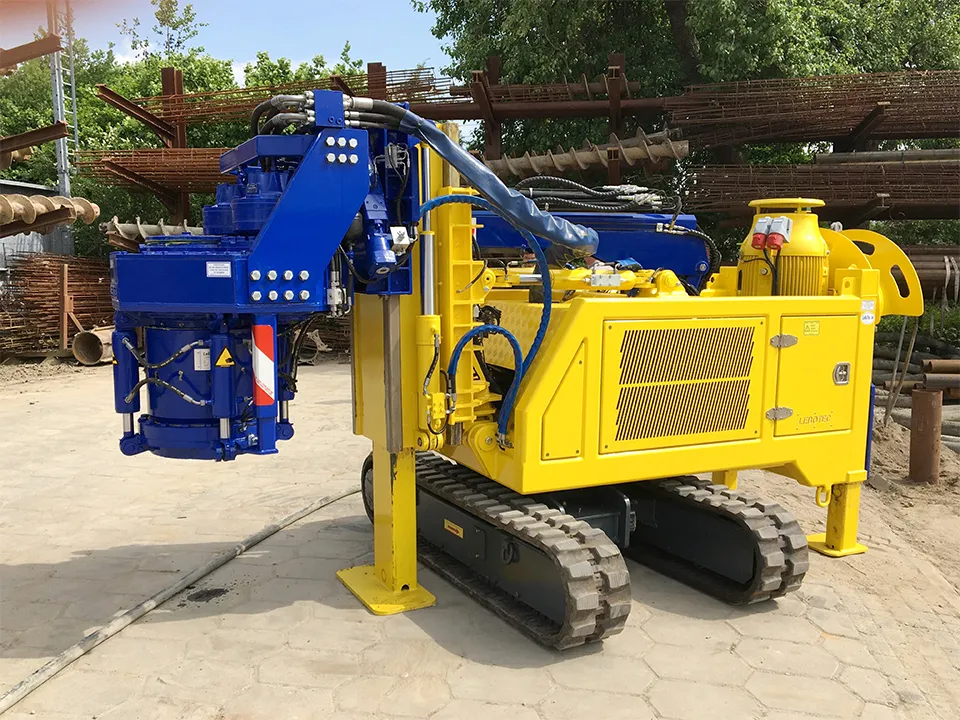
More than 150 piling rigs have already rolled out of the workshop of Wijchen-based Lebotec. At least 100 of them are completely unique and custom-made.
And not one has ever been returned or broken down before the end of its service life. Should anything unexpectedly fail to work quite as it should, Lebotec’s service team is on hand 24/7 to resolve the problem.
“Our machines generally last around 15 to 20 years. Some have even clocked up as many as 63,000 operating hours,” says Lebotec owner Jacques Bouten, clearly proud. Much of the machines’ reliability is down to the fact that Bouten looks at every machine built in Wijchen “as if he had to operate it himself”, adds sales manager Wil Zwartjes. “I suppose I’m a bit of a fanatic about my trade,” Bouten says with a smile.
No two Lebotec piling rigs are the same because every customer has their own requirements and working methods. “We once built a batch of eight of our mini piling rigs,” says Bouten. “But customers ask for different mast lengths, stabilisers in all shapes and sizes, different chassis widths, you name it. That can make our work challenging, because if you change one thing, the whole drawing has to be changed. But we find it fun and challenging above all. It never gets boring.”
Recording
Lebotec is always keen to work with customers to meet their specific requirements. This not only gives the machine builder a healthy order book, but also helps it build strong relationships with highly loyal customers. “Almost every piling job is different in our small country,” says Zwartjes. That is why we also maintain a sophisticated pile-recording system for our customers. What exactly is going into the ground? At what drilling pressure? What mix of concrete or grout is being used? How many litres of water, and at what mixing ratio? We record it all and store the data on our servers for 10 years. Customers can retrieve it whenever they need to, for example if the Building and Housing Inspectorate requests it.”
Lebotec prefers to sell not just the piling rigs themselves, but the entire process. “From the drilling rig to the concrete or grout pumps. The entire chain, from supply to actually forming the piles,” says Bouten. “For the process to run smoothly, it’s best to have one party handle the whole chain,” adds Zwartjes. “And that’s what we do well.”
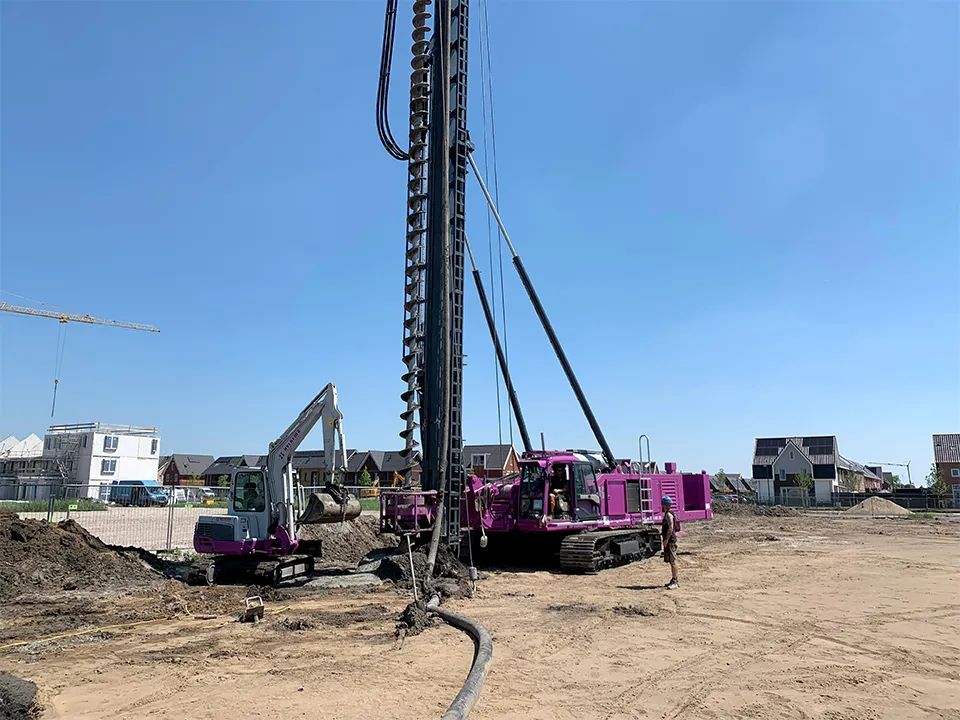
Controlling these complex processes means that more and more electronic systems need to communicate with one another. Lebotec makes that happen. For example, it designed an automation process that enables piles to be produced automatically on site. Bouten explains: “Imagine a concrete mixer, a concrete pump and a concrete screw-pile rig on a construction site. The screw is then driven to the required depth fully automatically, the concrete pump starts automatically, the concrete thickness is measured, the concrete is injected and the auger is withdrawn. We can do this with both concrete screw piles and Mini Vibropalen. This is where we really stand out.”
Emission-free
Bouten and Zwartjes expect the replacement of piling rigs to accelerate in the coming years as emission-free working becomes an increasingly common requirement. Lebotec is responding by electrifying its piling rigs. “But speed and power are essential in our work, and that means you need a lot of power. It’s technically perfectly feasible, but we can’t do it without our partners who supply motors and battery packs, and especially without a government that provides the right infrastructure. So we’re also investing in cleaner diesel engines,” Zwartjes concludes.
Question about this story? Ask your question
Keep following this
Get an email when a new story is published. No account needed.
- SubjectGeneral







