












No surprises with new pump installations thanks to a ‘digital twin’
Reducing failure costs and preventing damage: isn’t that what every company wants? The pump industry is no exception, especially when you consider the consequences a pump failure can have. Through its various clusters, GMB builds and renovates dykes, port areas, sewer systems, pumping stations, water treatment plants and sludge processing plants, among other things.
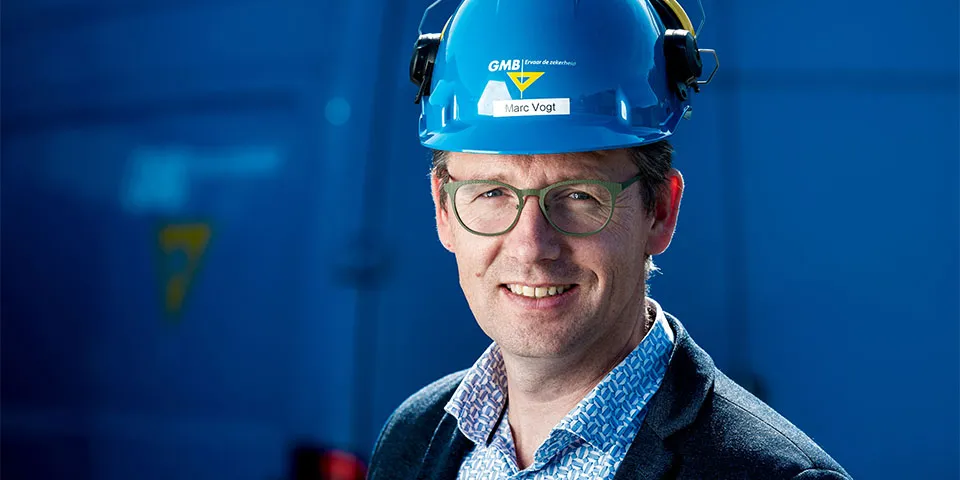
The Water Quality and Installations cluster uses a state-of-the-art method to reduce the risk of failure in a new pump installation to an absolute minimum. Together with their partners, they create a ‘digital twin’ before the pump is commissioned, then simulate its operation. Marc Vogt, design manager at GMB, takes us through the process.
Dry testing for maximum risk control
“The best way to explain how the digital twin works is to look at the AWP 2.0 project for Waterschap Brabantse Delta, which is currently under way,” Vogt begins. “We are currently renovating three pumping stations, replacing two old pumps with three new ones at each station. The first pump was recently commissioned, and we knew in advance that it would do its job without any problems. Beforehand, together with our partners, we created a digital twin of the discharge station. This involved building a virtual model of the pump, pipes and instrumentation so that they could operate in a digital simulation. We then used calculation software from our partner RHDHV to feed the simulation with data, including artificial rainfall, data from local measurements, all kinds of system influences that affect operation and, not least, test data for the pump supplied by our partner Pentair. Our partner Hoppenbrouwers’ software links everything together. The result is a virtually running pump, subject to influences that are certain to occur in real life at some point. A kind of digital baptism of fire…”
But the simulation does not stop there. Vogt explains: “This dry, virtual test also allows us to simulate all kinds of operating conditions. You can’t get more certainty in advance than that. The great thing is that you can fine-tune and adjust things in the simulation, then transfer them directly to the actual installation if they prove successful. That inspires confidence.”
An overview of the three pump lines.
Huge time savings
As well as providing certainty about the technology, the digital twin also saves a huge amount of time. “It makes sense, really, because without digital testing we would depend on peaks occurring in real life. We would have to wait for severe weather and hope the installation could withstand it. Besides the time that takes, there is a real risk of damage. ‘Trial and error’ is not desirable with pump installations of this size, not only because of the costs resulting from potential damage to the installation, but above all because of the impact on the surrounding area if a pumping station like this fails. Once again, it shows how fortunate we are to have the option of virtual testing. The computer is patient. Running a 24-hour virtual test is no problem: we simulate in real time.”
The first time leaves us wanting more
This is the first time GMB has worked this way. “That was possible because this particular project is ideally suited to it,” Vogt explains. “These pumps are large and powerful, and drainage must be maintained throughout the project. In the virtual environment, we can push things right to the limit… The forces involved are such that doing this in a real-world situation could cause enormous damage. That would cost time and money, and would effectively destroy capital. Now we can test with the shop open, as the saying goes. The old pumps are still running, the new pump can be commissioned reliably, and replacing them becomes a matter of avoiding unnecessary downtime.”
Taking a predictive approach
Vogt concludes: “There is more and more you can do with it. The pump that has now been commissioned is also being monitored. We link that data to the initial test results, and everything is matching so far. That provides validation. By analysing data, we will even be able to work predictively in due course. That is the future, and it will be ideal, for example, for further optimising systems.”
Question about this story? Ask your question
Keep following this
Get an email when a new story is published. No account needed.
- SubjectGeneral







