












Monitoring stations for water, air and soil data
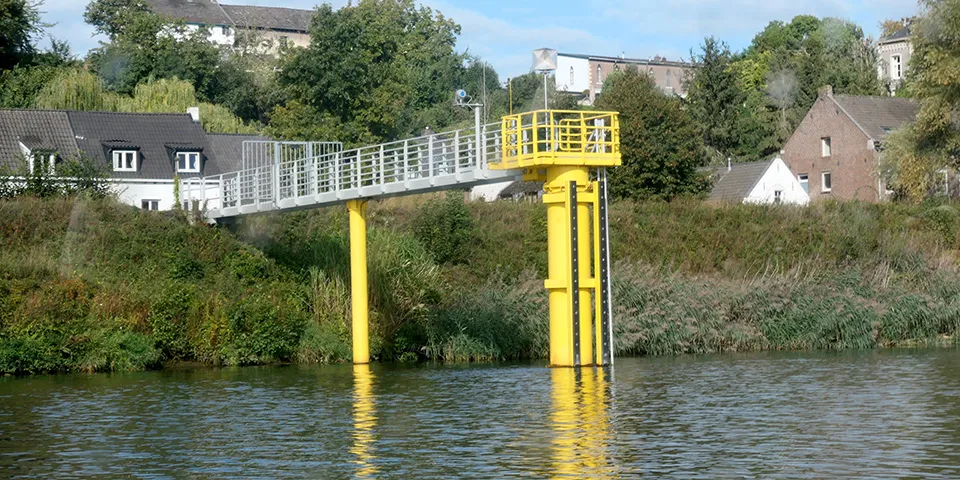
Monitoring stations on Dutch inland waterways and along the coast are equipped with instruments that generate important data. This includes data on water levels, ground subsidence and water salinity. The steel tubular piles are fitted with a platform to which monitoring equipment is attached. This equipment measures water levels, wave heights, wind, water salinity and ground subsidence. The data collected is continuously and automatically transmitted to a Rijkswaterstaat (RWS) data centre, where it is stored and used for various purposes.
Construction of monitoring stations in the steel workshop at De Boer & De Groot.
Monitoring station specialist
Family business De Boer & De Groot Civiele Werken BV, based in Harlingen, supplies and installs these monitoring stations. The company has unrivalled expertise in working with steel, timber and concrete for civil engineering projects in and around water, for example in marinas and for bridges, lock gates and sheet piling. The company has built up many years of experience in manufacturing, repairing and installing monitoring stations. Herke de Groot, director of De Boer & De Groot, says: “In 2010, we took part in an RWS tender to repair and replace the sections above the waterline of ten monitoring stations in the North Sea, north of Vlieland, Texel and Terschelling, and off the coast at Petten and Cadzand. We carried out this work in 2010 and 2011. By now, we can certainly call ourselves specialists, as contracts followed in quick succession.”
Monitoring station in the Wadden Sea.
A few examples
For example, in 2015 the company was awarded a contract by BAM Infra Verkeerstechniek, which is responsible for the multi-year maintenance of the National Water Monitoring Network. This RWS network comprises fixed monitoring points for real-time monitoring of water quantity, water quality and meteorological conditions for water and shipping traffic management. The monitoring stations needed to be replaced, and De Boer & De Groot was approached to carry out the work. Together with BAM and DEKIMO, the company delivered the monitoring stations in 2016 under a design and construct arrangement. “We installed a new monitoring station in the Meuse at Maastricht and another in the Rhine at Lobith. We also replaced monitoring stations at several other locations,” says De Groot. “In Maastricht, for example, we drove a new 25-metre-long steel tubular pile into the ground and fitted it with a platform. We also built an access bridge to make maintenance and inspection easier.”
In 2018, the company was brought in to build and install two permanent and five temporary monitoring stations in the Wadden Sea. “Working as part of a construction team, we developed the monitoring system design into a Detailed Design and a Construction Design,” says Henk Dokter, design lead at De Boer & De Groot. This resulted in permanent steel monitoring stations with a diameter of Ø 1,106 millimetres and a length of 33 metres. They were installed with their pile tips at 25 metres below NAP in the Pleistocene sand layer and fitted with a GPS monitoring system and a direct G4 telecom connection, enabling data to be collected and transmitted 24/7. The temporary monitoring points were made from steel tubular sections measuring Ø 559*10, with their pile tips also at 25 metres below NAP. They are temporary because data is collected during a one-week monitoring cycle each year. “It was a special project,” De Groot adds. “Out on the mudflats, with all their distinctive flora and fauna, we had to avoid causing any disturbance or environmental impact, and we also had to contend with the tides. A challenge!”
Question about this story? Ask your question
Keep following this
Get an email when a new story is published. No account needed.
- SubjectGeneral







