












Kandt puts new Scania 650S to work as a heavy-haulage tractor unit
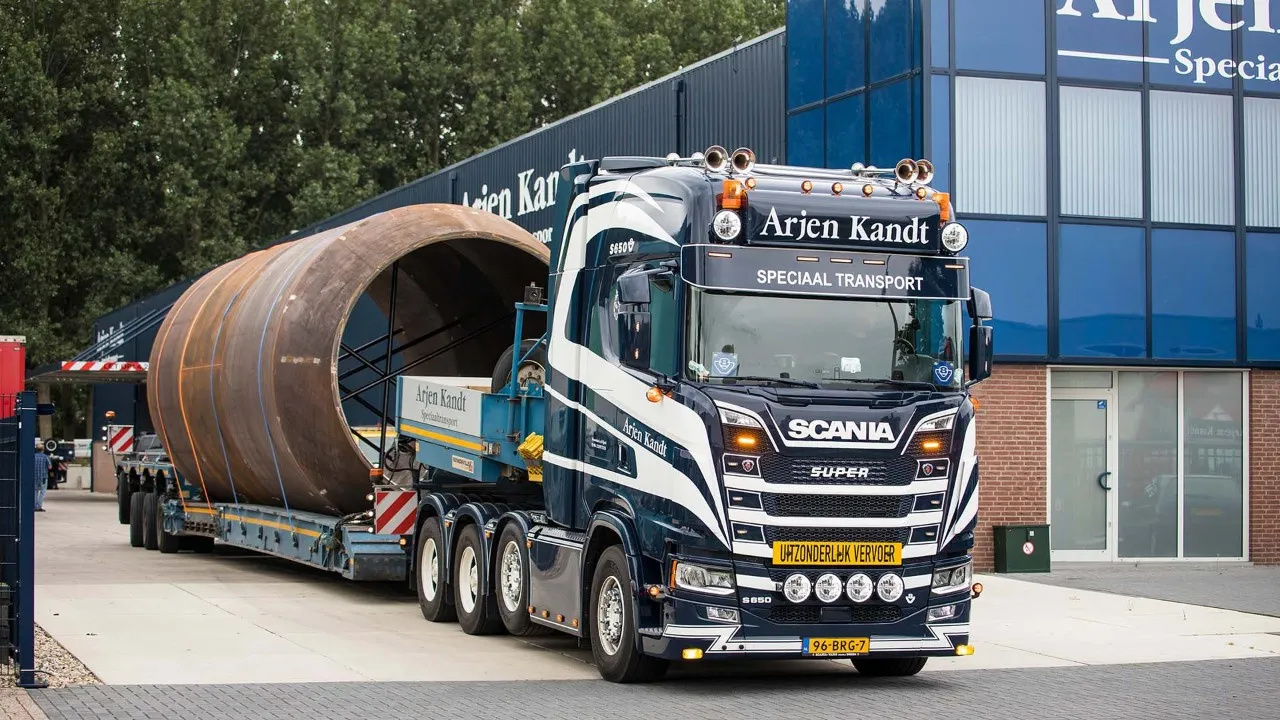
Arjen Kandt Speciaal Transport BV of Nieuwerkerk a/d IJssel has taken delivery of a new Scania 650S 8×4 with full air suspension, hub reduction and a steered tag axle, to use as a heavy-haulage tractor unit.
The company’s new flagship is approved for a gross train weight of 180 tonnes. It was built entirely to the specifications of owner and director Arjen Kandt, with numerous special details designed to make the work easier.
“I chose a Scania this time for several reasons,” says Arjen, summing up the story behind the new vehicle. “First of all, we know the brand well, of course, and we have several in our fleet. But above all, I wanted a truck with a V8 engine this time. That pretty much made the choice for me. The fact that Scania can supply a strong chassis with an innerliner also played a part. It’s also useful that Scania offers a factory-fitted 10-tonne air-suspended front axle and a reinforced fifth wheel. The gearbox is a GRSO926R, naturally with a retarder.”
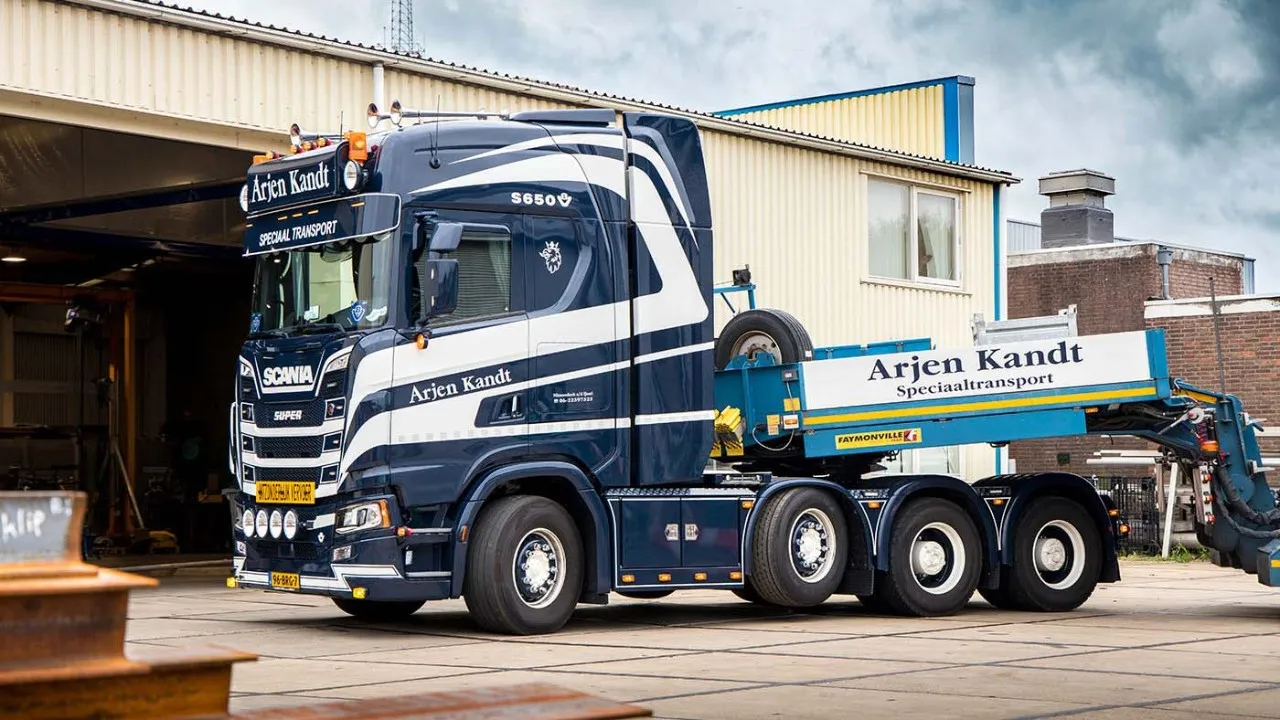
“Most of our trucks have five axles,” Arjen explains. “But we didn’t yet have a four-axle vehicle in our fleet. This truck works well as a four-axle vehicle because it doesn’t have a crane. We’ve added it as a genuine expansion of our special transport operations. Although it’s designed entirely as a heavy-haulage tractor unit, we also need to be able to couple it to a standard Tautliner. That’s why we chose a mechanically operated sliding fifth wheel. It makes the truck versatile and means we can use it with our entire range of trailers, from the heaviest low-loader to a standard curtainsider. The latter, like all our trailers, has a heavier 3.5-inch kingpin.”
The new truck is approved for a gross train weight of 180 tonnes. “But we’ve never run at that weight. We go up to a respectable 165 tonnes, usually when transporting a piling rig for our other company. But we carry all sorts of things besides that. That’s the great thing about this line of work. You take the heaviest or largest loads to the most remote places. And yet there’s no training course for it. You have to be capable, and you have to want to do it. Special transport is always challenging. Everything is heavy. It’s a job you can only learn by doing. But there’s something strange about it. To drive an LZV weighing barely 60 tonnes, you need to get an additional driving licence. But with a permit, you can be out on the road tomorrow with 160 tonnes or a load more than 30 metres long.”
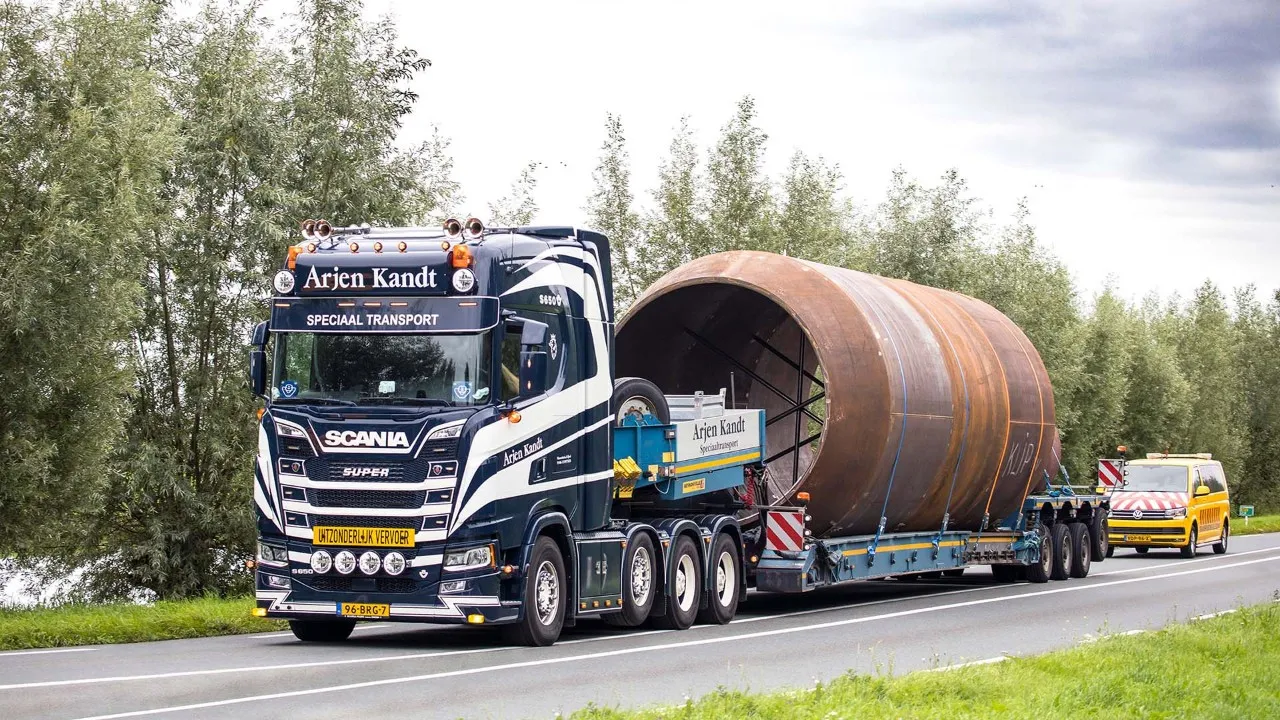
A huge amount of attention has gone into the details of the new truck. “You take things a step further each time,” Arjen says. “Part of that comes from experience. For example, we don’t want a radio link to the steering axles on our low-loaders. We have a wired joystick in the cab instead. We also keep improving the layout of the tanks and air reservoirs, the work lights and the use of storage space with every new truck. This one has 1,000 litres of fuel behind the cab, in a large frame with the air reservoirs and extra lights right at the top. Ematri took care of all that. This kind of setup is less unusual than it might seem. Those components are difficult to put anywhere else. There’s hardly any room along the chassis, and the chassis itself is already full of other components.”
Some of the other details are simply down to personal taste. “Looks matter too. We deliberately chose the tallest S cab. It’s a tough-looking cab, but it also gives us plenty of space for equipment behind it. We deliberately didn’t want Skylights on the roof because we don’t think they go with the old-school lightbox. That calls for classic-shaped spotlights. We’ve taken the idea of ‘full specs’ very literally in the cab. Although the driver hardly ever sleeps in it, it has everything.” The end result speaks for itself. “We noticed that during the build. All the miniature model manufacturers came by. So there’s already a model of it.”
Although the V8 engine can easily run well beyond a million kilometres, it’s not very likely to do so at Kandt. “We normally keep a truck for about 13 years, but we only cover around 70,000 kilometres a year. The engine still has plenty of life left by then, but it’s usually time for something new anyway.”
Question about this story? Ask your question
Keep following this
Get an email when a new story is published. No account needed.
- SubjectGeneral







