












Jan De Nul announces ambitious CO2 reduction targets
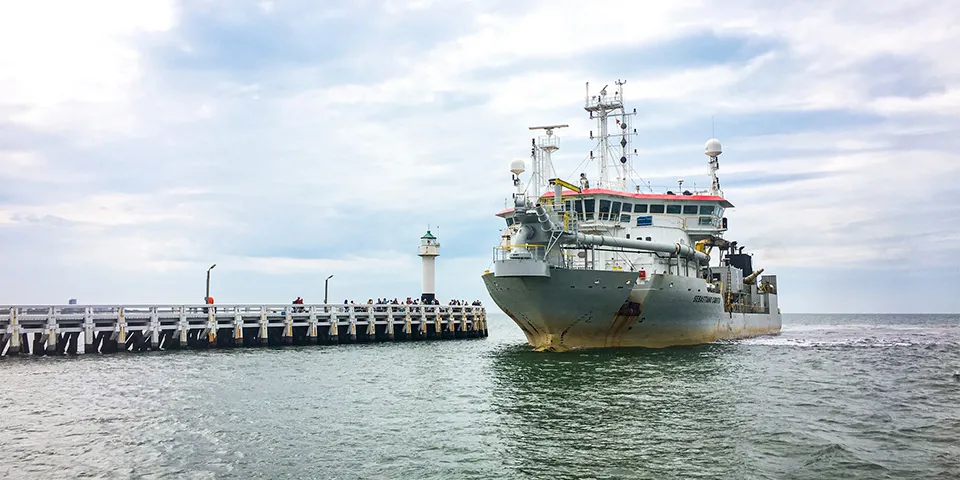
Jan De Nul Group commits to cutting CO₂ emissions by 15% a year on maintenance dredging works in the coastal marina of Nieuwpoort. It is the first dredging company in the world to target such a reduction on a commercial project. By 2022, the company also wants to work with the Flemish government to make a minimum 15% CO₂ reduction mandatory in 80% of maintenance dredging contracts in Flanders.
When tendering the maintenance dredging works in the coastal marina of Nieuwpoort, the Flemish government’s Agency for Maritime and Coastal Services gave the market every opportunity to use innovation to reduce CO₂ emissions. Jan De Nul Group won the contract, committing to cut emissions by 15% a year. This is unprecedented in the sector. No dredging company has ever targeted a CO₂ reduction of this scale on a commercial project.
Drop-in biofuel
Jan De Nul Group is using drop-in biofuel, among other measures, to meet its ambitious CO₂ reduction target. This high-quality fuel is a sustainable alternative to fossil diesel, made from vegetable oils or waste streams. “Drop-in” means that engines do not need to be modified to use it. It also cuts not only CO₂ emissions, but the amount of particulate matter released into the air. Combustion is much more efficient than with conventional diesel. As drop-in biofuel uses waste streams as feedstock, it also benefits the circular economy. Finally, its very clean-burning properties make it highly suitable for high-performance engines
The Agency for Maritime and Coastal Services (MDK), part of the Department of Mobility and Public Works, is demonstrating through this approach and its choice of Jan De Nul that it is a frontrunner within the Flemish government in helping Belgium meet its reduction targets. Under the Paris Agreement, Belgium committed to cutting CO₂ emissions by 15% by 2020, compared with 2005.
Nathalie Balcaen, Director-General of the MDK agency: “As a maritime partner of the Flemish government, we want to do everything possible to reduce our environmental footprint. We therefore pay particular attention to green criteria in the specifications we put out to tender. This is already delivering tangible CO₂ reductions, including through a focus on carrying out dredging works in an environmentally friendly way and on the contractors we work with.”
“The MDK agency does not only focus on climate requirements when drawing up tender contracts,” says Nathalie Balcaen. “We also take responsibility in our own operations. We are making our own vessels greener to reduce our CO₂ emissions. For example, we are building an electric ferry.”
Cutting CO₂ across the sector
For Jan De Nul, the project also fits with its ambition to take a leading role and roll out a CO₂ emissions reduction programme across the sector. The dredging company wants a minimum 15% CO₂ reduction requirement to be included in 80% of maintenance dredging contracts in Flanders by 2022. “We want to make every effort and inspire other companies in our sector to adopt promising energy or CO₂ reduction measures,” says Bart Praet, Head of Dredging Benelux at Jan De Nul Group. “We are keen to engage in dialogue with the Flemish government and Vlaamse Waterbouwers VZW, and are working closely with Zero Emission Solutions and the advanced sustainable fuels sector.”
The targets were announced shortly after the Flemish government decided to approve a three-year pilot project to test the CO₂ Performance Ladder in public procurement. Developed in the Netherlands in 2009, the ladder is a tool and certification scheme designed to encourage CO₂ reduction, and has proved a great success there. The Flemish pilot project will run from September 2019 to September 2022. The aim is for contractors to be awarded contracts if they offer maximum quality, minimum CO₂ emissions and a fair price.
“We are convinced that Jan De Nul can play an absolute leading role here,” says Bart Praet. “We want to be one of the first contractors to make a significant contribution to the Flemish pilot project and one of the first to achieve actual CO₂ reductions on a project.”
Bart Praet: “Our project in Nieuwpoort is a practical example that we hope will start a dialogue about reduction requirements. We want to encourage our peers in the industry to respond quickly and decisively with innovative, promising energy and CO₂ reduction measures.”
Question about this story? Ask your question
Keep following this
Get an email when a new story is published. No account needed.
- SubjectGeneral







