












Innovative joint technology guarantees optimum floor protection and load transfer
Text Geert Van Cauwenberge Beeld HCJ

Industrial floors are subjected to heavy daily loads from machinery, vehicles and human activity. Protecting these floors properly is therefore essential, not only to extend their service life, but also to ensure efficient and safe working conditions. For many years, HCJ (Hengelhoef Concrete Joints) has offered a revolutionary solution for reconciling joints and floors with its joint technology.
From the constant movement of goods and machinery to loading and unloading lorries, forklifts carrying thousands of tonnes of material cross floor joints every day in production and logistics facilities. This creates a vicious circle of damage, inconvenience and unsafe working conditions. Raf Jaenen, CEO of HCJ, briefly explains how companies used to tackle the problem of shrinkage in industrial floors. “Until around the 1980s, floors were cut up with saw cuts. This did solve the shrinkage problem, but created new problems because load transfer and floor-edge protection were not provided.”
“After the 1980s, expansion joints began to be used to accommodate concrete shrinkage. At first glance, this seemed a good solution, but its effectiveness depended on the type of forklift wheels and the intensity of forklift traffic.”
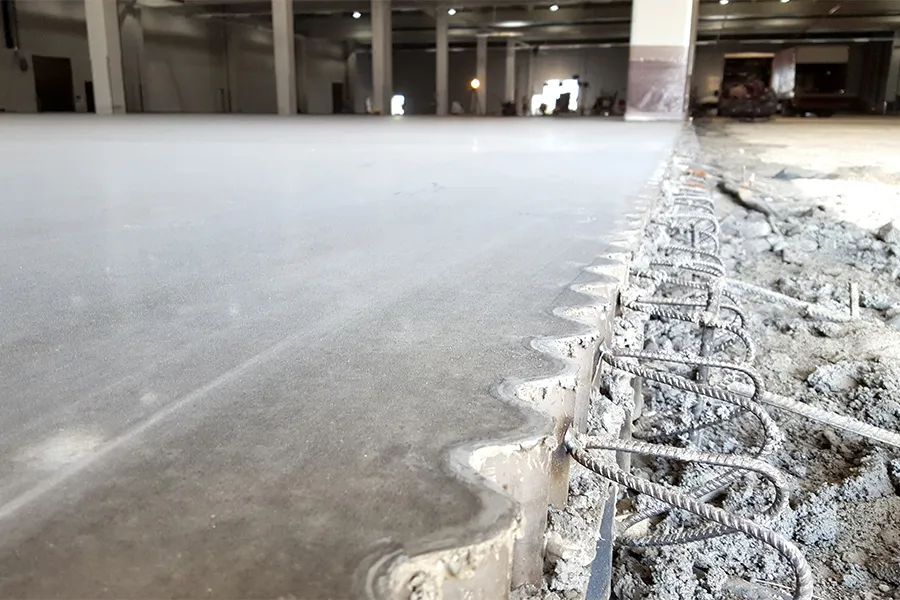
‘The joint is the floor, the floor is the joint’
“What’s more, every traditional straight expansion joint has one major drawback: the joint opening,” Raf continues. “In a logistics environment, forklift wheels drop into these openings, eventually damaging the floor, the handling equipment and the goods being transported. Not to mention the impact on forklift drivers.”
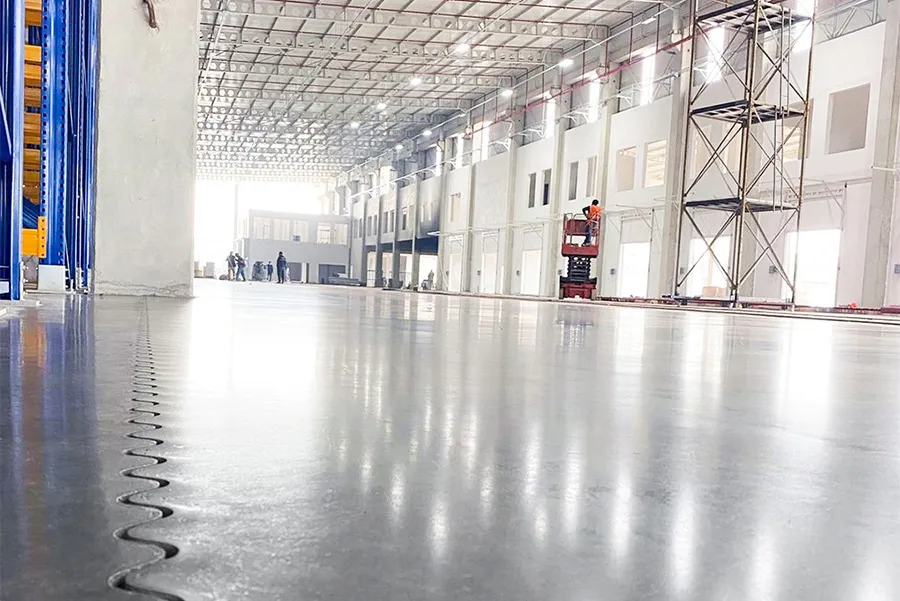
“At HCJ, we have spent years developing innovative solutions that not only strengthen floor joints but also eliminate the causes of potential damage,” Raf confirms. “In 2007, we launched our Sinus Slide® solution, which allows forklift wheels to move silently and without shocks or vibrations from one floor section to another, with no risk of damage. In 2012, we went a step further with the introduction of the Cosinus Slide® floor concept. In our search for the perfect expansion joint, we moved away from traditional (continuous) dowelling and anchoring. Based on the principle that ‘the joint is the floor, the floor is the joint’, the floor sections slide over one another. We call this horizontal movement. The floor itself therefore provides the optimum connection.”
Cosinus Slide®: revolutionary technology
Raf goes on to highlight the many additional benefits of HCJ’s Cosinus Slide® concept, the company’s flagship product. “The high load transfer of the Cosinus Slide® joint, combined with the right calculations, allows us to optimise floor thickness and make floors thinner, saving our customers money. It also helps us reduce the carbon footprint. I would also highlight the low repair costs and the opportunity to build an industrial floor that is future-proof and therefore has a longer service life.
Last but not least, our globally patented Cosinus Slide® joint enables efficient warehouse layout: thanks to its high load transfer, you no longer need to take the position of warehouse racking in relation to the joints into account.” The success of this globally patented solution is reflected in the impressive list of references Raf and his team can point to, including major companies such as IKEA, Volkswagen, Amazon, H.Essers, Panattoni, WDP and Katoen Natie, all satisfied users. “90% of the joints we manufacture are destined for export, half of them outside the EU,” Raf says.
Calculating the exact load transfer capacity
HCJ’s experts go a step further still. Raf explains: “Industrial floors were always designed on the basis of an assumed level of load transfer across the joints, usually a percentage of 40%. This figure was only an assumption, so the calculations were not based on accurate values.”
“For several years now, our team has been able to measure the exact load transfer capacity of the Cosinus Slide® joint. We produce a complete calculation for all relevant loads and combinations, up to ULS (‘Ultimate Limit State’, ed.). This calculation does not replace the design of the industrial floor slab itself, but ensures that the floor design uses a realistic and accurate value for the joint’s load transfer capacity. This additional support is one of the many ways we make a difference for our customers.” ■
Question about this story? Ask your question
Keep following this
Get an email when a new story is published. No account needed.
- SubjectGeneral







