












Industrial listed building gets 7,000 m2 of coloured concrete roof slabs
The former yard of Nederlandsche Dok en Scheepsbouw Maatschappij (NDSM) is located right on the River IJ in Amsterdam. In this emerging urban district, the listed welding hall is being transformed into an international cultural hotspot, home to the world’s largest Street Art Museum (6,500 m²). The roof, in particular, needed significant work.
The site was also known as the ‘cathedral of NDSM’. This was where huge ship components were welded together, then rolled out through the immense blue doors as a ship or hull. It is a tall, rectangular industrial hall with solid brick façades, square cross windows and a flat roof, enlivened by four truncated pitched roofs running across its width, which serve as rooflights.
Listed industrial heritage to become the largest
Street Art Museum.
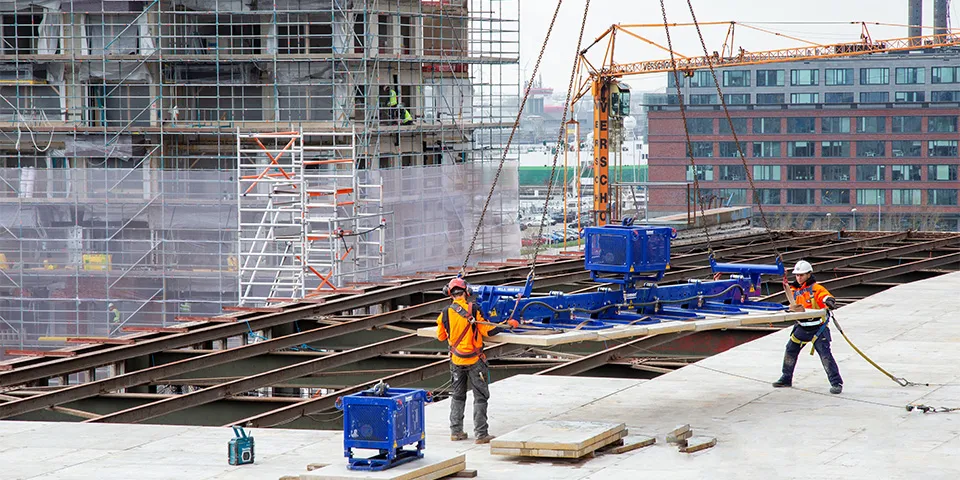
But before the ‘cathedral’ could become a museum, a number of changes were needed, particularly to the roof. The industrial heritage building’s pumice concrete roof, dating from 1952, was leaking and unsafe, so it had to be replaced. The new roof slabs needed to match the original appearance, dimensions and colour, while being as lightweight as possible. This is why, around three years ago, BMB ontwikkeling (Mediawharf bv) approached Betonfabriek Nigtevecht to produce replacement roof slabs measuring 2,000 x 500 mm. The request was ideally suited to the concrete factory, located between Amsterdam and Utrecht. For over 60 years, the company has produced a wide range of concrete products using a ‘strip-on-demoulding’ system. Its advantages include higher output per production day, meaning faster production and delivery times, as well as cost savings. The company works largely to customer specifications. After several discussions and calculations, it was decided to install roof slabs 1,000 mm wide, with a false joint that preserved the original dimensions visually while halving the number of installation operations required.
Ochre yellow to preserve the original colour
Years of welding work in the former welding hall had left the pumice concrete roof slabs ochre yellow, as rising welding fumes had stained them. The request was therefore to preserve this colour and give the underside of the roof slabs the same pigmentation. Betonfabriek Nigtevecht’s production process allows concrete products to be pigmented throughout, as well as coated with polymer-modified cement-based mortar in a range of colours, including the required ochre yellow. The heritage authority opted for this solution. Building contractor Regiobouw Haarlemmermeer then installed the roof slabs expertly.
Question about this story? Ask your question
Keep following this
Get an email when a new story is published. No account needed.
- SubjectGeneral







