












Hydrogen blending can significantly reduce emissions
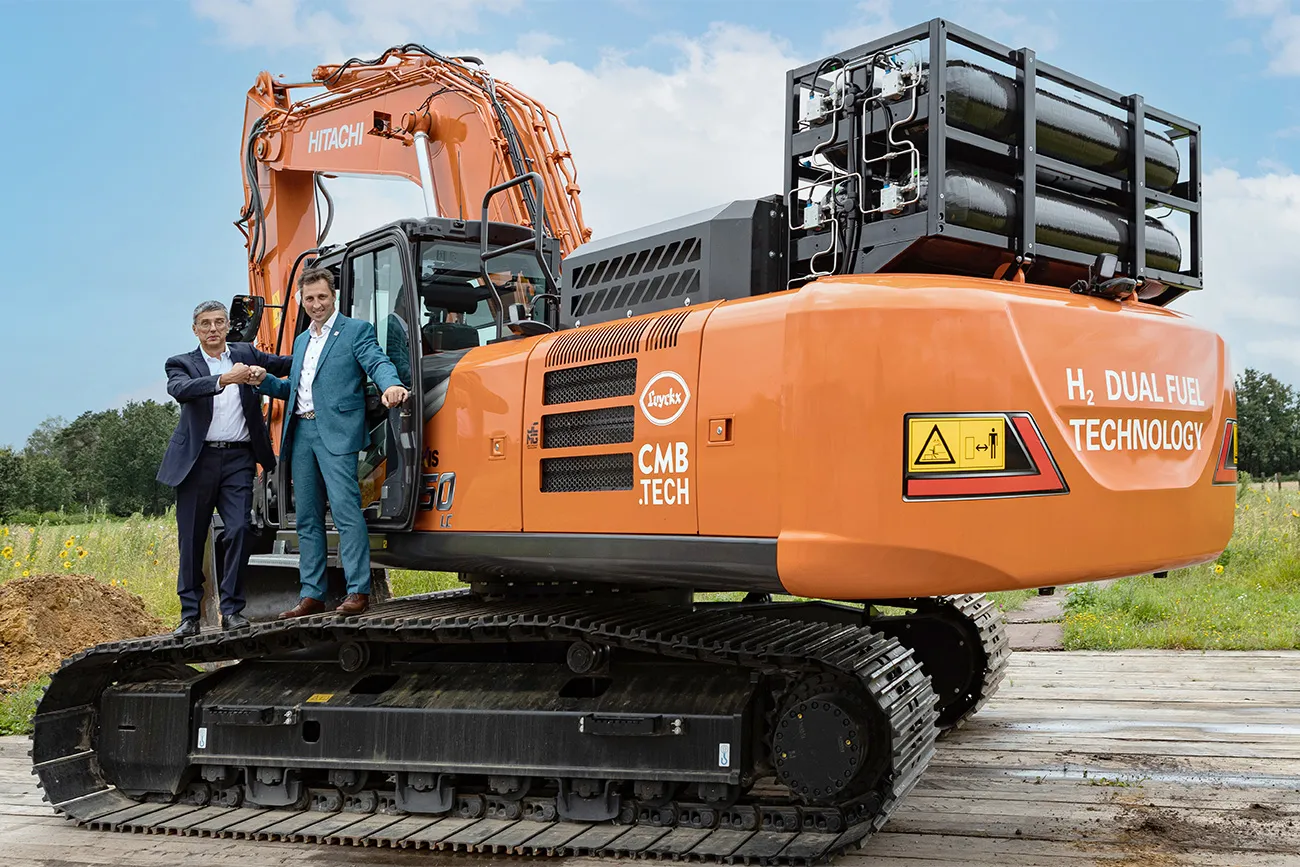
Diesel or hydrogen? This time, machinery distribution and service specialist Luyckx chose not to commit to one or the other. Instead, in collaboration with CMB.TECH, it has built its first dual-fuel excavator. As a Hitachi dealer, Luyckx chose to convert a 37-tonne ZX350LC-7. It runs on diesel blended with hydrogen, which can halve CO2 emissions.

Luyckx’s stand at MATEXPO prominently displayed the converted Hitachi ZX350LC-7, which had won third prize in the Green Awards. And rightly so. Hydrogen blending is major news for our sector. It has been used for some time in small-scale shipbuilding, which is also why Luyckx has joined forces with CMB.TECH. The Antwerp-based subsidiary of shipping company Compagnie Maritime Belge describes itself as an active developer and integrator of hydrogen solutions, focusing on engineering, hydrogen production, industry and marine applications. The adapted Hitachi ZX350LC-7 is now helping to accelerate the gradual greening of the heavy construction and earthmoving sector. Dual-fuel technology offers companies an affordable way to make significant progress with the energy transition using their existing machines, without being permanently dependent on hydrogen availability, according to the company.
From challenge to vision
For Jos Luyckx, CEO of the Brecht-based company, the case is clear: “Driven by the needs of our end users and fleet owners, we began a feasibility study on our own initiative to explore potential alternatives that could help reduce CO2 emissions, make our fleet more sustainable and support responsible business practices. We have been looking for the right solutions for several years. The main challenge lay in the energy requirements of heavy machinery. This vision led us to start working with CMB.TECH.”
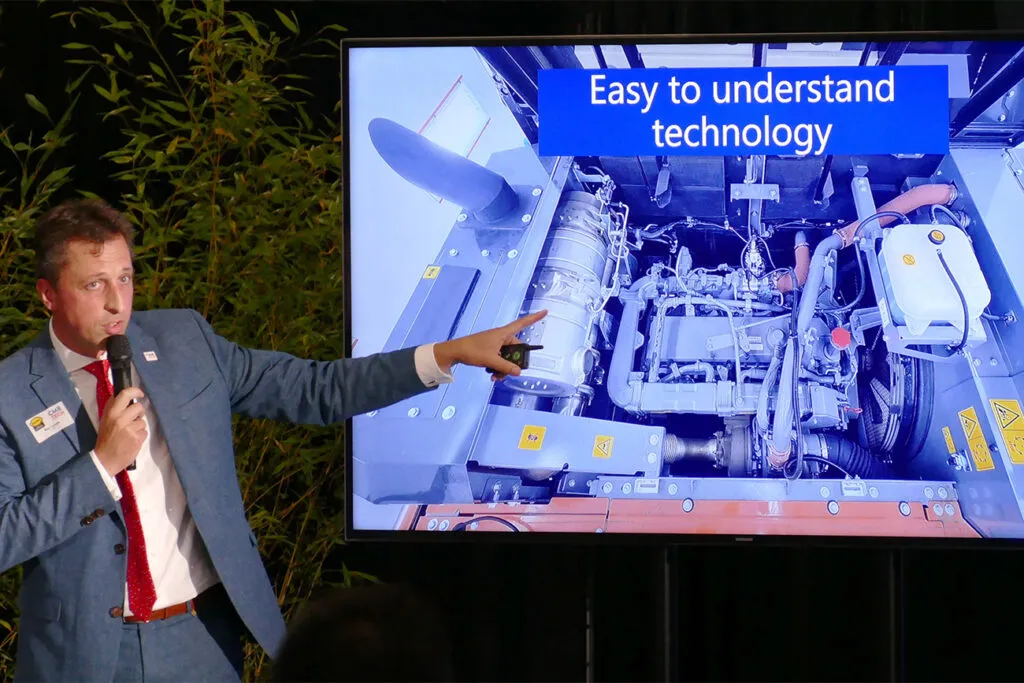
The conversion to dual-fuel operation involved few changes to the Isuzu engine, so it can still be maintained in much the same way as a standard machine. The excavator starts on diesel, and hydrogen is added only once the engine has reached operating temperature. It is supplied from the tanks clearly visible behind the cab.
An affordable solution
Fully electric drive systems are still quite expensive and, with current technology, are not suitable for the heaviest equipment. Choosing electric power alone could therefore hinder rather than advance the energy transition at present, making an interim solution a more practical choice. From that perspective, dual-fuel technology is a sound option for now.
Roy Campe, technical director at CMB.TECH, puts it this way: “The additional cost of the machines in this sector is relatively limited, while every kilogram of hydrogen used immediately reduces CO2 emissions. From now on, we are offering applications that can deliver up to 8 tonnes of CO2 reduction per site per day, wherever in the Benelux they are located, with no operational restrictions and at the lowest possible cost.”
Mobile hydrogen refuelling station
As hydrogen supply is another major bottleneck, CMB.TECH also presented a mobile hydrogen refuelling station alongside the dual-fuel excavator. Built on a box trailer, it can deliver up to 600 kg of green hydrogen at a pressure of 350 bar to a machine anywhere a truck can reach. It can be used not only for excavators and other machinery, but also for trucks, generator sets and similar equipment. Roy calls the mobile refuelling station “the answer to supplying hydrogen for marine and industrial applications”.
Question about this story? Ask your question
Keep following this
Get an email when a new story is published. No account needed.
- SubjectGeneral







