












Ground improvement using locally sourced material
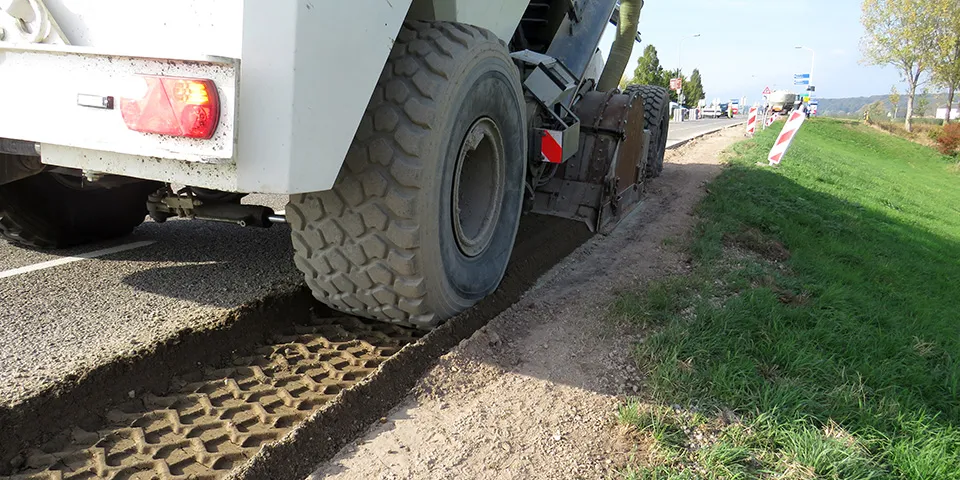
Building foundations for roads, cycle paths, paved verges, parking areas and hardstanding generally requires a continuous supply of primary construction materials and a large number of transport movements. Terrastab takes a different approach, using locally sourced material to rapidly create a stable structure of very high quality. No material needs to be removed or new foundation material brought in.
Excavating, removing, bringing in and processing material often takes a long time on civil engineering projects. Terrastab specialises in soil stabilisation, reusing 100% of the existing material on a project. “This enables us to upgrade the soil or even give it a new function, without having to bring material in or take it away,” says Erwin Bonestroo of Terrastab. “This is a major advantage, particularly in view of the current PFAS issue.”
The Romans
According to Erwin, the soil stabilisation technique used by Terrastab is as old as the road to Rome. “The Romans already used this proven technique, which we have naturally developed and extended. For each project, we analyse the composition of the locally sourced material and select the right binders and additives based on the intended future load. You can imagine that soil stabilisation for a cycle path requires a different composition from that for a crane hardstanding during the construction of a wind farm. The additives and binders, whose composition is determined in our own laboratory, account for only a fraction of the overall package and are negligible in comparison. This also enables us to achieve a huge reduction in CO2 emissions compared with the traditional method.”
Terrastab specialises in soil stabilisation, reusing 100% of the existing material on a project. In this case, a road surface in Castricum without a wearing course.
High compressive strengths
Technical expertise and a healthy dose of creativity set Terrastab apart in the world of soil stabilisation. Erwin says: “In recent years, we have worked on leading projects at home and abroad. Our ability to achieve high compressive strengths, work on dike slopes and build foundations for airports has more than proved the technique’s capabilities. Structural designers and engineers are also enthusiastic about our method. With our own R&D department and laboratory, we continue to develop optimal structures and expand the range of applications. Alongside our proven paved verge solution, which has a service life of around ten years, we are now developing verge concrete made with locally sourced material, once again without bringing in or removing primary construction materials. This enables us to complete between 700 and 1,000 metres of verge concrete per day, fully finished and ready to use. That is more than three times as much as with the traditional method.”
Question about this story? Ask your question
Keep following this
Get an email when a new story is published. No account needed.
- SubjectGeneral







