












Full steam ahead, as sustainably as possible
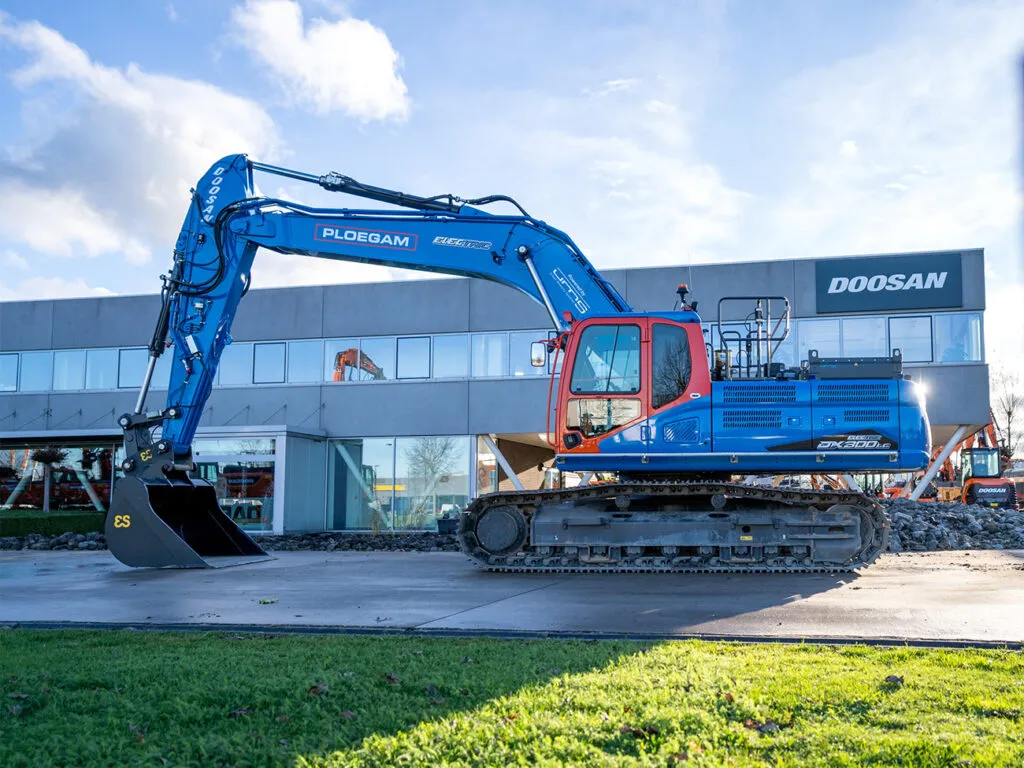
‘Full throttle ahead’ is becoming a thing of the past. We prefer to talk about ‘full steam ahead’. The Rotterdam A16 infrastructure project is being carried out by construction consortium De Groene Boog with zero emissions wherever possible. To achieve this, De Groene Boog needs partners willing to take a stand for clean working practices. Ploegam is one of those companies. Its lorries run on HVO fuel, and the company is at the forefront of the electrification of construction equipment in the Netherlands. A conversation with managing director and owner Chris Ploegmakers and innovation manager Martin Egas.
Biofuel
“Ploegam was brought in to transport sand for the project. It was a logistical challenge, with as many as 85 lorries on the road at peak times. All were fitted with Euro 5 and Euro 6 engines running on HVO-100 biofuel. It was a complex job on several fronts, involving capacity, equipment, planning and organisation,” Ploegmakers begins. Egas adds: “We chose smart routes to avoid traffic jams and stayed off the roads during rush hour. However, because of the coronavirus restrictions, we were able to drive during rush hour, as the roads were quiet.” Ploegam kept detailed records of every vehicle movement. “We had a site manager continuously monitor the loading and unloading locations to keep track of who was driving where and how often,” explains Ploegmakers. Ploegmakers and Van Schaijk from Nistelrode shared the transport work, each using 15 to 20 of their own lorries. “The remaining capacity was provided by transport companies that we selected ourselves, based on the project’s environmental requirements.”
Taking control of the electrification process
What is notable is Ploegmakers’ commitment to electrifying equipment. Egas explains: “We started electrifying equipment in-house in December 2019. Our first electrified Doosan DX300 was ready to go to De Groene Boog after the 2020 construction holiday. Since then, we have invested heavily in electrification and can also make heavy equipment fully electric. As one of the pioneers, you quickly come up against a key problem: how do you charge heavy equipment? We found the answer in interchangeable battery packs. You take a fully charged battery pack to the excavator, rather than taking the excavator to a charging station.”
Martin adds: “Together with our supplier Staad, we are putting our expertise in electrification to broad use. Staad B.V. has set up a dedicated independent company, ECE (Electric Construction Equipment), focused entirely on the zero-emission construction site. ECE’s aim is to make the switch to zero emissions accessible to everyone. With the interchangeable battery pack at the heart of the operation, we should be able to make it happen.” Egas concludes: “Our first 100% zero-emission project will start next year: the strengthening of the Stenendijk dike in Hasselt, with Dura Vermeer. Zero-emission working is no longer a utopia, but a reality.”
Question about this story? Ask your question
Keep following this
Get an email when a new story is published. No account needed.
- SubjectGeneral







