












From dredged sediment to dike clay: “Building with Nature”
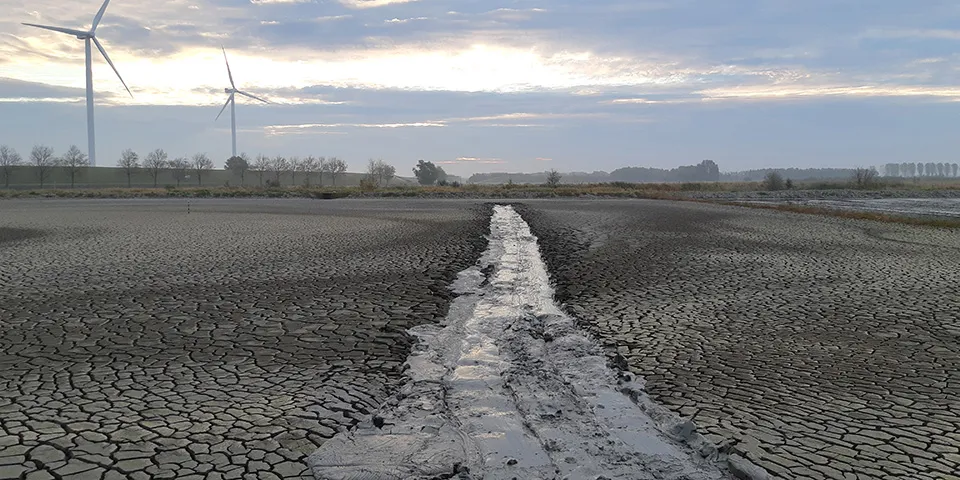
At Delfzijl, clay made from dredged sediment from the Eems-Dollard is being left to mature on a site of around 15 hectares. This pilot project, the “Kleirijperij”, was conceived and carried out by a consortium comprising Ecoshape (Van Oord, Boskalis, Arcadis, RHDHV, Witteveen+Bos, Wageningen Marine Research and Deltares), Groningen Seaports, Rijkswaterstaat, Het Groninger Landschap, Provincie Groningen and Waterschap Hunze en Aa’s.
The aim of this pilot? To produce usable clay that can be used to strengthen a disapproved sea dike along a 12.5 km stretch. We discuss this unique project with Marcel van den Heuvel, Technical Manager of Kleirijperij and Engineering Specialist at Van Oord, and Erik van Eekelen, Programme Manager at EcoShape and Lead Engineer Environmental at Van Oord.
Erik van Eekelen, Programme Manager at EcoShape and Lead Engineer Environmental at Van Oord, on the left, and Marcel van den Heuvel, Technical Manager of Kleirijperij and Engineering Specialist at Van Oord, on the right.
A major step forward for the water engineering sector
We ask why Van Oord is involved with Ecoshape. Van Eekelen explains: “Van Oord places great importance on Building with Nature. Innovative developments that contribute to greater sustainability in the water engineering sector matter to everyone. We are happy to share our knowledge in this area so that everyone can benefit from it. This helps make water engineering projects better and, in turn, more viable. Through the Building with Nature principle, we want to think proactively about using natural resources in ways that have a positive impact on the ecosystem. This is of great importance to society, not just to Van Oord as a contractor, but to the entire Dutch water engineering sector.”
100% green construction material
The Kleirijperij pilot project in Delfzijl contains dredged sediment from the Eems-Dollard. Through a natural process, the sediment is expected to consolidate and ultimately produce clay firm enough to cut. “The great thing is that what there is too much of in one place, dredged sediment, can ultimately be used to solve a shortage somewhere else, namely a shortage of clay. The dike in need of repair can soon be strengthened with mature clay in a 100% green way,” says Van den Heuvel. “Because there is no need to transport clay from distant areas, this approach is even more sustainable. Better still, using clay as a natural building material means the dike retains its green character. Where asphalt would otherwise have been used, we will instead have a 100% green construction material for reinforcement.”
July 2019: the maturing sediment is already developing a distinct clay structure. (Image: Deltares)
Pilot follows an initial trial
“The idea first took shape in 2014, when EcoShape launched a programme with the Wadden Sea ports, all of which have problems with sediment. There is a relatively large amount of maintenance dredging, but major intervention is not possible because the Wadden Sea is a UNESCO World Heritage Site. Together, we defined several projects, including the Delfzijl salt marsh trial and the sediment motor in Harlingen. Sediment management is a major issue. EcoShape partners were already working on the Eems-Dollard problem when the water boards approached us about dike reinforcement, looking for an alternative to traditional asphalt. Green dikes have landscape value, which is why there is a great need for clay,” continues Van Eekelen. “In 2015, we got together to discuss our ideas, which we wanted to test at full scale. In July 2017, six parties signed an agreement to carry out the trial. We have now set up a few hectares, and the Kleirijperij has become a reality. The first sediment arrived at the depot on 5 April 2018.”
The 15 trial plots, or depots, each measure just under 100 x 100 metres and have an average depth of 1.5 metres. “Everyone was surprised by how quickly a crust formed on the depots, which had been filled with liquid sediment with a consistency similar to chocolate milk. The crust soon reached a thickness of 30 to 40 cm. The clay dries out through shrinkage and consolidation, allowing more oxygen to enter,” explains Van den Heuvel. “It is partly a physical process and partly a chemical one. Water, salt and organic matter (algae, etc.) have to be removed because the material needs to become dike clay that meets the applicable guidelines for density, salt content and organic matter.” Van Eekelen adds: “The requirements for dike clay have been translated directly into the pilot.”
Second location now in operation
A second location has since been added, bringing the total number of trial plots to 25. “No two plots are the same: we vary the layer thickness, sometimes using a draining sand layer and sometimes more active treatment layers. We also let some plots become overgrown, and one plot is half-filled with fresh water to influence salt removal. The pilot will be a success if we can develop a sound business case,” says Van den Heuvel.
For Van Oord, it is important to map the processes that can be used to convert other types of sediment. “If the technique can be tailored to sediment in specific areas, anywhere in the world, then clay can be produced close to the source. This could be an excellent solution in some parts of the world. That is why we need to establish how to identify the type of sediment, what kind of clay is needed and which process is appropriate,” explains Van Eekelen. “For Van Oord, the key is applying these findings more widely. This is a technical matter, but it is also very much about stakeholder management, with nature becoming an essential component of the overall picture.”
Question about this story? Ask your question
Keep following this
Get an email when a new story is published. No account needed.
- SubjectGeneral







