












Fieldwork is crucial for useful soil investigations
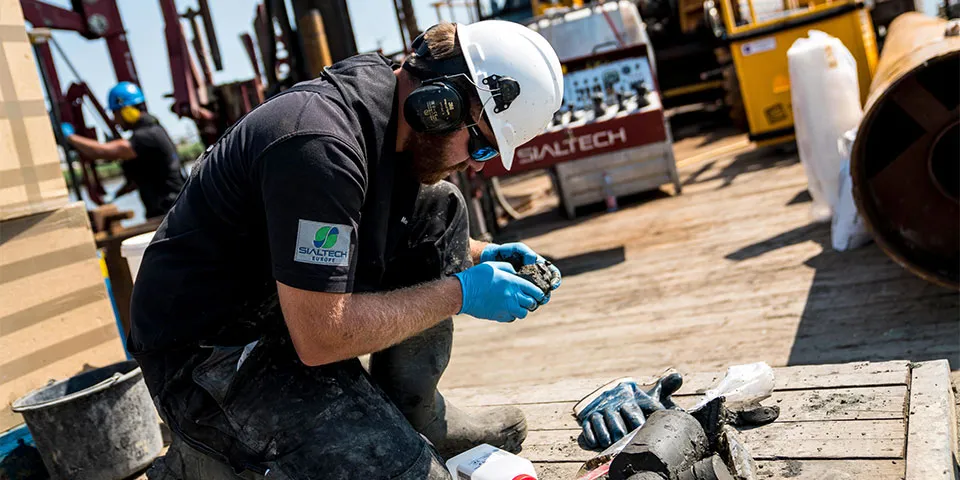
Fieldwork is a key part of any good soil investigation. Carrying out soil drilling and taking soil and groundwater samples, while taking into account the purpose of the investigation and local conditions such as geology or the presence of contaminants, places very different demands on an organisation from processing the results.
Henk Nijmeijers, director of Sialtech, is speaking. The company operates internationally and has more than 25 years’ experience in soil drilling and taking soil and groundwater samples, both on land and in water.
From geotechnical drilling in the centre of Amsterdam to a sediment investigation in the ports of Rotterdam, or from archaeological research in Antwerp to an environmental soil investigation in Sweden. Quality comes first at Sialtech, which is why many renowned organisations at home and abroad call on the company. Nijmeijers: “We grew out of a consultancy, and that is still part of our DNA. We believe that good fieldwork is crucial to the final advice. We draw on our knowledge of different drilling and sampling techniques to carry out good soil investigations. In the Netherlands, we have therefore always been closely involved in the development of legislation and regulations. Internationally, we also try to share our knowledge by contributing to the planning of projects.”
Sialtech is proficient in almost all standard drilling and sampling techniques, from traditional percussion drilling to the more innovative sonic drilling. “Thanks to our background, the wide range of techniques we offer and our extensive expertise, we can always work with the consultant to find the best approach. That sets us apart from other fieldwork companies. We know what is needed to carry out a useful soil investigation.”
Projects
Sialtech is involved in a wide variety of projects, including the geotechnical soil investigation for the construction of a new road tunnel beneath the Scheldt. “The Scheldt Tunnel, or Oosterweel Tunnel, is an immersed tunnel. To assess the geotechnical bearing capacity and the stability of the ground, it is important to map out the conditions. We carried out the drilling and soil sampling for this project,” explains Nijmeijers. “The contract involved drilling and sampling from a working platform in the Scheldt.”
For a major environmental soil investigation in central Sweden, Sialtech recently ‘flew in’ the CompactRotoSonic. “This rig uses sonic vibrations to drill through any type of geology. In this case, the ground consisted mainly of boulders and rock.”
Closer to home, Sialtech helped with the soil investigation at Griftpark Utrecht Nederland. Researchers hope to find bacteria deep in the heavily contaminated soil. Here too, Sialtech helped determine how to carry out the investigation and which drilling and sampling techniques would be best to use.
“So we can certainly say that soil is in Sialtech’s DNA. As is our drive to keep developing.”
Question about this story? Ask your question
Keep following this
Get an email when a new story is published. No account needed.
- SubjectGeneral







