












Exploring deep soil layers affordably
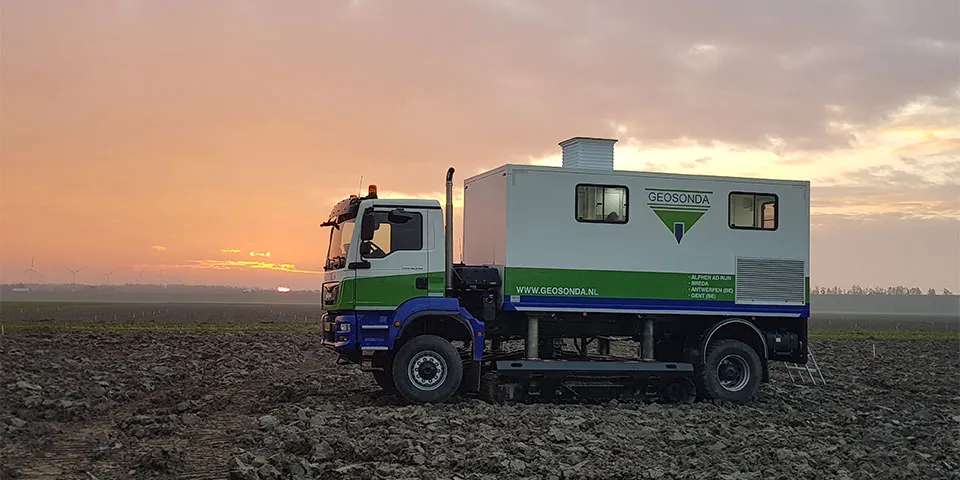
Geosonda focuses on ground investigation in the broadest sense and has been one of the pioneers in geotechnical site investigation since 1971.
“CPT testing is a relatively affordable way to investigate deep soil layers. Every year, we are involved in around 1,500 projects, all of which we deliver safely, to a high standard and cost-effectively,” says Aad van der Burg of Geosonda.
Before a construction project can begin, a ground investigation must first be carried out to check the subsoil. “We have advanced equipment for investigating the ground,” Van der Burg continues. “This ranges from large crawler-mounted CPT rigs to smaller tracked vehicles and even dismantlable equipment for locations that are difficult to access. Data generated by the ground investigation is used for foundation recommendations, excavation support advice, settlement calculations and so on. If required, our sister company Geomet can provide geotechnical advice.”
Geosonda is commissioned by architects, structural engineers and local authorities, as well as by fellow geotechnical consultancies to carry out fieldwork. “In those cases, we act as a subcontractor on a project, carrying out only the CPT testing,” explains Van der Burg. “We have extensive experience in CPT testing for all kinds of infrastructure projects, such as the construction of new roads, railway lines, viaducts and traffic gantries along national roads. Gantries and masts are getting bigger and bigger, and are structures in their own right. Ground investigation is often required for them too. We are fully VCA-certified and familiar with all relevant legislation and regulations.”
As well as carrying out CPT testing, the geotechnical services provider specialises in geomonitoring, including surveying and installing inclinometer casings and settlement plates. “Inclinometer casings can be used to measure horizontal movements,” Van der Burg continues. “They are often installed next to a sheet-pile wall or construction pit. A settlement plate allows us to determine changes in the elevation of deeper soil layers. A third service is monitoring groundwater levels and flows over a specified period. This data is then used as the basis for the geohydrological advice.”
According to Van der Burg, Geosonda’s strengths are its flexibility, ability to respond quickly and ease of scaling up capacity. “That last point is particularly useful for infrastructure projects, for example when CPT testing needs to be carried out at night on and around roads and railways. We operate nationwide from our branches in Alphen aan den Rijn and Breda. Recent major infrastructure projects we have worked on include the Leidsche Rijntunnel and the RijnlandRoute.”
Question about this story? Ask your question
Keep following this
Get an email when a new story is published. No account needed.
- SubjectGeneral







