












Customs Support Group research: despite greater focus on customs management, European companies still face significant non-compliance risks
Geopolitical instability and the complexity of cross-border trade are prompting European companies to place greater emphasis on customs management. However, in-house expertise remains inadequate to anticipate changes and non-compliance risks proactively
Key findings:
- Customs management is becoming a strategic priority: 44% of companies report that the function has greater visibility and is more involved in strategic decision-making.
- In more than 70% of cases, European companies outsource customs clearance to external customs professionals, mainly because of a lack of in-house expertise and capacity, greater awareness of compliance risks, potential delays and commercial opportunities.
- One in three European companies responds to trade uncertainty only reactively. Three-quarters of respondents have not yet taken steps to mitigate the compliance risks associated with changing export and import tariffs.
- Goods classification is a major risk area: 56% are at risk of misclassification, one in three has never reviewed its classifications, and 28% has already experienced negative consequences, such as additional costs or customs inspections.
Global trade is becoming increasingly complex: geopolitics, volatile markets and an ever-growing web of regulations are making customs and trade compliance a strategic priority for European companies. At the same time, in-house capacity and specialist expertise are often insufficient to keep pace with developments. This is the main conclusion of the second Strategic Radar Customer Survey 2026 by Customs Support Group (CSG). For this research, Europe’s leading independent provider of customs clearance and trade solutions evaluated questionnaires from nearly 200 European manufacturing and retail companies.
Customs management moves into the boardroom
Customs management is increasingly moving from the back office to the boardroom: almost 44% of the companies surveyed say the customs function has become more important. 18.5% describe this as a significant increase in its importance to the organisation. This shows that companies are taking the growing complexity and volatility of cross-border trade more seriously at a strategic level.
The reality, however, is somewhat more complicated: although the strategic importance of customs management is growing, many organisations lack the necessary expertise and capacity. “The research reveals a paradox,” says John Wegman, CEO of Customs Support Group. “Customs and trade compliance is more important than ever, yet many companies are understaffed and respond reactively rather than proactively. This is highly risky in a geopolitically unstable environment. External trade advisers and specialist customs brokers can help fill this gap. They are increasingly positioning themselves as long-term strategic enablers, rather than purely operational suppliers.”
Outsourcing remains the norm
Despite the growing strategic importance of customs management, operational customs clearance is outsourced by many companies: 70% of the European companies surveyed do not have an in-house team for customs declarations and rely on external partners. Even where in-house teams do exist, they are usually small: around two-thirds of European companies that handle customs declarations themselves employ no more than four full-time staff for this work. These companies also usually work with external partners.
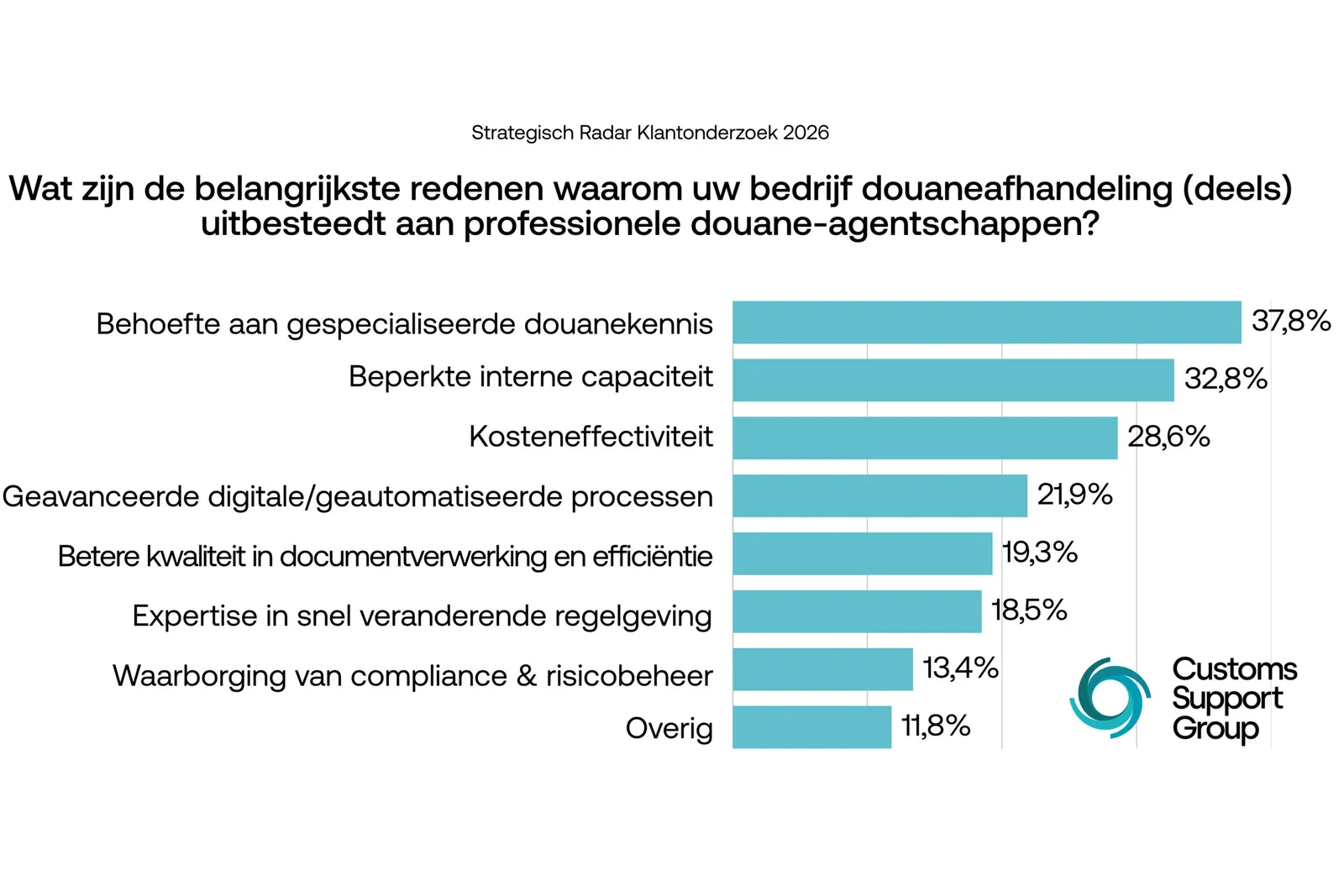
A lack of specialist customs knowledge is the main reason for outsourcing for 38% of respondents. A third cite a lack of capacity, while just under 30% consider outsourcing more cost-effective. Other benefits include access to digital solutions (22%), better documentation quality (19%) and support with rapidly changing regulations (18.5%).
Despite the shortage of in-house expertise, there is considerable reluctance to recruit: although 23% of European companies have hired additional staff for their customs compliance department in the past 24 months, only 6% plan to recruit more. 58% have no plans to expand at all.
Goods classification: one of the biggest non-compliance risks
As tensions over tariffs continue to rise, accurate goods classification is essential for determining import duties and understanding the impact on the supply chain. Although customs declarations are often outsourced, goods classification remains an in-house responsibility: 60% classify goods entirely in-house, while 20% combine in-house expertise with external support.
Only 30% have a high level of confidence in their goods classification, which is relatively low given the importance of the task. Checks on goods classification are also limited: only one in three companies reviews its classifications annually, while a third has never carried out a review. Just 12% plan to conduct a review this year.
As a result, more than half of the European companies surveyed (56%) are at risk of misclassification, which could have a significant financial and operational impact, including higher costs or customs inspections. Indeed, 28% report having already experienced these consequences. Accurate goods classification is also crucial to making the most of trade agreements, many of which are new.
“This discrepancy between responsibility and review practices is concerning,” says John Wegman. “Companies that classify goods once and then fail to review those classifications regularly create unnecessary risks: from additional payments to inspections and operational delays, or missed commercial opportunities. Where in-house capacity is limited, partially outsourcing to trusted external partners can help address this shortfall.”
AI supports, but human expertise remains essential
Compared with last year, artificial intelligence plays a less prominent role this year. No company relies entirely on AI for classification. Only 24% use AI regularly or occasionally for goods classification. Notably, 55% are still holding off on implementing AI for these tasks.
“This reluctance is justified,” says John Wegman. “Goods classification has significant implications for regulatory compliance, and organisations do not want to risk an algorithm misclassifying goods and triggering huge fines. Human expertise, what we call ‘real intelligence’, remains the foundation. That said, AI can add value, for example by consolidating data and supporting analysis, while the final classification decision is left to experienced human specialists.”
Many companies only react in a crisis, and that is too late
The war between Russia and Ukraine remains the biggest external strain on supply chains: 32% of European companies report being directly affected by this conflict. The Red Sea crisis follows closely behind (23%), along with the tariff conflict with the US (21%).
Many companies are therefore concerned about future geopolitical instability and uncertainty. On a scale of one to five, the level of concern stands at around 3.1. Around a third are concerned or very concerned.
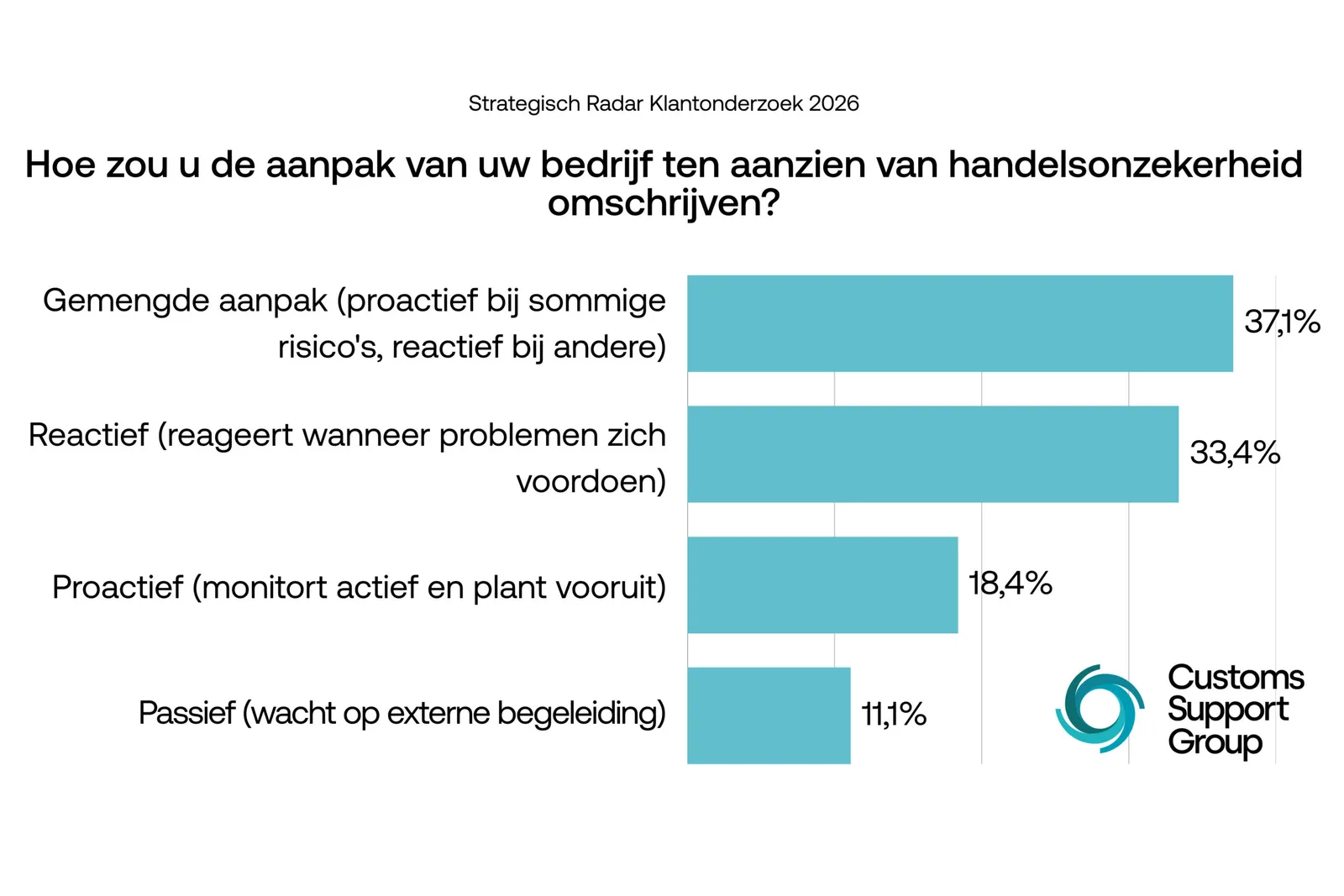
Despite this, many companies are reacting rather than anticipating: more than 42% have taken no specific measures to address geopolitical tensions and their impact on the supply chain. In addition, three-quarters of European companies have taken no measures to mitigate the risks of tariff conflicts. Overall, just 18% say they address trade uncertainty proactively and with foresight. A third only respond when significant problems arise, while around 10% describe their approach as passive.
“This is not sustainable. In 2026, a reactive approach will no longer be viable,” warns John Wegman. “Regulatory pressure, enforcement intensity and geopolitical instability are expected to lead to more proactive and structured responses. Organisations that do not adopt this approach face a higher risk of non-compliance, increased costs and operational disruption.”
Download the full Strategic Radar Customer Survey 2026 here
Methodology
Customs Support Group conducted the Strategic Radar Customer Survey in the fourth quarter of 2025 among 194 European importers and exporters. The online survey focused on five key themes:
- In-house customs clearance capabilities and staffing;
- Outsourcing patterns for customs tasks;
- Goods classification management;
- Impact of geopolitical events;
- Strategic responses to trade uncertainty and regulatory volatility.
Respondents came from, among other countries, Italy and the Netherlands (17.5% each), Germany (16.1%), Poland (13.3%), Belgium and the US (7% each), and France and the UK (5% each). Respondents work in logistics (28.8%), customs (19.1%), management (14.6%) and procurement (8%).
Question about this story? Ask your question
Keep following this
Get an email when a new story is published. No account needed.
- SubjectGeneral







