












Construction of the outer lock head cofferdam for the New Lock in Terneuzen well under way
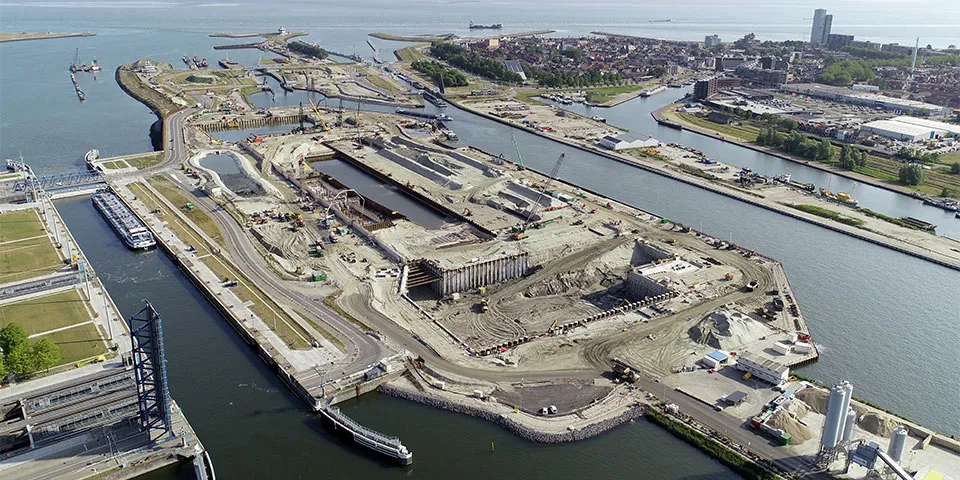
Work is proceeding at full pace in Terneuzen to build the cofferdam for the outer lock head.
The lock heads are being built in a dry cofferdam, where work will take place on the door recesses, bridge chambers and levelling system on both sides of the lock chamber. Work on the outer head, the lock head on the Western Scheldt side, is slightly ahead of work on the inner head, on the Ghent-Terneuzen Canal side.
The cofferdam for the outer head was first excavated dry to -11 metres NAP, and ultimately needs to reach a depth of -22 metres NAP. To reduce the upward pressure on the base, the outer-head cofferdam was filled with around 15,000 m3 of canal water after the dry excavation. Two cranes then carried out wet excavation to -22 metres NAP from a 55 x 22-metre pontoon in the cofferdam. This work is currently in full swing at the inner head.
12,000 cubic metres of underwater concrete
Most of the material excavated during the wet excavation was pumped away via the existing pipeline route. The non-reusable soil was taken by ship from Buitenhaven-West for disposal. Reusable soil was sent via a branch in the pipeline route to one of the soil depots elsewhere on the construction site. After the dry and wet excavation, it was time to pour underwater concrete on the base of the outer-head cofferdam. First, a layer of gravel was laid as a base for one metre of underwater concrete. The concrete was poured on 4, 5 and 6 August 2020 in a continuous operation. Divers poured a total of 12,000 cubic metres of underwater concrete, working 24 hours a day for three days. The process had to be carried out without interruption to ensure the quality of the concrete floor.
Production at the on-site concrete plants
The on-site concrete plants are located at the Zeevaartweg construction site, where the underwater concrete was produced. A total of 60 tonnes of cement was used, delivered from Belgium by two bulk trucks per hour. As the process could not be interrupted, a ship carrying cement was on standby as a back-up in case anything went wrong with road deliveries. Sand and gravel for production were delivered by ship during the day.
This approach was part of the plan to minimise disruption as much as possible. Having the concrete plants on site meant that concrete mixers did not have to travel on public roads. In addition, producing the concrete on site helps ensure consistent quality of the underwater concrete.
Pumping out the cofferdam
The underwater concrete has now hardened and the cofferdam is being pumped dry. The thick concrete floor, combined with dewatering, keeps the pressure under control and prevents the floor from bursting upwards. Dewatering is carried out carefully and in a controlled manner. Groundwater is extracted from beneath the cofferdam and then returned to various soil layers nearby, meaning its impact on the surrounding area is negligible. Water levels around the cofferdam are monitored, as is the stability of the façades of several houses in the centre of Terneuzen. Survey markers have been installed on the façades for this purpose. The dry cofferdam is around 25 metres deep.
Question about this story? Ask your question
Keep following this
Get an email when a new story is published. No account needed.
- SubjectGeneral







