












Building and installing the Jan Linzel Viaduct over the A4: a large-scale precision operation
Work on the cycle viaduct in The Hague is nearing completion. The viaduct crosses the A4 between the Ypenburg and Prins Clausplein interchanges. The cycle viaduct, named the Jan Linzel Viaduct, is no less than 330 metres long.
Development
Because of its length, the viaduct comprises nine sections. These were fabricated as steel structures by Hillebrand and will rest on eight concrete supports installed by Dura Vermeer. “It’s a very intensive project. The entire engineering and production process had to be set up in a relatively short period, with the closure of the A4 as the firm deadline,” says Willie Lievense, project manager at Hillebrand. Installing the four sections above the A4 required thorough preparation, which Hillebrand’s multiple teams worked on carefully for a long time. “Good preparation is half the battle. Especially when you see how smoothly the main contractor, Dura Vermeer, and we, as a bridge-building specialist, work together. When you complement each other, play to each other’s strengths and value each other’s contribution, you achieve excellent results.”
Installing the viaduct sections was a major undertaking: no fewer than 4 of Mammoet’s 7 ‘heavyweights’ were working at the same time. One of them was a 750-tonne crane, the largest mobile crane on wheels still permitted on the road.
Production
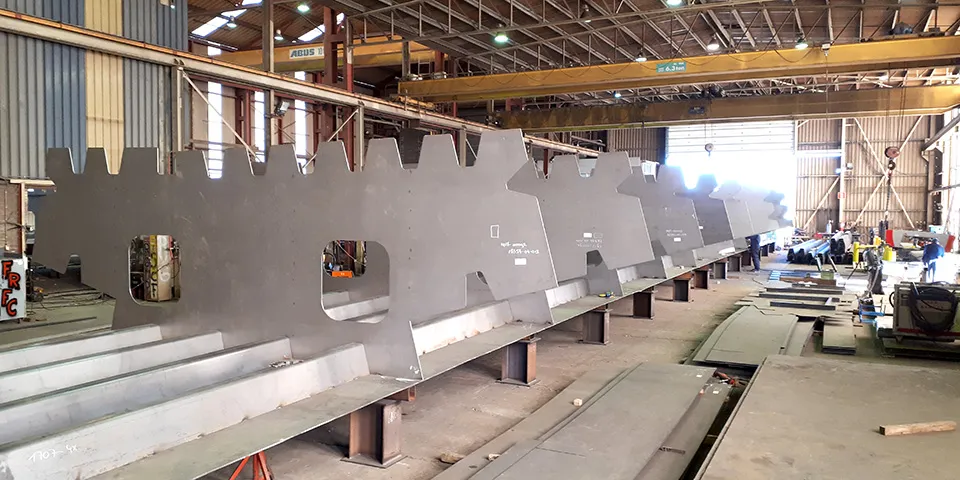
As well as the excellent collaboration with Dura Vermeer, Lievense praises the entire Hillebrand team that worked on the project. Hillebrand has two large waterside production facilities, providing the capacity needed for the project. “Production alone involved no fewer than 35,000 man-hours. The main challenge was creating the gently curved shape.” Lievense explains: “You have to account for factors such as the bridge’s own weight, gravity and pressure loads, so during production you need to create a greater curve than the one you ultimately want. That takes a lot of engineering.” The workshops in Middelburg and Vlissingen worked with an extensive 54-metre-long jig. Using this jig, they created a kind of box girder from steel plates, with internal stiffeners. “It may look like a matter of welding plates together, but it takes a great deal of expertise and experience to create a strong structure.”
Transport
“Transporting all these non-standard sections and components was also a major challenge. Our partner Mammoet played an important role in that. Together, we explored various options. In the end, we decided to lift the enormous components from Middelburg and Vlissingen onto an inland vessel using heavy cranes, then take them by water to Schiedam. There, the components were lifted off the vessel and driven to The Hague at night on special transport trailers. Our team was ready at the destination to assemble the bridge sections.”
And of course, installation
Sections A and B were installed above the motorway carriageway on the first night. On the second night, the two largest sections, which span the motorway’s entry and exit lanes, were assembled: bridge section C, measuring 54 metres and weighing 160 tonnes, and bridge section D, measuring 46 metres and weighing 130 tonnes. “That kind of weight calls for heavy equipment,” says Lievense. “So four heavy-duty mobile hydraulic telescopic cranes were deployed: one 500-tonne, one 700-tonne and two 750-tonne cranes. A large-scale precision operation, then. When everything literally falls into place and the work is completed safely, it gives you an immense sense of satisfaction.” The remaining five sections run alongside the motorway and will be installed in the final phase. Dura Vermeer will then, of course, complete the bridge.
Question about this story? Ask your question
Keep following this
Get an email when a new story is published. No account needed.
- SubjectGeneral







