












An unusual launching method on the new A16 Rotterdam
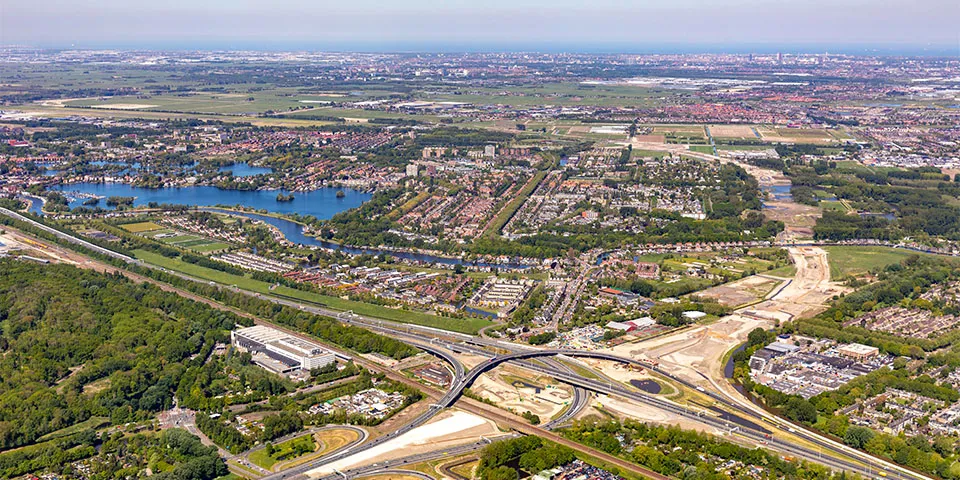
Rijkswaterstaat is building a new motorway between the A13 at Rotterdam The Hague Airport and the A16/A20 at Terbregseplein. The 11 km-long A16 Rotterdam will allow traffic on the A13, A20 and surrounding local roads to flow more freely. The new link will improve accessibility and quality of life in the region. The De Groene Boog construction consortium includes, among others, TBI companies Mobilis and Croonwolter&dros. Mobilis is responsible for the civil engineering works, while Croonwolter&dros is responsible for all installations, including the tunnel systems. We speak to Martijn Jansen, design lead at Mobilis.
Viaduct will be a feat of engineering
“The viaduct over the existing infrastructure at Terbregseplein will be a feat of engineering. We are pushing in-situ-cast box girders across Terbregseplein without disrupting traffic. This is also known as the Incremental Launching Method,” Jansen begins. “In civil engineering, this method involves building an entire bridge deck from just one side, pushing the bridge superstructure towards the other side in sections. We are talking about 400 metres per girder, per direction of travel. We are currently working on the piers, over which the box girders will later be pushed. This method is unique in the Netherlands.” The girders are pushed at a speed of around 0.5 metres per hour. “It is completely safe, but it may be an unusual sight for traffic passing underneath. The launch is from the north side, where the construction facility is located.”
The crossing with the HSL is also a challenge: the works must not affect the existing infrastructure. The A16 Rotterdam, which passes over the HSL, will be 8 metres above ground level. Jansen says: “The ground is being raised using EPS. Micropiles provide the necessary foundation and function as ground anchors under compression. In the layers of the HSL foundation, we isolate the micropiles using PVC casing. This means that all load transfer takes place below the foundation layer of the HSL structure. The crossing with the Rotte is also a construction challenge: we are building a tunnel under the river on site. Safe and watertight.”
Traffic heading for The Hague will no longer use the ring road
“The 11 km-long A16 Rotterdam will allow traffic on the A13, A20 and surrounding roads to flow faster and more smoothly,” says Jansen. “As well as improving traffic flow, it will reduce disruption for residents living alongside the A20 and A13 at Overschie, cut noise pollution and reduce emissions.”
The A16 will pass over the existing Terbregseplein, then continue as a tunnel through Terbregseveld and under the Rotte. “After that, the A16 continues in a semi-sunken tunnel beneath Lage Bergse Bos. You won’t hear, see or smell the new A16 here. This was a requirement set by Rijkwaterstaat, as stated in the route decision. The semi-sunken tunnel emerges from the ground in the north of Rotterdam. New viaducts will cross the railway to pass over the HSL and Randstadrail, after which the A16 runs parallel to the N209 before joining the A13,” Jansen explains.
Energy-neutral design wins Sustainable Pearl award
The A16 Rotterdam has been carefully integrated into its surroundings, with the motorway out of sight, earshot and smell at many locations. It is also the world’s first energy-neutral motorway with a tunnel. Jansen explains: “Many parts of the project are connected to solar farms, including the installations inside the tunnel. The A16 Rotterdam project has received a ‘Duurzame Parel’ award for this, recognising projects that apply the Aanpak Duurzaam GWW in a unique way. Duurzame Parels are awarded to a client and contractor working together on a GWW project who have devoted more than average attention to applying the Aanpak Duurzaam GWW or elements of it.”
The De Groene Boog construction consortium consists of BESIX, Dura Vermeer, Van Oord and TBI companies Croonwolter&dros and Mobilis. Jansen says: “During the tender phase, ambitious commitments were made on the use of materials and energy during the operational phase. The consortium also submitted its bid with CO2 Performance Ladder level 5, aiming for a minimum 10 per cent reduction in CO2. CO2 emissions will be reduced to a minimum. In addition to using solar farms and LED lighting, we are also using electric transport and hybrid equipment.” The project slogan, ‘Groen en Groos’, is therefore no coincidence.
Three project areas
The De Groene Boog construction consortium has divided the A16 Rotterdam project into three areas: the area north of Rotterdam, the tunnel and the area around Terbregseplein. During the preliminary design phase after the contract award, Jansen was responsible for all structures; he is now responsible for designing the civil engineering structures in the area north of Rotterdam. “You can think of the tunnel as one complex, integrated project, with a great deal of interaction with the surroundings, residents, businesses and stakeholders such as Recreatieschap Rottemeren. The area north of Rotterdam presents a geotechnical challenge because of the soft ground and the large number of crossings. At Terbregseplein, we will use the so-called Incremental Launching Method. It is a unique method in the Netherlands, which Mobilis is using to build the A16 Rotterdam.”
Question about this story? Ask your question
Keep following this
Get an email when a new story is published. No account needed.
- SubjectGeneral







