












A solution that fits every gully? It’s here!
Drainage contractors all know the problem when they need to clean or unblock a gully: the odour trap can fall out of its fixing. Putting it back in place is awkward and time-consuming.
Nering Bögel has developed a new flap that stays firmly in place. The ‘click flap’ is innovative not only in its application. During the design process, Nering Bögel discovered that municipalities’ needs now go beyond having an effective odour trap.
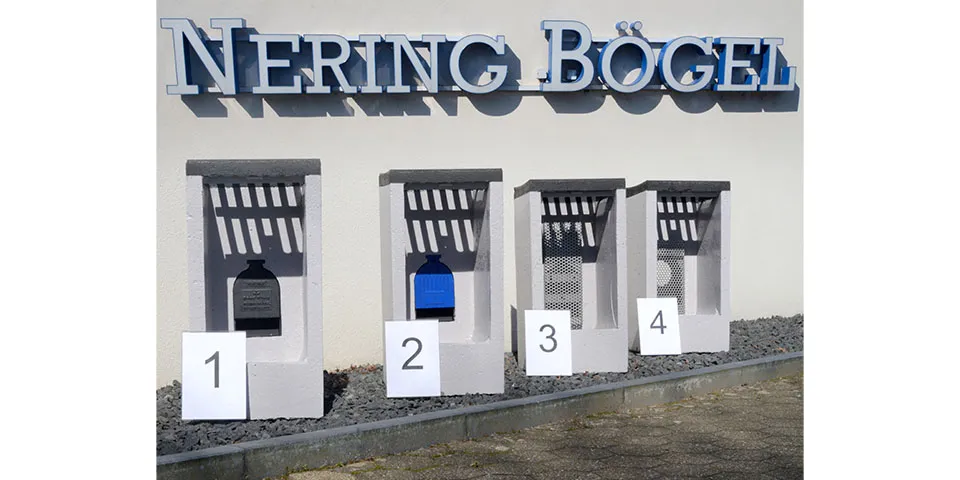
1: A gully with a cast-iron odour trap, the traditional design.
2: A gully with the new click flap, a new design suitable for the wastewater system.
3: The traditional gully with a cast-iron odour trap, combined with the debris catcher.
4: A gully with a debris catcher and no odour trap, allowing optimum water flow while preventing debris from entering the downstream system.
An odour trap is not wanted everywhere
We speak to Toin Bongers, Operations Director, and Henrie van Geneijgen, field service representative at Nering Bögel. “Of course, the starting point for designing the click flap was to ensure that it could not fall out of the gully,” Van Geneijgen begins. “However, some municipalities told us that they only want an odour trap in places where it is genuinely needed, for example in gullies that drain wastewater or combined sewage. In other locations, where there is no connection to a combined or wastewater sewer, they would prefer not to have a flap at all. They would rather maximise water flow.”
Bongers adds: “Especially with a 160 mm connection diameter, you get maximum drainage capacity, which is needed to tackle increasing waterlogging. An odour trap does, however, restrict drainage capacity.” Bongers and Van Geneijgen believe gullies need to be better prepared for peak loads. “At the same time, a lot of debris ends up in a gully, such as leaves, twigs and street litter. Ideally, that debris should not enter the downstream system, particularly if the gully drains into a vulnerable infiltration system,” Van Geneijgen explains. “The aim, then, is to have a device in the gully that keeps the debris there. Nering Bögel already had such a device, but it was always used in combination with an odour trap. We have now addressed this by developing a debris catcher that can be fitted in the odour trap chamber.”
The age-old gully is suddenly multifunctional
“By listening to what municipalities wanted, we have not only been able to develop a solution that keeps the odour trap firmly in place, but have also met the need to keep all debris in the gully,” Bongers continues. “And the great thing is that this age-old gully has suddenly become multifunctional, thanks to all the options now available. We have come up with something simple, effective and unique. The choice is now between a gully with a cast-iron odour trap, the traditional design; a gully with the new click flap, a new design suitable for the wastewater system; the traditional gully with a cast-iron odour trap combined with the debris catcher; and a gully with a debris catcher and no odour trap, allowing optimum water flow while preventing debris from entering the downstream system.”
Anyone who thinks the new solutions can only be used in Nering Bögel gullies is mistaken. Van Geneijgen says: “We wanted the new solutions to support sustainability and circularity. That is why gullies from other brands can also be retrofitted with our products. Any old gully can be upgraded in this way!” The debris catcher also has the benefit of keeping pests out. Bongers explains: “The debris catcher can prevent pests such as rats from emerging in the street, for example by travelling from wadis through the sewer. Keeping these pests out makes a significant contribution to public health.”
Robust design with clever features
The debris catcher has been carefully designed. To start with, it is made of stainless steel, making it highly durable. Van Geneijgen points out another clever feature: “We designed it to ensure that drainage continues even when water levels fluctuate, including when the gully is largely full of debris. The debris catcher is also designed to stay firmly in place if cleaning or emptying is not carried out with sufficient care.” Old gullies are inherently sustainable, as they are made of concrete and cast iron, with no plastic. The fact that the new variants developed by Nering Bögel extend the service life of any gully makes the overall solution even more sustainable.
Question about this story? Ask your question
Keep following this
Get an email when a new story is published. No account needed.
- SubjectGeneral







