












A helicopter view prevents surprises
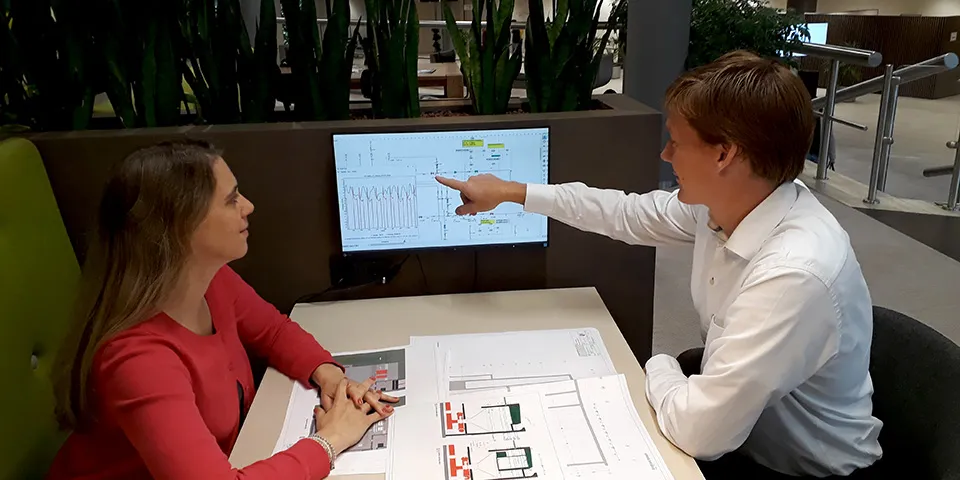
On a flagship project such as the renovation and upgrade of the wastewater pressure main (AWP 2.0) in West Brabant, it is important to keep the scope firmly in view at all times. As part of the PAUW consortium, Royal HaskoningDHV acts as BIM coordinator for all parties, among other roles, and oversees the project as a whole. To prevent surprises, the consultancy and engineering firm uses a Virtual Commissioning model, or digital simulation, to test the control systems at the pumping stations. This is unique in the Netherlands.
Digitalisation
According to Maartje Wise, Project Director at Royal HaskoningDHV, GMB Waterkwaliteit & Installaties has relied on the consultancy and engineering firm’s expertise for many years. “We have worked together across the business on various areas for many years, from flood defence reinforcement to pumping stations and more. That collaboration seems to be growing ever closer. For the AWP 2.0 project, we submitted a tender together with the other PAUW partners. The fact that only two other bidders were involved gives an indication of the project’s complexity. The risks are significant, so we have placed a strong focus on digitalisation and clash detection on this project. Digital transformation is also embedded in our strategy, with the aim of making major advances across the business.”
For AWP 2.0, Royal HaskoningDHV coordinates all the 3D design work.
Putting the pieces together
For AWP 2.0, Royal HaskoningDHV is responsible for the hydraulic design, civil and structural design, mechanical engineering coordination, coordination of the interfaces in the control plans for the pumps, and BIM coordination for all PAUW partners. “The collaboration between all the partners runs like clockwork,” says Maartje. “Communication is open and transparent, and absolutely everything is up for discussion. This is also helpful for mitigating potential risks. At Royal HaskoningDHV, we now use BIM on virtually all our infrastructure projects. We have extensive 3D modelling expertise and coordinate all the 3D design work for AWP 2.0, bringing all the pieces together in a single integrated model. This also makes it possible to carry out clash detection, so any issues can be identified early. What is truly innovative is that we are creating a Virtual Commisioning design for the AWP: a virtual model that can fully simulate the process between the Factory Acceptance Test (FAT) and the Site Acceptance Test (SAT).”
Virtual Commisioning
Christiaan Nieuwenhuizen, Hydraulic Engineer at Royal HaskoningDHV, explains the Virtual Commisioning (VC) model. “Essentially, it is a digital test environment (digital twin) of Pentair Nijhuis’s pumping installations and the long pressure mains, which allows us to test the pump control system designed by Hoppenbrouwers Techniek. We can then see virtually how the pumps and the transport system respond to different situations. In many cases, it is not possible to test every scenario in practice because there is not enough water. The VC model is used to assess all the possible variations or deviations that might occur. This helps prevent surprises when the system is operating in practice.” Maartje adds: “The VC model is a perfect fit with our digital transformation. On a project as complex as this, being able to eliminate or reduce risks adds enormous value.”
Question about this story? Ask your question
Keep following this
Get an email when a new story is published. No account needed.
- SubjectGeneral







