












A flood of new machines
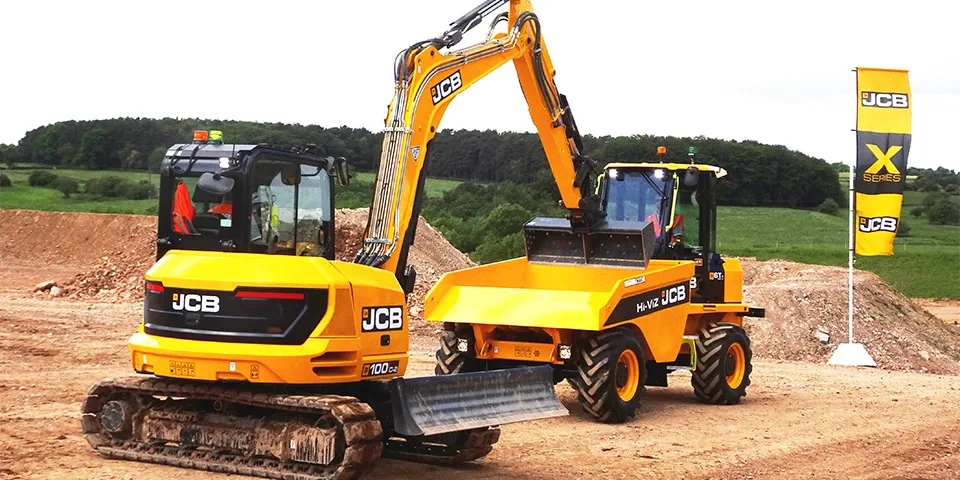
Brexit or not, the world keeps turning for JCB. The British construction equipment manufacturer continues to innovate and share the results with the rest of the world. At the beginning of June, trade journalists from across Europe were given an in-depth look at a large number of new machines and digital tools.
To start with the biggest news: the Hydraload 555-210R is not only JCB’s first rotating telehandler, it is also set to be a gamechanger on sites where a lot of prefabricated elements are used or, for example, sewer pipes are installed. With a lift height of 20.5 metres and a maximum lifting capacity of 5.5 tonnes, it can replace mobile and even fixed cranes, while also handling a wide range of other material-handling tasks. It can of course also be used as a telehandler with a platform for ‘standard’ applications. The outrigger system is highly flexible: it can be deployed in a wide or narrow configuration and features automatic levelling, making set-up extremely quick.
The Hydraload 555-201R will be launched in Europe later this year. It is set to be a gamechanger on sites where a lot of prefabricated elements are used.
A 2-metre jib can be used for lifting work, and attachments are recognised automatically, with the correct load chart selected. The Hydraload 555-201R will be launched in Europe later this year, adding the largest and most advanced model yet to the existing Loadall telehandler range.
More electric machines
The prototype of the fully electric 1.9-tonne 19C-IE mini excavator is now production-ready and will be available from autumn. It is five times quieter than the diesel version and designed for outdoor use, in cities, for example, or indoors and in tunnels for excavation or demolition work. Another electric newcomer is the new Teletruk 30-19E. This compact telehandler is also fully electric and is intended in part to replace and complement the forklift truck, while offering several distinctive advantages. Its telescopic mast, for example, allows it to place pallets further away and higher up: it can handle up to 1,900 kg at distances of 2 metres, and its turning circle is minimal. With no lift column, forward visibility is greatly improved, while its lower profile means it can now drive straight into containers. Its driving performance also outstrips that of a forklift truck. In addition, it operates quietly, both for bystanders and in the new Command Plus cab.
Lord Bamford explains to the European trade press why the fully electric Teletruk 30-19E is such a major step forward.
More new developments
There is plenty of other news worth mentioning, including the two compact CT160 and CT260 vibratory rollers. They offer a choice of two drum widths, provide better visibility of the drums and are easy to operate. The dumper range has gained a second 6-tonne model, the 6T-1HiViz. It offers the same high level of safety as last year’s 7-tonne HiViz, with even better visibility and no additional sensors or cameras. A lower centre of gravity has increased stability. It can also be fitted with JCB’s SiteSafe cab.
The electric 19C-IE mini excavator, shown as a prototype last year, will become available later this year.
Cleaner diesel engines
JCB maintains that diesel engines will be in use for a long time yet, but they will of course need to be very clean. The company is working hard to achieve this. Its own DieselMax engine range is fully Stage V compliant and is already fitted to a number of machines. JCB calls it ‘near-zero emissions’, a bold claim in keeping with its statement: “We want to be part of the solution, not part of the problem”. JCB has already produced a quarter of a million diesel engines, so the stakes are high. It was also announced that JCB will now use Cummins diesel engines in its larger machines.
The assembled trade press got a look inside JCB’s impressive Uptime Center at its head office in Uttoxeter, UK.
Digital tools
Uptime is the buzzword of 2019. At JCB, it is increasingly the starting point for customer relationships. JCB machines are reliable by design, and this needs to be demonstrated to the full in practice. Extensive monitoring of machine data can help make this happen. JCB has Uptime Centers at five locations around the world, with a sixth planned, where customers receive support to keep their machines working 24/7. JCB’s LifeLink system has been supplemented with an ‘Operator app’ (the iOS version is already available, with Android to follow later this year) and a fleet management system.
JCB calls the Stage V version of its own DieselMax engine ‘near-zero emissions’ and this chart shows just how close we have come to that point.
Question about this story? Ask your question
Keep following this
Get an email when a new story is published. No account needed.
- SubjectGeneral







