












86 years of pump expertise
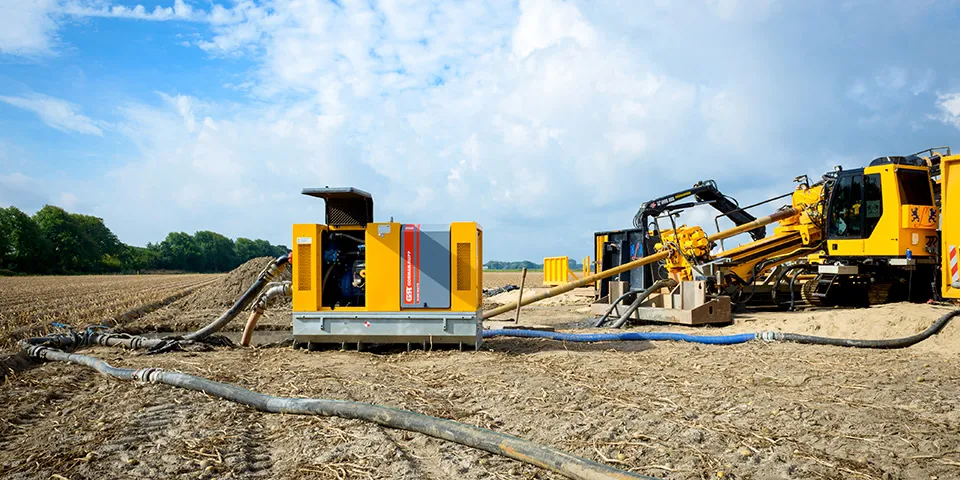
Gorman-Rupp pioneered the self-priming centrifugal pump. The first model was unveiled back in 1933. Since then, the pump manufacturer has grown into a market leader in the United States, with a range of thousands of pump types. The manufacturer is now well established in Europe too, not least thanks to its S-Line pump sets, a series of mobile pump sets developed specifically and fully tailored to the needs of the European market.
“There is a suitable Gorman-Rupp pump for every application,” says Jos Kelderman, Marketing Manager Europe. “We made our name with self-priming centrifugal pumps, but we also manufacture other pump types, ranging from diesel- or electrically driven pump sets and centrifugal pumps to submersible pumps, diaphragm pumps and gear pumps. Our self-priming centrifugal pumps are widely used in wastewater treatment plants, as well as, for example, to drain construction pits. Unlike a conventional submersible pump, our pumps are always positioned above ground. This extends their service life and also means the pump unit is always directly accessible. Maintenance can therefore be carried out safely, simply and quickly.”

Remote shed
Gorman-Rupp began in a remote shed. Kelderman: “The first pump was literally developed in a shed during the Great Depression of the 1930s. Despite the huge growth the family business has undergone, with the company now active worldwide on every continent, the friendly atmosphere of those early days is still very much alive. That is true here in Europe too. Our nickname, ‘The Pump People’, is no coincidence. We are proud to be a people-focused company with a strong emphasis on innovation and technological improvements. We stand behind the quality of our pumps, which are generally generously sized. This makes them extremely reliable and suitable for every application. The branches in the Netherlands and Belgium were formerly Gorman-Rupp distributors and have since been incorporated into the family group. The Dutch branch is now the central hub for all European operations, where engineering and assembly of diesel- and electrically driven pump sets, among other activities, take place. The Belgian branch specialises in building above-ground (sewage) pumping stations. Both branches also handle sales, service and rental activities in their respective countries. In the Netherlands, we are moving to a new site in early 2020, with an even larger warehouse stocked with a wide range of pumps and parts, modern workshops and a brand-new training centre.”
Specialist applications
In the Netherlands and Belgium, Gorman-Rupp is primarily active in the contracting, infrastructure and industrial sectors, as well as in sewerage and wastewater applications. “We have a wide range of pumps available for the infrastructure sector, and mobile pump sets can also be hired,” Kelderman explains. “Many infrastructure contractors use our rental division, so they can always be sure of having the right pump for the right application. This ranges from draining or keeping a construction pit dry to highly specialised applications. A good example of the latter is pumping bentonite. We have developed special pumps for this, which are available for hire.”

The online PumpTr@xxTM monitoring system sends the user an alert by text message or email if, for example, the fuel level drops below a certain point or the pump unit is moved.
S-Line pump sets
The heart of Gorman-Rupp’s pumps is manufactured in the United States. “Three years ago, we began a development programme to better tailor our pumps to the wishes and needs of European customers,” says Kelderman. “European contractors have more use for compact units. That is how the S-Line came about. Pumps in this range are powered by modern, high-performance diesel engines that meet the strictest EU Stage V emissions standards without the addition of AdBlue. There is a reason for that. Pump units are generally installed and expected simply to work. They are started up, and then no one gives them a second thought. As a pump manufacturer, you can find that frustrating, or you can take it as the starting point for product development. Adding AdBlue, for example, means an extra task that no one wants. The online PumpTr@xxTM monitoring system sends the user an alert by text message or email if, for example, the fuel level drops below a certain point or the pump unit is moved. After all, a mobile unit is often left running unattended and can be relatively easily moved or stolen.”
Built to withstand rough handling
Kelderman sums up the development of the S-Line pump sets as being based on practical experience. “The pump units are therefore designed to meet the specific requirements and conditions in which they are used. In other words, they are built to withstand rough handling and have a smart design. This makes the pump sets easy to clean, safe to work with and pleasing to look at. All dry self-priming pumps feature an oil-lubricated shaft seal with a large oil capacity. This provides optimum cooling for the seal, making the pumps resistant to prolonged and intermittent dry running. Finally, the combination of modern, quiet and fuel-efficient water-cooled diesel engines, revolutionary noise-reducing wing doors and soundproof enclosures keeps noise levels pleasantly low.”
Larger waste items in the fluids being pumped, such as plastic packaging materials, are a common problem. They can cause pumps to become blocked. The patented Gorman-Rupp EradicatorTM system pulls solid materials apart so they do not tangle together. This drastically reduces the number of blockages. “This is another example of an innovation designed to ensure our customers need to spend as little time as possible looking after our pumps and can focus on their core activities,” says Kelderman.
With its current range, Gorman-Rupp has a portfolio ready for the future. “The drive system is essentially secondary to the application. We can offer the right solution for every situation with our thousands of pump types. From very small mobile pump sets, also compliant with EU Stage V emissions standards, to very large units, infrastructure contractors can come to us for all their pumping needs,” Kelderman concludes.
Question about this story? Ask your question
Keep following this
Get an email when a new story is published. No account needed.
- SubjectGeneral







