












2021: a year of anniversaries for Daimler Trucks and Buses
Stuttgart: 2021 is a special year for Daimler Trucks and Buses, with no fewer than four anniversaries to celebrate.
In 1896, Gottlieb Daimler presented the first truck; in 1946, the first Unimog struggled across rough terrain as a prototype; five years later, in 1951, Otto Kässbohrer unveiled the first bus with a self-supporting structure, the Setra; and finally, in 1996, the prototype of the modern truck, the Mercedes-Benz Actros, was launched.
1896: the first truck
When Gottlieb Daimler presented his first truck in 1896, it was still equipped with wooden wheels fitted with steel tyres. The world was not waiting for such a vehicle. There were no buyers to be found in Germany, and in England, where the vehicle eventually found a buyer, an attendant still had to walk in front carrying a red flag to warn other road users. And yet this imposing vehicle, named Phoenix and powered through its rear wheels by a 1.06-litre, 4 hp two-cylinder engine, marked the beginning of an unparalleled success story in goods transport.
The Phoenix, incidentally, had little in common with a real truck: strictly speaking, it was a converted horse-drawn cart. The chassis was fitted with transversely mounted leaf springs at the front and coil springs at the rear. This suspension was essential, not only because the roads of the time were in poor condition, but also because the engine was particularly sensitive to jolts.
However, the final part of the drivetrain was a modern feature: a belt transferred the engine's power to a shaft mounted across the vehicle's longitudinal axis. A pinion, or reduction gear, was fitted to each end of the shaft. Each pinion tooth engaged with the internal teeth of a ring gear, which was firmly connected to the wheel it drove. Much later, this design principle became a characteristic feature of Mercedes-Benz trucks: the axle with planetary hub reduction, found in the ‘new generation’ and the SK (Schwere Klasse, heavy class), and still used today in construction trucks.
1946: the first Unimog prototype
In 1946, the Unimog ‘Prototype 1’ made its first test drive. Chief designer Heinrich Rößler was at the wheel himself, putting the prototype through its paces on the difficult mountain roads near Schwäbisch Gmünd. The vehicle did not yet have a cab, but it was already carrying a load of timber. The Unimog's origins were closely linked to the difficult situation in the post-war years, when supplying the population was particularly challenging. In 1945 and 1946, there was a severe shortage of food. This situation gave Albert Friedrich, who years later would head the aircraft engine development department at Daimler-Benz AG, the idea for an agricultural vehicle that could boost productivity in farming.
After the war, Friedrich had re-established contact with Erhard & Söhne, a metalworking company in Schwäbisch Gmünd and a supplier to Daimler-Benz. As early as December 1945, the ‘L’ department (Landwirtschaft, agriculture) got to work. Friedrich entrusted the project to his then colleague, technical designer Heinrich Rößler. He began work on 2 January 1946. Within a few weeks, an entirely new design had been developed, with the engine and gearbox positioned to the right of the vehicle's centre. This meant that the propeller-shaft tubes, which protect the drive shafts, could be positioned at right angles to the axles, and the chassis needed only four drive joints. It was a brilliant design, still used 75 years later in the Unimog U 4023/U 5023, part of the exceptional off-road implement series. In March 1946, Hans Zabel from Gaggenau, who had been involved in the project from the outset, came up with the name Unimog (Universal-Motor-Gerät, universal motor vehicle), and the first test drive followed in October 1946.
1951: Setra's first bus
The Setra brand is proud of its roots. In 1951, Kässbohrer Fahrzeugwerke of Ulm unveiled the S 8, which gave the brand its name: Setra refers to ‘selbsttragend’, meaning self-supporting. The first mass-produced bus with a self-supporting body, a rear-mounted engine and a directly driven rear axle was presented at the IAA (Internationale Automobil Ausstellung) in Frankfurt. Over the past 70 years, across six model generations, the brand has not only set new standards in European bus manufacturing, but has also inspired, transformed and driven the sector forward. The brand's current flagship, which has always stood for maximum individuality, is the S 531 DT, a double-decker in the Setra TopClass 500.
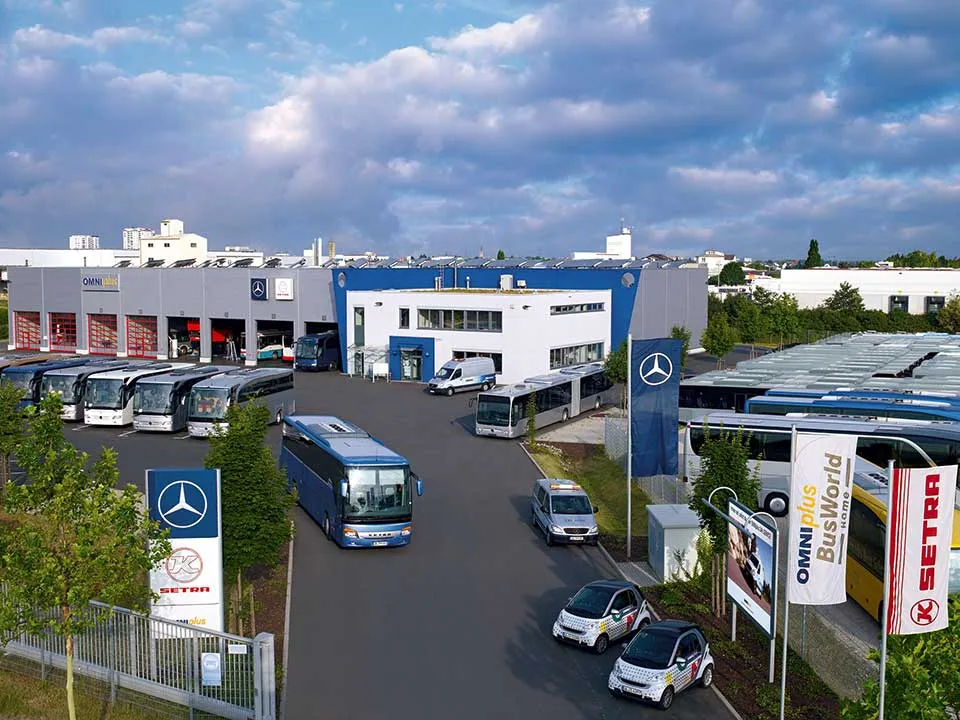
As early as 1996, a year after Mercedes-Benz Omnibusse and Setra merged to form EvoBus GmbH, Omniplus was established as the brand covering the two marques' after-sales activities. Omniplus was built on the already successful customer service operations of both brands. Today, Omniplus has a service network of more than 650 workshops in 42 European countries. It provides bus-specific services and offers genuine parts, effective training and innovative digital services, all from a single source.
1996: the Mercedes-Benz Actros
At the end of September 1996, Mercedes-Benz unveiled a new heavy-duty truck at the IAA Nutzfahrzeuge that would revolutionise the sector: the Actros was the first truck to feature disc brakes on all wheels and the EBS electronic braking system. Together, these two technologies made the Actros the safest vehicle in its class. Innovative technologies such as the ‘Telligent’ systems also significantly increased efficiency: service intervals more than doubled, fuel consumption was 3 to 7% lower depending on the application, and payload increased by 400 kg. This was accompanied by significantly higher levels of safety and comfort. For example, at a speed of 85 km/h, the Actros's stopping distance could be reduced by the length of an articulated lorry thanks to the Telligent braking system with disc brakes. Attention was also paid to a wide range of details: a new lining for the wheel arches, for example, effectively reduced spray in wet weather.
The newly developed, more fuel-efficient V-engines and improvements to vehicle assembly made the trucks more environmentally friendly: vehicle assembly required almost 50% less energy. The new cabs offered up to 47% more interior space and were fully tailored to drivers' needs. They were also safer: they had successfully passed the full range of crash tests, both simulated and real-world. Other new features included airbags and seats with integrated belt tensioners.
Every new Actros unveiled was named ‘Truck of the Year’, and the Actros remains a trailblazer in safety today.
Question about this story? Ask your question
Keep following this
Get an email when a new story is published. No account needed.
- SubjectGeneral







