Challenges and opportunities in Belgian industrial construction: interview with Marc Dillen (Embuild Vlaanderen)
Tekst Geert Van Cauwenberge Beeld Embuild / Shutterstock
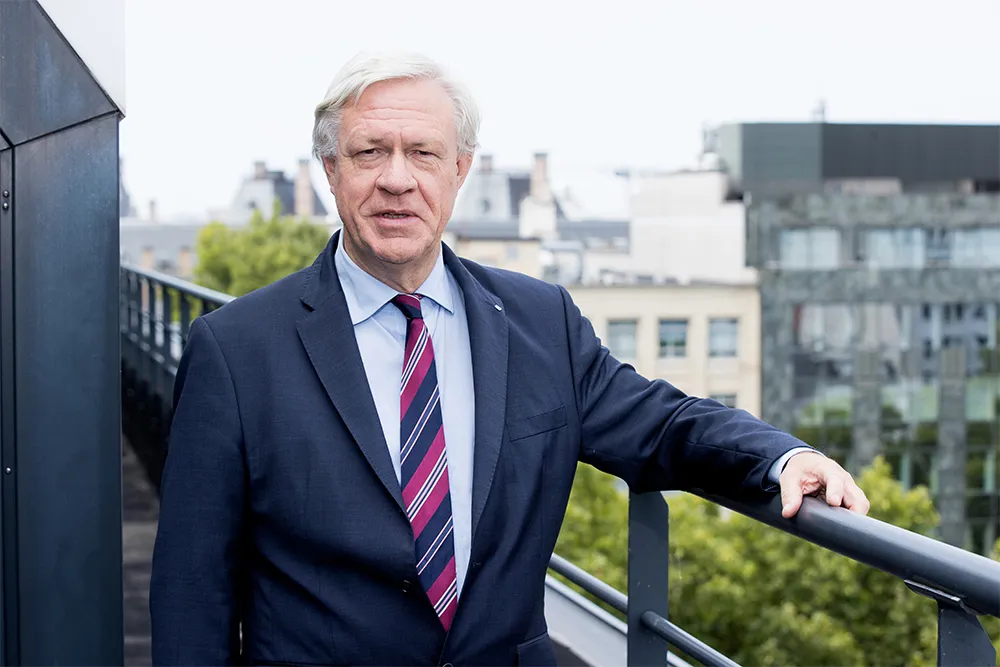
2023 was a difficult year for the construction industry in our country. Embuild’s annual report shows that overall construction activity in Belgium fell by 0.3 per cent last year. With more than 16,000 members, Embuild is the construction sector’s most influential trade organisation. In industrial construction, Marc Dillen, managing director of Embuild Vlaanderen, sees a mixed picture: new-build projects are taking a hit, while renovation projects are on the rise. What does he see as the key challenges and opportunities in non-residential construction and renovation?
A closer look at the figures in Embuild’s 2023 annual report shows that non-residential construction in Belgium fell by 3.3 per cent, while non-residential renovation edged up by 1.6 per cent. Notably, the number of infrastructure projects in the country increased by 4.7 per cent. “Since 2018, the Flemish Environment Department has published annual figures on the number of permit applications submitted for industrial and business projects through the Flemish Environment Permit Desk,” says Marc Dillen. “And what do the figures show? In 2023, we saw a sharp fall in the number of applications, with 1,816 dossiers submitted. This contrasts starkly with the 2,227 and 2,567 applications in 2021 and 2022.”
A resilient sector
Despite these worrying figures, the (industrial) construction sector has proved resilient and well placed for the future. The head of Embuild Vlaanderen says that challenges such as sustainable construction and renovation, digitalisation and automation, compliance and workforce management can be turned into significant opportunities. “As a sector federation, we continue to help drive efforts to tackle the barriers. These include, for example, slow permit procedures, complex administrative management and a lack of available building land. In our annual report, we have listed five priorities for each region, highlighting issues such as public investment, fossil-free buildings, an adequate construction workforce and more efficient permit procedures.”
Slow permit procedures
Slow permit procedures are one of the most widely discussed challenges facing Belgium’s (industrial) construction sector. It is hardly surprising when the permitting process takes an average of two to three years. “The number of permit applications increases year after year. The same number of civil servants have to process an ever-growing number of permits,” observes Marc Dillen. “This bottleneck not only delays project delivery, but also drives up costs and weakens the competitive position of Belgian industrial construction companies. We urgently need to simplify administrative procedures, including through digitalisation.”
Occupations in short supply
Complex administrative management on industrial construction sites is a well-known problem. Marc Dillen says: “This includes coordinating different construction activities, managing permits and safety regulations, and keeping records and reports up to date. Let’s make even greater efforts to digitise construction processes, use modern applications such as BIM, and invest in training and upskilling construction workers.” Labour shortages are another major challenge. “We see the list of occupations in short supply getting longer every year. This can also make it harder for construction companies to grow,” says Marc Dillen. “Our construction companies struggle to find enough skilled staff. A strong staff retention policy, partnerships with education and training institutions, and recruiting workers from abroad can all help.”
Available business space
Another thorny issue in our country is the lack of available public land for new business premises. Marc Dillen says: “Modern, well-equipped business parks are crucial to the country’s economic development. Recent Vlaio figures show that 63 per cent of business park land in our country is used for economic purposes, while 12 per cent is designated for infrastructure. It is also notable that 9 per cent of these sites cannot be developed for the time being. Embuild is calling, among other things, for existing sites to be used more efficiently through redevelopment and repurposing. Local action groups often wield too much power, reducing the net amount of available business space.”
A strong focus on sustainable construction
Finally, the head of Embuild Vlaanderen points to the considerable efforts Belgian industrial construction companies are making in sustainable construction and renovation. “I’m thinking of the rise of circular construction solutions, where project developers calculate how many tonnes of CO2 are emitted from design through to construction. Or the advantages of vertical integration, which shortens construction projects and reduces reliance on external suppliers. There is also growing attention to sustainability labels such as BREEAM and LEED, and the GRO certification for buildings owned by the Flemish government.”
Vraag over dit verhaal? Stel je vraag
Blijf dit volgen
Bij een nieuw verhaal krijg je een e-mail. Geen account nodig.
- ThemaLogistics property that grows with you
- OnderwerpAutomation