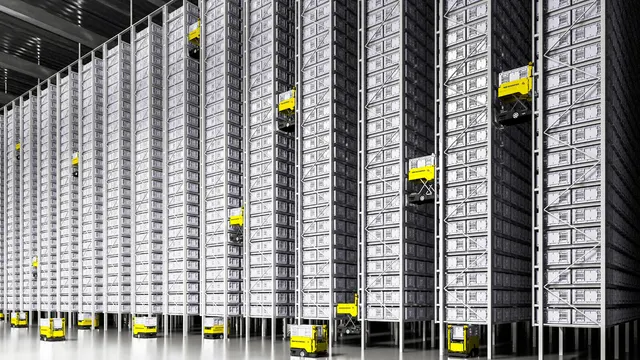
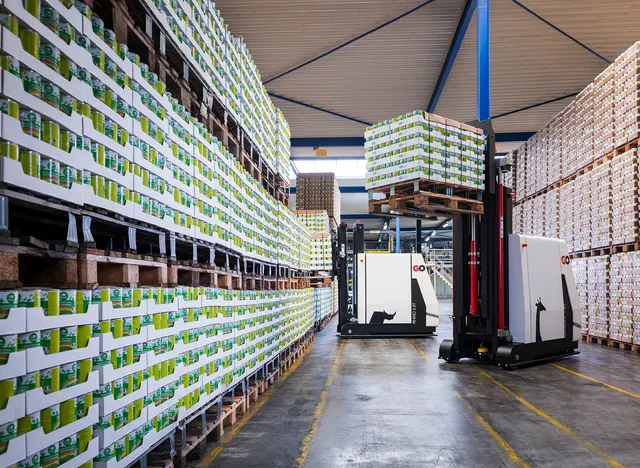
Leasing as a catalyst for warehouse automation
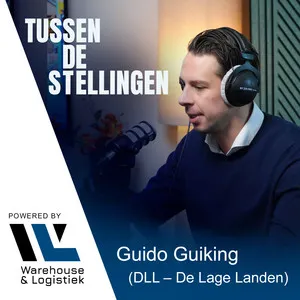
Between the Racking #6
In this episode of Between the Racking, Roel van Gils talks to Guido Guiking (DLL, De Lage Landen) about financing warehouse automation and robotics.
Guiking explains how companies can use leasing to fund major automation investments without a large initial capital outlay. Converting CAPEX into OPEX keeps cash flow and the balance sheet manageable, while the financing term can be aligned with the contract period. Topics include financial lease, operational lease and more flexible models such as pay-per-pick and Robotics as a Service, which are particularly attractive to 3PLs and fast-growing companies.
The discussion also looks at residual value, second-hand markets for AGVs and AMRs, and the rapid increase in automation levels in warehouses. The central message is to involve finance early in the automation process, as a strategic part of decision-making.
A business enquiry for De Lage Landen International B.V.? Get in touch
Full transcript
All chapters (33)
- Introduction to the podcast and guest
- The tagline “We are always here for you”
- DLL, De Lage Landen internationally
- How does financing help companies?
- Tailored financing
- What exactly is financed?
- CAPEX versus OPEX
- Interest rate risk and long lead times
- Scalability and flexible models
- Financial lease versus operational lease
- Off-balance benefits of operational lease
- Pay-per-pick and Robotics as a Service (RaaS)
- RaaS for fast-growing companies
- Administrative impact and partnerships
- The future of RaaS
- Is there a second-hand market?
- Leasing and equipment returning to the market
- Software upgrades and integration
- Growth within existing sites
- Depreciation and residual value
- What happens at the end of the financing period?
- Financing for 3PLs versus end customers
- Multi-client facilities
- What is fully financed?
- When to involve DLL
- DLL at LogiMAT in Stuttgart
- Generating business on the show floor
- Staffing and follow-up
- Expectations for the next edition
- Increasing levels of automation
- Leasing for large-scale roll-outs
- Final question: the key message
- Closing
Introduction to the podcast and guest
Roel van Gils Welcome to the Between the Racking podcast from the Warehouse & Logistiek platform of Louwers Mediagroep here in Weert. Joining me at the table is Guido Guiking from De Lage Landen. Welcome, Guido.
Guido Guiking: Thanks, Roel. Tell us a bit about yourself. My name is Guido Guiking, and I work for De Lage Landen as an international account manager in intralogistics. We help major end users, as well as manufacturers and suppliers, deliver their logistics automation projects. Specifically, we focus on robotics and automation in warehousing.
The tagline “We are always here for you”
Roel van Gils Your website carries the tagline: “We are always here for you.” Could you give us an example of what you mean by that?
Guido Guiking: When we say we are always here for you, we mean that the size of the project doesn’t matter to us. We work on projects ranging from a single robot to fully automated warehouses, like the ones you know from the likes of bol.com. We provide these customers with financing from A to Z.
DLL, De Lage Landen internationally
Roel van Gils You, DLL, De Lage Landen, I should say, bring together financial and operational expertise. Could you explain that in more detail?
Guido Guiking: That’s right. To go back to DLL, De Lage Landen, it’s great that you mention it, because De Lage Landen has been a household name in this field for more than 50 years. Certainly in this region, and throughout the Benelux too. But ‘De Lage Landen’ doesn’t roll off the tongue internationally. So five or ten years ago, they decided they needed to do something about their international branding. The name was changed to DLL to make it easier to pronounce internationally, because the G doesn’t work in many regions.
Roel van Gils But it still stands for De Lage Landen?
Guido Guiking: Absolutely. A lot of companies ask what it stands for. It’s simply De Lage Landen.
Read the full transcriptCollapse transcript30 more chapters
How does financing help companies?
Roel van Gils How can financing help my company? Can you give an example?
Guido Guiking: In many different ways. You need to distinguish between the types of company. Broadly speaking, we help two types of businesses: large multinationals, major American or European companies operating worldwide, and SMEs moving from a few warehouses to the next stage and starting to automate.
Guido Guiking: For SMEs, we mainly help with liquidity and project financing. The reasons are often different for large companies. They usually have good access to capital, but are more concerned with cash flow. They may have a project with a set payback period and want to raise capital for precisely that period. Or they may have a five- or ten-year business case with an end customer and want to match the funding to that term. That is often why large companies choose leasing.
Tailored financing
Roel van Gils So you offer a wide range of financial solutions.
Guido Guiking: Exactly. For small businesses and multinationals alike. And it’s always tailored to the customer.
Roel van Gils And it’s always tailored to the customer.
Guido Guiking: Exactly. That’s also because these projects are always bespoke. No two projects are the same. We finance trucks too. They have a diesel or electric engine and can travel a certain distance. The only thing that may differ is the colour. But with these projects, every aspect is different: the scale, the size and the types of products to be handled. Sometimes it’s refrigerated pallets that need to be moved from A to B; sometimes it’s small boxes of medicines.
What exactly is financed?
Roel van Gils Do you finance all of those too?
Guido Guiking: Yes, we finance the equipment needed to handle and store those products.
Roel van Gils So everything in a warehouse?
Guido Guiking: Everything in or outside a warehouse can be financed. I focus specifically on robotics and automation within the warehouse. That includes racking, equipment and software. Hardware often accounts for the largest share, with software making up a smaller part, although software is becoming increasingly important, especially with AI.
Guido Guiking: Hardware includes racking, shuttle systems that travel through the racking, and AGVs, robots that lift and transport pallets or boxes. They are controlled by software, such as a warehouse management system. We finance the entire project.
CAPEX versus OPEX
Roel van Gils What is the difference between CAPEX and OPEX? And why do companies choose one solution over another?
Guido Guiking: We see CAPEX as an investment made by the company itself. OPEX is expenditure. Costs are often easier to accept than a large investment. If you put an automation project on lease, you convert a CAPEX investment into OPEX. There’s no upfront investment, just monthly lease payments.
Guido Guiking: For many companies, that’s easier to accept and get approved internally than an initial investment of 40 or 50 million. Projects like these also often deliver savings, for example through fewer staff, greater efficiency or more revenue from the same space. If the cost reduction is equal to or lower than the lease payment, it’s a logical investment.
Interest rate risk and long lead times
Roel van Gils To what extent is there interest rate risk?
Guido Guiking: There is often interest rate risk because these projects take a long time. If you decide to automate today, it often takes nine to twenty-four months before everything is in place. A lot can happen to interest rates during that period. We can manage and hedge that interest rate risk. This means you lock in your rate today and are not exposed to market risk.
Guido Guiking: For companies, predictability is more important than speculating on interest rate movements.
Scalability and flexible models
Roel van Gils When it comes to scalability, are you better able to scale if you choose a flexible model?
Guido Guiking: That could certainly be the case. The current trend is for many new models to come onto the market, offering even greater flexibility. We’ve seen this in other markets already, with SaaS, for example, software as a service. Now there’s robotics as a service in this market too. It builds on the pay-per-pick model. These are developments from a more advanced form of operational lease, like what you see with cars, where the end user has complete flexibility.
Financial lease versus operational lease
Guido Guiking: In the Netherlands, the most common options are financial lease and operational lease. With financial lease, ownership eventually transfers to the end customer, who owns the equipment at the end of the term, for example after five or ten years. With operational lease, ownership remains with the leasing company. At the end of the term, the end customer can choose whether to return it, buy it for a small amount or continue renting it for a further period.
Off-balance benefits of operational lease
Roel van Gils That’s also the most commonly used model in intralogistics, isn’t it?
Guido Guiking: Yes, exactly. One advantage, especially for large companies, is that it is often treated as off-balance-sheet. This means the balance sheet does not grow and its ratios are not affected. Financial lease, by contrast, is treated as additional debt on the balance sheet. That is why operational lease is the preferred option for many multinationals nine times out of ten.
Pay-per-pick and Robotics as a Service (RaaS)
Roel van Gils You mentioned pay-per-pick or RaaS just now. Are those sub-models?
Guido Guiking: Yes, they are sub-models of operational lease that give the end customer even more flexibility. With pay-per-pick, you don’t pay a fixed monthly amount, but a fixed amount per pick. You pay according to the number of orders processed on the line. It’s an attractive option, also because it is fully off-balance-sheet under the latest accounting rules.
Guido Guiking: It also offers flexibility if revenue falls. Companies with seasonal peaks pay less during quieter periods. They pay more during peak periods, but revenue is higher then too. However, the more flexibility you have, the higher the cost. Someone has to pay for that flexibility.
RaaS for fast-growing companies
Guido Guiking: Start-ups and fast-growing companies find it difficult to estimate exactly how much equipment they will use. These models can help them get off to a good start. A multinational in the food industry can often predict its revenue precisely. A fast-growing e-commerce company, however, may find that harder. A RaaS model scales perfectly with revenue.
Administrative impact and partnerships
Roel van Gils Does that mean more administrative work for you as well?
Guido Guiking: That’s right. That’s why we work with partners on this. It’s not something we offer stand-alone. We currently have a partnership through which we are rolling out this model.
The future of RaaS
Roel van Gils Do you expect it to become more common in the future?
Guido Guiking: RaaS will certainly play a major role in smaller robotic solutions, such as packaging machines, AGVs and AMRs. I’m less convinced it will happen soon for large, complete projects like those at DHL or bol.com. Those companies can forecast their needs accurately.
Is there a second-hand market?
Roel van Gils Is there a secondary market, a second-hand market?
Guido Guiking: The short answer is: not really, yet. There has traditionally been a large second-hand market for forklifts. AMRs and AGVs are following in their footsteps. The technology is relatively new and has only become widely applicable in recent years. Equipment typically operates for five to seven years before being decommissioned, so it will be several years before that market develops.
Leasing and equipment returning to the market
Guido Guiking: AMRs and AGVs can return to the market after a lease period and be used by another company as second-hand equipment. Their technical lifespan is often ten to twenty years. Because they are software-controlled rather than operated by people, they last longer.
Software upgrades and integration
Roel van Gils So the software would need to be upgraded?
Guido Guiking: Yes, software has to be integrated into a new environment and sometimes updated. But that is becoming easier all the time. I expect the market for AGVs and AMRs to grow in the future. Other fixed installations, such as shuttle systems in racking, are less suitable for relocation to another site.
Growth within existing sites
Guido Guiking: If an installation has been running for ten years and the user outgrows it, a new end user can take over at the same site. The lifespan of equipment is often underestimated. Technology is depreciated over ten to fifteen years, but we see examples of systems running for 25 to 30 years, such as shuttle systems and high-bay cranes.
Depreciation and residual value
Roel van Gils Does the first customer then pay for the full depreciation?
Guido Guiking: That depends on the arrangement. For accounting purposes, assets are often depreciated over ten or fifteen years. Whether ownership rests with the customer or the leasing company depends on whether it is a financial or operating lease. We do include residual values in our calculations, but they are relatively low because they are difficult to verify. This is also necessary to offer an off-balance-sheet operating lease.
What happens at the end of the financing period?
Roel van Gils What happens when the financing period ends?
Guido Guiking: With a financial lease, you become the owner of the equipment. With an operating lease, ownership remains with us. That makes sense if, for example, you only have a five-year contract with an end customer. You may not want to keep the equipment after that. An operating lease gives you the flexibility to extend the agreement, buy the equipment or return it.
Financing for 3PLs versus end customers
Roel van Gils How does financing differ for end customers compared with 3PLs?
Guido Guiking: 3PLs are logistics companies that provide logistics services for third parties, that is, manufacturing companies. We work with both types of customer. There is a clear trend for many manufacturers to outsource their logistics to logistics service providers, because logistics is not their core business. So many of our customers are 3PLs.
Guido Guiking: They often have a contract of a certain duration with an end customer. It might be short, three years, or long, ten to fifteen years. Particularly with longer contract periods, investing in automation is realistic, given the payback period for those projects. They often want their cash flow to match the contract duration. So if they have a seven-year contract, they also want a seven-year financing solution. That ensures cash-flow neutrality throughout the contract.
Multi-client facilities
Roel van Gils But there are also arrangements where 3PLs serve multiple end customers?
Guido Guiking: Absolutely. Many 3PLs have a multi-client facility. In that case, they sometimes opt for a shorter financing term, for example three or five years, to spread the investment costs. They then retain the installation and can use it for different end customers.
Guido Guiking: The end customer often has a lot of influence over a 3PL’s investments. They set requirements for quality, error rates and production capacity. Meeting a lot of requirements means you need a lot of people. In Western Europe, and especially in the Netherlands, labour is expensive and people expect to earn more every year. At the same time, the end customer often wants to pay a fixed amount per order. Automation is an ideal solution, because you can forecast your costs accurately over the contract period.
What is fully financed?
Roel van Gils For 3PLs, are all project costs covered too? Installation, transport?
Guido Guiking: Exactly. We include everything: engineering costs, which often already account for 10% of the project, the hardware, the software and everything else involved. In a worst-case scenario, if things go wrong, we also want full ownership so that we can deploy it with another party.
Guido Guiking: If, for example, we finance a facility for DHL and the contract ends, there are plenty of other parties that would want to take over the installation. But that is only possible if we have financed the entire project, including the software, cables and all the components. That is why we prefer to finance the whole project.
When to involve DLL
Roel van Gils When does it make sense to involve you?
Guido Guiking: At an early stage. Once you have an idea of the technical installation you want to put in place and a rough estimate of the investment, whether we are talking about one million, ten million or a hundred million, it makes sense to involve us.
Guido Guiking: We can then determine the most suitable financing solution: a short-term financial lease, an operating lease or a combination. That gives you a clearer picture of cash flow sooner and increases the chances of getting the project approved quickly.
DLL at LogiMAT in Stuttgart
Roel van Gils You will also be at LogiMAT in Stuttgart. What can we expect?
Guido Guiking: This will be the second year we have had our own stand there. LogiMAT is the world’s largest logistics trade fair. All the major suppliers and smaller ones are there. We visited for years and had our own stand for the first time last year. It was such a success that we are taking part again this year, in an even better location. I believe we will be in Hall 3, a prime spot.
Guido Guiking: Many of our partners will be there too. We work with both end customers and suppliers. When they meet end customers there, they can talk to us directly about financing options.
Generating business on the show floor
Roel van Gils Do those conversations already happen at the trade fair itself?
Guido Guiking: Absolutely. Last year, a surprisingly large number of companies came to see us. Some were not yet customers, but wanted to find out what the options were. Others were further along in the process and wanted to know specifically whether we could help them deliver the project.
Guido Guiking: We actually won business last year from customers we met there. We had not expected that.
Staffing and follow-up
Roel van Gils Do you have enough people to staff the stand?
Guido Guiking: Certainly. There are always two or three people on the stand. Our management team also maintains relationships with partners who are there. If there are live leads, we can follow them up quickly. A lot of business is done at trade fairs.
Expectations for the next edition
Roel van Gils Are you expecting a lot from it?
Guido Guiking: It is the most important trade fair in Europe. Last year was successful. We are seeing growing demand for financing and automation. The economic situation in Europe may not be fantastic, but that is not stopping companies from investing.
Guido Guiking: If they do not invest now, they will fall behind. Supplier lead times have previously stretched to two or three years. Companies have learned from that and are now investing when an opportunity arises.
Increasing levels of automation
Guido Guiking: When we started five or six years ago, projects were often pilots involving a few robots and some software. Those investments were worth a few hundred thousand. Many of those pilots proved successful and grew into fully automated warehouses.
Guido Guiking: Even so, not everything is automated yet. The level of automation may be around 60%, sometimes 80%. There is still plenty of scope for further automation. New-build facilities are also becoming increasingly automated.
Guido Guiking: Capital investment in new warehouses is increasing. Ultimately, operating costs come down because you need fewer people, work more efficiently and make fewer errors. But the initial investment is higher.
Leasing for large-scale roll-outs
Guido Guiking: For companies with not just one but, for example, a hundred warehouses worldwide, these are huge, capital-intensive investments. Leasing is a strong solution in that situation.
Final question: the key message
Roel van Gils If there is one thing we could leave our listeners with?
Guido Guiking: They can always get in touch with us to discuss possible solutions. It may be that we do not have a suitable solution at that point, but we can still offer guidance for future investments.
Closing
Roel van Gils Thank you, Guido, for the conversation, and best of luck at the trade fair.
Guido Guiking: You’re welcome, Roel. Thank you. I’m sure it will go well.
Companies in this story
Keep following this
Get an email when a new story is published. No account needed.
- ThemeAutomating goods flows
- Subject2026
- CompanyDe Lage Landen International B.V.