Autonomous mobile robots in practice: Arie Verhoeven of Gobotty on AMRs, AI and logistics automation
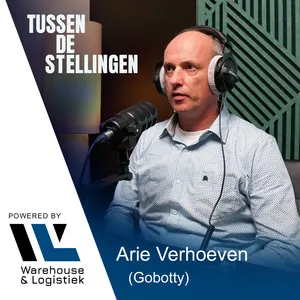
In conversation with Arie Verhoeven, Technical Specialist, Gobotty | Host: Roel Van Gils
How do autonomous mobile robots work in practice? In this episode of Tussen de Stellingen, host Roel Van Gils talks to Arie Verhoeven of Gobotty about the development of AMR solutions for logistics automation. From pallet transport and greenhouse horticulture to AI-driven routes, LiDAR technology and fully autonomous collaboration with employees on the shop floor. They also discuss why Gobotty has chosen a rental model, how implementations work and what role robots will play in the future of manufacturing.
Have a business enquiry for Gobotty B.V.? Get in touch
Full transcript
All chapters (14)
- Introducing Gobotty and AMRs
- Different types of robotic systems and applications
- Working with people and what sets the solution apart
- First customer contact and implementation process
- LiDAR technology and safety systems
- Outdoor applications and autonomous GPS navigation
- AI, self-learning software and collaboration between robots
- Target markets and applications in manufacturing
- Capacity, towing capacity and different sizes
- Electric drive, battery life and charging stations
- Implementation, infrastructure and IT integration
- Rental model and cost structure
- Maintenance and robot availability
- Ambitions and advice for the market
Introducing Gobotty and AMRs
Roel Van Gils Welcome to another episode of Tussen de Stellingen. Joining me at the table is Arie Verhoeven from Gobotty. Welcome, Arie.
Arie Verhoeven Good afternoon. Good afternoon. Thank you for having me. I’m Arie Verhoeven from Gobotty, based in Hendrik-Ido-Ambacht. We have a technical logistics background, which means we can help our customers in a number of ways and get to grips with their processes. We’ve actually been developing AMRs for about six or seven years. A year and a half ago, we decided to set up a separate company as a distinct legal entity. We want to stay close to our customers and give them a single point of contact. AMR stands for Automatic Mobile Robots. These solutions allow us to move all kinds of products from A to B, including pallets, boxes and individual items. We can also adapt our robots for customers with specific goods, so that a standard model can meet their needs. We use technologies that we have developed ourselves in other companies. We have 25 years of experience in control engineering.
Different types of robotic systems and applications
Roel Van Gils Oh, I see. So what exactly do your robots do? I understand you have different types. Could you tell us a bit more?
Arie Verhoeven We have one type that transports products from A to B. These might be pallets, for example. If you have a production line that goods come off and you want to move them to a vehicle or another location, we can drive our vehicle up to the roller conveyor. Our AMR also has a roller conveyor, so it can automatically take on the goods. It then drives to the destination. There, it moves up to another roller conveyor and can unload the goods. That’s one solution. We also have a model that can be loaded, for example, by a small crane. If you have boxes or individual items, a small crane can load them onto our robot. It then drives to another location. This application is often used between two different production lines. For example, if one line produces something and you want to print it or carry out a particular operation on the second line. In the past, there were often roller conveyors between two lines, with each line dedicated to a single product. These days, it’s called flexible manufacturing. You can also skip certain steps. Connecting the lines with AMRs means you can organise your process very flexibly. It can be different every day if that’s what you need. We also work a lot in greenhouse horticulture and in the supply chain to auction houses, transporting plants and flowers. A lot of carts are used in this sector. They are often moved by electric tugs operated by people. We can do that fully autonomously, so no labour is needed. We can collect the carts, couple up to them, take them away and leave them at their destination.
Roel Van Gils So it saves labour without anyone actually having to be physically involved?
Arie Verhoeven Yes, without anyone having to be involved.
Read the full transcriptCollapse transcript12 more chapters
Working with people and what sets the solution apart
Roel Van Gils So no one actually has to be physically involved?
Arie Verhoeven Yes, without anyone having to be involved.
Roel Van Gils What makes your solution different from other robotic systems?
Arie Verhoeven Our robot can operate fully autonomously. And under the CE marking requirements that apply throughout Europe, we can work alongside people and other vehicles. We’re one of the few companies in the Netherlands that can do that. We have to comply with the CE marking requirements. We can move and transport goods. If we’re travelling on a particular platform or along a route where people are also walking, we avoid them entirely.
Roel Van Gils So your robots work alongside people as part of the same process?
Arie Verhoeven Yes, exactly. That’s what makes our concept unique: it’s permitted under the regulations.
Roel Van Gils And what regulations are those?
Arie Verhoeven The CE marking requirements. There are also some specific markings that apply in our field, but I can’t remember them off the top of my head.
Roel Van Gils No problem. Perhaps that’s getting a bit technical for this podcast anyway. But are you the only ones who can do that?
Arie Verhoeven We’re the only ones who can do that. Another thing that sets us apart is that quite a few robot manufacturers, our competitors, collect images and transfer them to other countries. We don’t do that. We store everything on the robot. When you drive a robot around a company’s premises, you learn a great deal about the customer. You simply don’t want that data leaving the premises. That’s another thing that distinguishes us from other companies. The third point is that getting a robot to move isn’t particularly difficult, but it’s all about the customer’s process. We need to make the right changes to that process and take the burden off the customer. Quite often, adjustments are also needed to the receiving station where goods are dropped off, or the dispatch station where they are picked up. We take care of those adjustments too. And, as a fourth point, we hardly ever sell our robots, we almost always rent them out. Customers are often wary of committing to these solutions. We remove those barriers for them. There’s no need for an investment. We simply charge a fixed monthly fee. Any adjustments needed at the customer’s premises are included in the monthly fee. We also provide maintenance and servicing. So the customer knows exactly how many euros per hour it costs to carry out the task.
First customer contact and implementation process
Roel Van Gils Tell us what that first meeting with a customer looks like. People might be a bit wary, or think: bringing in all this technology...
Arie Verhoeven We always start with a cup of coffee. We sit down and get to know each other. Then I always like to take a walk around the business, because you can see what’s really going on. You see much more than a thousand words can tell you. We’ll already have come up with a rough plan together at the table, maybe a sketch or something like that. We develop it further back at our office, then put together a bespoke proposal for the customer. We discuss it again, and the customer decides whether or not to proceed with us. If they decide to go ahead, we supply a suitable robot and make the necessary modifications. Then, on a date we’ve agreed together, one of our programmers comes in. They commission the vehicle on site with the customer. We want the customer to get involved straight away, so we can pass on our knowledge and put any concerns to rest from the outset. Ideally, you also involve the people who currently do the work. As I said, getting a robot to move isn’t particularly difficult. But the people who will be working with it need to understand the process too. You need to involve them from the start to make sure the process succeeds.
LiDAR technology and safety systems
Roel Van Gils And if we look a bit more closely at the technology, I understand you use LiDAR systems? How does an AMR work?
Arie Verhoeven The LiDAR is at the front of the robot, or around it, depending on the type. On the vehicle that tows the carts, it’s at the front. The other vehicle has 360-degree coverage. So it knows what’s around it. It can see 270 degrees around itself, and starts taking action at a distance of 18 metres.
Roel Van Gils So it looks ahead?
Arie Verhoeven It looks ahead, but also 270 degrees behind itself. It uses the image it sees continuously to calculate where it needs to go. If it detects moving objects, it calculates whether it needs to reduce its speed. It must never cause a collision, of course.
Roel Van Gils But if someone happens to cross its path, can it make an emergency stop?
Arie Verhoeven Yes, it will stop very quickly. You want every colleague to get home safely.
Roel Van Gils And does it take the load into account?
Arie Verhoeven Yes. That depends on the type of load. If, for example, you have a pallet carrying a big bag weighing 1,500 kilos, the software needs to ensure the robot can stop in a controlled manner in accordance with the standards. The same applies in corners: when transporting a large, heavy product, you need to make sure it doesn’t go off course or lose its load.
Roel Van Gils What’s the average speed of one of these robots?
Arie Verhoeven The maximum speed is about 6 kilometres per hour, roughly walking pace.
Outdoor applications and autonomous GPS navigation
Roel Van Gils I understand you have different types. But they can work outdoors too, can’t they?
Arie Verhoeven Yes, we have one type that can work outdoors. That’s the Enduro’s. It can operate outside, even in rain and snow, and over rough terrain. So if there’s a kerb or tree roots, it can simply drive over them. It navigates fully autonomously using GPS.
Roel Van Gils Okay. Can you give us an example of how it might be used?
Arie Verhoeven Yes, these robots are ideal for greenhouse horticulture, for example. The floors are often uneven. We can also drive along the paths and under the greenhouse roof sections. We can couple up to the Danish carts and CC carts widely used in the auction sector and move them autonomously. There are also companies that carry out certain operations outdoors. For example, they might store goods on pallets in a yard. If those pallets are kept in a fixed location, we can collect them automatically. Of course, it’s important to have a higher-level system that knows where the pallets of products are. They need to be identifiable, of course.
Roel Van Gils But the robots operate fully autonomously, as I mentioned. So there’s no need to put markings or anything else on the floor, for example?
Arie Verhoeven Yes, that's right. It's also one of the ways we stand out from other suppliers. We don't need floor markings, coded lines, reflectors or copper strips in the floor. None of that is necessary. We scan our customer's existing infrastructure ourselves. That also makes it a good system compared with others. So if you change something in your business, you hardly need to change anything on the system. You just make the change in the robot's software.
Roel Van Gils But do you then come back and walk around the site again? Or is it surveyed? Or does the robot do it itself?
Arie Verhoeven The customer can do it themselves. We train them to do that. But most customers leave it to us. We simply come over by appointment. It only takes a few hours to add the changes.
AI, self-learning software and collaboration between robots
Roel Van Gils Is the robot self-learning too?
Arie Verhoeven Yes. It has a lot of AI software. At a certain point, it measures all the patterns in its movements. These are logged continuously. If you find that it often repeats the same movements, for example, it will get better and better at positioning itself around that turn. On the first day, you often see it wobble a little as it goes around a turn. After about seven days, you can see it taking the turn smoothly. That's because it works out what speeds it can use in those turns.
Roel Van Gils So it keeps improving its times?
Arie Verhoeven Yes. It also has another kind of intelligence. If you have several robots working together and give them a task from a higher-level platform, the system works out which task to assign to which robot, to get it done in the shortest possible time.
Roel Van Gils Right, so it picks the robot best suited to the job.
Arie Verhoeven Yes, it chooses the right robot, so to speak. All that intelligence is built in.
Roel Van Gils Collaboration must be quite common too, with several robots operating in the warehouse?
Arie Verhoeven Yes, it happens very often. I have very few customers with just one robot. It does happen, and we have customers who are perfectly happy with a single robot. But very often you want a back-up, so they start with two robots.
Roel Van Gils That makes sense. The downside of a robot, of course, is that when it stops, it can't do anything.
Arie Verhoeven So a lot of customers simply have two.
Roel Van Gils But it doesn't happen very often that they stop, does it?
Arie Verhoeven No, it happens very rarely. Certainly compared with people calling in sick.
Target markets and applications in manufacturing
Roel Van Gils Speaking of customers, which sectors are your main customers in?
Arie Verhoeven They are companies that make products. We call them manufacturers. Say you have a company that mills steel. You need to keep supplying material to the CNC machine and removing the finished work. We can automate the supply of material to a company like that. Once a job is finished, it is also removed as part of another process. That process needs other tools too, such as chisels. The machine knows which chisels it will need in two hours. We can send that task to a small robot and have it deliver the chisel. So you also cut down on a lot of walking around the site. But the robot handles transport from A to B, not collecting the chisels. Another device does that. At some companies, people walk around carrying the chisels, or use a small trolley. You could also put a small robot there to drive to the warehouse. The storekeeper puts a chisel on the robot, which then drives it to the right destination. Other companies have a production line where products are carried away on roller conveyors. Forklifts or powered pallet trucks are often used for that now. Our robots can do it fully autonomously. Another application is trolley transport, particularly in horticulture under glass.
Capacity, towing capacity and different sizes
Roel Van Gils And in terms of capacity, what can the robots handle?
Arie Verhoeven We have various types of robot for indoor use. We often talk about payload. The smallest can lift 60 kilos and the largest 1,500 kilos.
Roel Van Gils And by lifting, you just mean transporting?
Arie Verhoeven Transporting. Think of a pallet. Everyone knows what a pallet is. We can transport a pallet weighing 1,500 kilos.
Roel Van Gils Oh, that's substantial.
Arie Verhoeven Yes.
Roel Van Gils That's quite a large robot, then.
Arie Verhoeven Yes. They can also tow loads.
Roel Van Gils So is the towing capacity the same?
Arie Verhoeven No, that's a different type. We have several models, with towing capacities ranging from 600 to 1,300 kilos. Towing capacity also relates to braking capacity. Many companies have a route that slopes upwards to another floor. That's a ramp, and the robot needs enough power to brake on it.
Roel Van Gils Oh, when it stops there and has to start moving again.
Arie Verhoeven Yes, it also has to be able to remain stationary. You don't want your train of goods rolling backwards when you're trying to go forwards. All of that complies with the guidelines. Larger models are also due next year. We're developing models with greater power, with towing capacities of 2.5 to 5 tonnes.
Roel Van Gils So that's a serious towing capacity. Will they be the same size, or will they be larger too?
Arie Verhoeven The 5-tonne model will be considerably larger. The 2.5-tonne model will be the same size. Only the motors and battery capacity will be greater.
Roel Van Gils You mentioned the smallest model, the one with a 60-kilo capacity. How big is it, roughly? Can you give us an idea?
Arie Verhoeven It's about 40 to 60 centimetres. Think of a crate, a big plastic crate on wheels.
Roel Van Gils And what about the 1,500-kilo model?
Arie Verhoeven That's about 1 metre 80 by 1 metre 20.
Roel Van Gils Right. That's still fairly compact, like a small car.
Arie Verhoeven A small car, yes.
Electric drive, battery life and charging stations
Roel Van Gils And I assume they're fully electric?
Arie Verhoeven Of course. So they're sustainable, with no emissions inside your business.
Roel Van Gils How long can they operate for, then? What's the average range?
Arie Verhoeven It depends a little on the power, of course. But broadly speaking, they can work and drive continuously for 16 hours on one charge. It varies a little by model. It takes between two and four hours to recharge fully.
Roel Van Gils So you could run two shifts with one robot in a day. But does it ever charge during the day, or is that something it does at the end of the day?
Arie Verhoeven It can charge during the day. It depends a little on the application. If that's not possible, we can simply run it continuously for 16 hours, which is usually enough. Some companies operate 24 hours a day, so the robot needs to charge in between. For example, if there's a lunch break or no tasks for half an hour, we can give it a quick charge.
Roel Van Gils And does that come with a charging station?
Arie Verhoeven Yes, there are two options. The software tells us when the battery is starting to run low, and we know how far the robot is from the charging station. We keep calculating whether it can still complete the task it has just been given. We use as much of the battery as possible, then send it to the charging station. We have two types. One requires you to plug in a cable by hand. That's used very rarely. The other has a coil installed in the floor for inductive charging. It can also be wall-mounted. The robot carefully moves its support up against the wall. It doesn't make physical contact, but simply stops in front of the charging station. Once it's finished charging, it sends a signal to the central system. It then receives new tasks and sets off again. That's how charging is done in 90% of cases.
Roel Van Gils So no one needs to get involved.
Arie Verhoeven That's right, no one needs to get involved. It remains fully autonomous.
Implementation, infrastructure and IT integration
Roel Van Gils Does a company need to make a lot of changes to use your robots?
Arie Verhoeven No, no. We use the existing infrastructure. Sometimes a charging station needs to be installed somewhere, for example. There needs to be space for it, as well as a power socket for three-phase power or 230 volts. But we discuss that with the customer in advance. Sometimes the floor is very uneven where one part of the building meets another. The raised edges need to be ground down. We go through things like that with the customer. But in general, the customer doesn't have to do much. We're also able to go through all the processes with the customer. We often have to work with the customer's existing IT infrastructure, of course. We need Wi-Fi or 5G.
Roel Van Gils Does that need to cover the whole site?
Arie Verhoeven It doesn't need to provide complete coverage, but on average we do need Wi-Fi coverage every 15 metres. Wi-Fi or 5G, either is fine. That's something we agree with the customer. Almost all companies have a good Wi-Fi network. Our customers naturally also want to make sure their network can't be hacked. So the process often involves close co-operation between their IT department and our IT team.
Roel Van Gils Because no one wants to hack the robot, really.
Arie Verhoeven Yes, exactly.
Roel Van Gils So the barrier to switching to a robot is very low, really.
Arie Verhoeven It is very low, yes. But for many customers it's still quite a big step. We need to guide them through it.
Rental model and cost structure
Roel Van Gils And as you mentioned, you don't sell them. You use a leasing arrangement, right?
Arie Verhoeven Yes, we don't lease them. Legally, it's something different. We rent them out. Up front, we calculate what the customer needs: how many robots, what infrastructure, how many charging points, and so on. If it's a very long warehouse, for example, it may be useful to have charging points in several places. We work that out in advance too, and draw up a concept plan for the customer. The system is then commissioned. After that, there's a fixed monthly fee. The customer knows that everything is provided for that amount.
Roel Van Gils And why did you choose that model?
Arie Verhoeven Because there's quite a lot of concern about AMRs in the market. We have a lot of faith in our own product, which is why we came up with this model. In practice, it's proving successful. The customer knows exactly what it will cost per hour or per month. They can compare that with their labour costs, which of course they pay every month.
Roel Van Gils And everything is included in that price, right?
Arie Verhoeven Everything is included: maintenance, depreciation and anything that breaks. We take on all the risk.
Roel Van Gils But are there any set-up costs, perhaps? Do you need to survey the site? Is everything included in that rate?
Arie Verhoeven It's all included in that amount, unless the customer does something they're not allowed to do. For example, if they cause damage, there's nothing we can do.
Maintenance and robot availability
Roel Van Gils Is there a lot of maintenance? Do they need much maintenance?
Arie Verhoeven No. The customer just needs to clean the sensors every day with a small, special dusting cloth. That’s the maintenance. It takes two minutes. The lenses simply get dirty from dust in the workplace. We need to come by twice a year, depending a little on how intensively the process is used. We do a check on a number of points and replace the wear parts. We always schedule this with the customer to cause as little disruption as possible. Many companies have a particular day of the week when things are a little quieter. That’s when we carry out the maintenance.
Roel Van Gils So it’s not much trouble, then?
Arie Verhoeven Not much at all.
Roel Van Gils And just to go back to that for a moment, who is it really of interest to? From how many FTEs?
Arie Verhoeven It’s really of interest to any customer who moves goods from A to B, where more than one FTE is involved each day. If someone is driving an electric tow tractor back and forth all day, and we put an AMR in its place, our business model is set up so that it costs less than having that person on the tractor. We’re not looking to eliminate people from companies. Those people can simply do other things more efficiently. We’re particularly good at repetitive tasks.
Ambitions and advice for the market
Roel Van Gils Where do you ultimately want to grow? What are your ambitions?
Arie Verhoeven We want to take the burden off our customers. Our ambition is for the red Gobottys to soon be driving around every company in the Netherlands where electric tow tractors are currently going back and forth.
Roel Van Gils Because that’s your signature colour.
Arie Verhoeven It is our signature colour, yes. We chose it deliberately. It stands out nicely.
Roel Van Gils Okay, great. And finally, perhaps some advice for the market?
Arie Verhoeven I’ve noticed during sales conversations that some customers are quite sceptical. Is it really that simple? That’s why I always say: just try us out. We’ll put one in place at your site for two weeks. We’ll set it up for a particular process at your company. You can then test it for two weeks. If you like it, we’ll leave it there. If you don’t, we’ll take it away. We’d be very happy to work with the customer.
Roel Van Gils Okay, great. Well, I’d say: give it a try.
Arie Verhoeven Yes, exactly.
Roel Van Gils Well, Arie, thanks very much for all your input and for sharing your story. I think that was very clear.
Arie Verhoeven You’re welcome. If you’d like to get in touch, call us on 088-425-6900 or email [email protected].
Roel Van Gils Great. Thanks for listening, everyone, and see you in the next episode.
Companies in this story
Keep following this
Get an email when a new story is published. No account needed.
- ThemeAutomating goods flows
- SubjectAutomation
- CompanyGobotty B.V.