In conversation with Pascal de Vries of LAPP: How do you keep intralogistics moving?
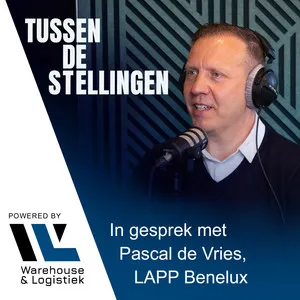
Between the Racks #1
In this episode of Warehouse & Logistiek’s Between the Racks podcast, Pascal de Vries joins us as a guest. Pascal is Customer Success Manager at cable manufacturer LAPP, a company that supplies products and advice to system integrators, for example. These include suppliers of warehouses and warehouse automation.
In the podcast, Pascal discusses a number of major challenges facing the intralogistics sector. For example, some companies are very cautious about investing, but is that caution justified? Cost savings are always attractive, but where can they be found? Pascal explains the possibilities. Many business owners in the Netherlands and Belgium are also deciding whether to keep operating locally or move elsewhere, to Eastern Europe, for instance. Surprisingly, a solid foundation can mean that plenty of opportunities remain locally too. In the podcast, Pascal explains how high-quality cabling and automation play a key role in this.
Have a business enquiry for LAPP Benelux? Get in touch
Full transcript
All chapters (37)
- Introduction to the podcast
- Welcome from the guest
- Introducing Pascal and LAPP
- Who are LAPP’s customers?
- The propositions
- Proposition: investing in uncertain times
- Proposition: suppliers’ role in reducing costs
- Proposition: certainty or solutions
- Keeping intralogistics moving
- Growth in the intralogistics market
- Target groups in intralogistics
- Examples of intralogistics applications
- Automation and investment in intralogistics
- Growth in the intralogistics automation market
- The role of advice on cable solutions
- The complexity of intralogistics systems
- An example of a practical solution
- Benefits of pre-assembled cables
- Faults caused by incorrect cable assembly
- How the prefabricated cable strategy came about
- Specific solutions for Warehouse & Logistiek
- New developments in communication and power
- Cable quality
- How much cable is there in a warehouse?
- Changes in system cabling
- Reducing cable use
- Automate or relocate to Eastern Europe
- Working with system integrators
- Investing in uncertain times
- The share of cables in an investment
- What makes a good cable?
- The future of cabling
- Internationalisation at LAPP
- Sharing expertise internationally
- Closing the podcast
- Final question
- Closing remarks
Introduction to the podcast
Ferdi den Bakker Welcome to Warehouse & Logistiek’s Between the Racks podcast. My name is Ferdi den Bakker, and today we’re discussing cable solutions that are essential to keeping intralogistics processes running smoothly. Welcome, Pascal.
Welcome from the guest
Pascal de Vries Good morning.
Introducing Pascal and LAPP
Ferdi den Bakker Hello. You’re Customer Success Manager Intralogistics at LAPP.
Pascal de Vries That’s right.
Ferdi den Bakker A supplier of cable solutions. LAPP Benelux is a sales company, established in 1989.
Pascal de Vries That’s right too.
Ferdi den Bakker The company supplies products and advice to system integrators, for example, such as suppliers of warehouses and warehouse automation.
Who are LAPP’s customers?
Pascal de Vries It goes a bit further than that. We have a lot of customers, of course, but in intralogistics our customers are system integrators and machine builders that make components for system integration.
The propositions
Ferdi den Bakker To start with, I’d like to put three dilemmas to you. It would be great if you could give a brief response to each one. We’ll come back to them in more detail later.
Pascal de Vries Sounds good.
Proposition: investing in uncertain times
Ferdi den Bakker First one. Macroeconomic challenges are making companies very cautious. If in doubt, it’s better not to invest. Are there reasons to set that caution aside?
Pascal de Vries The macroeconomic situation is indeed quite unsettled at the moment. We’re seeing companies in the market hesitate to invest, particularly in intralogistics solutions. These are often major investments. There is some reluctance in the market right now.
Proposition: suppliers’ role in reducing costs
Ferdi den Bakker Second proposition. Cost savings are popular. How important is a supplier’s role in achieving them?
Pascal de Vries Very important. As a company, we’re problem-solvers. We offer solutions to customers, and these help increase their ROI.
Read the full transcriptCollapse transcript30 more chapters
Proposition: certainty or solutions
Ferdi den Bakker Third proposition. What do companies need more: certainty, or solutions to the challenges they face?
Pascal de Vries Solutions to their challenges. That’s where companies can make gains. There are all sorts of options. There are thousands upon thousands of solutions. It’s our job to offer the right one.
Keeping intralogistics moving
Ferdi den Bakker The theme of this conversation is keeping intralogistics moving. The world is changing. Global megatrends such as digitalisation and automation are transforming society, and intralogistics along with it. What’s your view on this, Pascal, from your perspective as a supplier of cable solutions?
Growth in the intralogistics market
Pascal de Vries We’re seeing a clear trend that has been going on for years. Over the past ten years, the intralogistics market has grown faster than other industrial markets. We expect that to continue over the next ten years. That’s why we’re developing specialist expertise in this area and working with major companies internationally to come up with effective solutions.
Target groups in intralogistics
Ferdi den Bakker So who do you target as a company? Who are your customers?
Pascal de Vries They’re mainly system integrators, the companies that offer machine lines as a solution. But they also include machine builders that manufacture parts of those lines and therefore need the associated cables and connectivity solutions.
Examples of intralogistics applications
Ferdi den Bakker What kinds of intralogistics processes do you supply cabling for? Can you give a few examples?
Pascal de Vries Certainly. There are AGVs and AMRs, automated vehicles that travel from A to B. We’re seeing tremendous growth in that area. We’re also seeing growing popularity for storage systems, such as ASRS and small-parts warehouses, which are boosting returns for our customers. And of course there are conveyor belts, solutions for moving goods from A to B. Those are the main applications we deal with in intralogistics.
Automation and investment in intralogistics
Ferdi den Bakker These are major developments, and often major investments too. Although they can be compact and small-scale as well. What’s your view on the development of this type of automation, from self-driving vehicles to large tote systems such as Autostore?
Pascal de Vries It’s an essential development, for two reasons. First, there’s a shortage of people in the market at the moment. Second, it can increase the return on investment. With automation, you can run operations 24/7. That depends somewhat on the application and how it’s used, but it enables you, as a LAPP customer, to run your business more efficiently.
Growth in the intralogistics automation market
Ferdi den Bakker How fast is that market growing? How much demand is there for these kinds of solutions and the support you provide?
Pascal de Vries I do have figures for that, but I don’t have them with me right now. What we’re seeing is that this market is simply growing faster than other industrial markets. That’s a fact. These solutions are also becoming more popular because they make operations more efficient and deliver higher returns.
The role of advice on cable solutions
Ferdi den Bakker I imagine companies don’t necessarily know exactly what they need. How much of a role do you play in providing advice? How much demand is there for that among customers?
Pascal de Vries They’ve often already designed the machines or lines they produce. Then it’s our job to take a look with them and ask: your colleague does it this way, how do you do it? That might involve connecting the control power, in other words the power cables, or the data communication cables. These involve different protocols, and some companies do things differently from others. Sharing our experience in this area is naturally valuable to the customer.
The complexity of intralogistics systems
Ferdi den Bakker Is it easy to get an overview of the whole landscape and exactly what’s needed, given that every process is different?
Pascal de Vries That’s right, every application is different. But if you look at the bigger picture, for example at the power supply and communication for machines and AGVs, these are actually quite similar. So it doesn’t make a huge difference which application it is. There are differences, of course, but the overall principles are fairly consistent.
An example of a practical solution
Ferdi den Bakker Problems always make for a good story, and so do examples. Can you give us examples of challenges companies have faced where you were able to play your role as a problem-solver effectively?
Pascal de Vries There are plenty of examples. But I think the best one is that companies used to process a lot of their own cables. What do I mean by that? Buying the cable, buying the connector, buying the ferrules, and so on. We now have the option to pre-assemble the cables. The market has responded to this solution with enthusiasm. It’s also a response to the shortage of people. A skilled technician can be put to better use than installing connectors.
Benefits of pre-assembled cables
Ferdi den Bakker That shortage of people keeps coming up. How much can a company gain when a process runs smoothly?
Pascal de Vries It delivers benefits in several areas. It saves time. A technician can make the connection straight away with a plug-and-play solution. Another advantage is that we produce the cable ourselves as the supplier. In many cases, we also make the components ourselves. And we have our own assembly plant. That means we can offer our end customers a cost-effective solution.
Faults caused by incorrect cable assembly
Ferdi den Bakker I’m surprised companies used to process their own cables. It sounds like a specialist job.
Pascal de Vries It is a specialist job. And if you connect a hundred connectors, there are always two or three that aren’t quite right. That can lead to all sorts of faults. And there’s often a connector at both ends of the cable. So which one is faulty? You have to disconnect both to solve the problem. That takes a lot of time. So on top of the time it takes to connect the connectors in the first place, repairs take at least as long again.
How the prefabricated cable strategy came about
Ferdi den Bakker When did the thinking change from ‘we want to do this ourselves’ to outsourcing more of it?
Pascal de Vries It’s part of our company strategy. About fifteen years ago, senior management in Germany looked at how we could set ourselves apart in the market. How could we add value for our customers? Offering prefabricated solutions was certainly one way. That’s why we’ve invested heavily in it. We now have five assembly plants in Europe. That says it all, really.
Specific solutions for Warehouse & Logistiek
Ferdi den Bakker This is, of course, a podcast for Warehouse & Logistiek. Are there any specific solutions for this sector that you’d like to highlight, ones that might offer more added value than others?
Pascal de Vries The solution is tricky, because every customer faces a different challenge. It’s not as if we’ve invented a new wheel. There are different types of cable. There are power cables, where developments are taking place, but they aren’t major changes. Then there are communication cables, which use different protocols. What we do at LAPP is work with our customers to understand what they’re doing, what developments are underway, what their R&D department is working on, and whether we have the right products to serve them well in two or three years’ time. These are questions we ask ourselves and also discuss internationally with sales experts in intralogistics.
New developments in communication and power
Ferdi den Bakker: Are there any particular developments you can point to? Anything people are working towards at the moment?
Pascal de Vries At the moment, there are developments in communication protocols. People often want to combine communication cables with power cables. Developments are already underway, but as a cable supplier, we’re looking at whether we can offer other solutions that allow a single cable to be used for both communication and power.
Cable quality
Ferdi den Bakker: What matters most when it comes to cables? Is it quality?
Pascal de Vries Absolutely.
Ferdi den Bakker: How do you guarantee it?
Pascal de Vries We test the cables we manufacture using high voltages. Imagine a production line making, for example, a 4 x 1.5 control cable. For each production run, 40 to 50 kilometres of cable is wound onto a very large reel and tested at high voltage. If there’s a fault anywhere in the conductor insulation or outer sheath, it will be detected. They identify the fault and cut the 50-kilometre length in half. Then they test 25 kilometres. If the fault isn’t in that section, it goes to production. The other 25 kilometres is tested in turn. That’s how we eliminate a lot of technical problems at the outset.
How much cable is there in a warehouse?
Ferdi den Bakker: Can you give an example of how many metres or kilometres of cable there are in an average warehouse?
Pascal de Vries It varies enormously from project to project. I happened to visit Schiphol yesterday. There’s a new cargo handling hall there. I think it contains hundreds of kilometres of cable. But it’s also a hall that I believe is one and a half kilometres long. You can get lost in there. It’s impressive. But there are also projects where the system is less than a tenth of the size of what’s there. So it all depends on the size of the project.
Changes in system cabling
Ferdi den Bakker: What drives the amount of cable needed? Is it the size of the warehouse or the type of automation?
Pascal de Vries Around 20 years ago, systems were often controlled from a central point. There would be a central point in the middle of the factory hall, with cables running back and forth from there. That applied to both power cables and data communication cables, so an enormous number of kilometres of cable were used. These days, we deal much more with loops. Machines are connected to one another and loops are created. That means less cable is needed. As a cable manufacturer, that’s a bit of a shame for us, but of course it makes perfect sense to design systems that way.
Reducing cable use
Ferdi den Bakker: Is that an opportunity to save money? Do companies say they want to use less cable?
Pascal de Vries There are certainly savings to be made. For us, that means we have to make sure we can supply every type of cable used. Even though less cable is used in each application, we have to ensure that we keep the number of metres we sell more or less the same.
Automate or relocate to Eastern Europe
Ferdi den Bakker: The theme is keeping intralogistics moving. That also means companies have to make choices. Do we stay here or move elsewhere to cut costs?
Pascal de Vries Absolutely. Companies struggling with staff shortages and rising costs sometimes have to weigh up whether to move production to Romania or automate. I have a good example. A welding company opted for automation. My customer was a machine builder that builds components for welding machines and makes AGVs. What happens is that a semi-finished product is picked up automatically and taken to the welding robot. The robot does its work, then the product is automatically taken away again. The owner told me that he had recouped his investment within one year and eight months. And he said: I’m glad I didn’t move to Romania.
Working with system integrators
Ferdi den Bakker: You’re providing more and more advice. Does that ever clash with system integrators who already have a design in place?
Pascal de Vries It varies from one system integrator to another. Some have had their design set in stone for years. But I share my experience from working with other companies. Engineers and R&D teams are often open to that. It doesn’t mean they’ll change everything straight away, but it does help to exchange ideas.
Investing in uncertain times
Ferdi den Bakker: One of the dilemmas was whether to be cautious about investment. Is that caution justified?
Pascal de Vries I wouldn’t call it misplaced. But at LAPP, we say that every crisis is also an opportunity to prove yourself in the market. The end customer often has to make an investment of several million. Banks are cautious. There’s uncertainty. But that’s exactly when we say that investing can create opportunities.
The share of cables in an investment
Ferdi den Bakker: How much of an investment of several million do you account for?
Pascal de Vries If you include cables and accessories such as cable glands and connectors, that’s about 1 to 1.5 per cent of the total project budget.
What makes a good cable?
Ferdi den Bakker: And what makes a good cable?
Pascal de Vries A good cable is one you connect and then don’t have to think about for 20 years. That’s what our customers want. They want the assurance that they won’t have to worry about it for 10 to 20 years.
The future of cabling
Ferdi den Bakker: Unless the landscape suddenly changes with new systems.
Pascal de Vries Yes, exactly. But cables will continue to be needed for communication and power. I don’t see power being distributed wirelessly any time soon.
Internationalisation at LAPP
Ferdi den Bakker: One part of the podcast gives you the chance to explain something yourself.
Pascal de Vries We’re seeing increasing internationalisation in the market. Our customers operate around the world. They expect us, as the LAPP Group, to provide a single point of contact and a shared strategy. The organisation has invested heavily in this over the past few years. Experts from different countries work together to support customers worldwide.
Sharing expertise internationally
Ferdi den Bakker: Do you also adopt solutions from other countries?
Pascal de Vries Absolutely. Austria, for example, has a lot of large intralogistics companies. We’re in close contact with colleagues there. We can adapt solutions that work well there for customers in the Benelux.
Closing the podcast
Ferdi den Bakker: That brings us to the end of the podcast. Very little in logistics works without cabling. It’s an essential part of automation. What did you think of the podcast?
Pascal de Vries I enjoyed doing it. Intralogistics is my work, and I deal with a varied customer base and a range of applications. I think we’ve covered a good part of the load in this podcast.
Final question
Ferdi den Bakker: Do you see yourself as a podcast phenomenon?
Pascal de Vries Well, not quite. I enjoyed doing it, but I wouldn’t want to do it every week.
Closing remarks
Ferdi den Bakker: Thanks for listening. Would you like to hear more conversations like this, and are you interested in intralogistics processes and developments in logistics? Then subscribe to Warehouse & Logistiek’s Tussen de Stellingen podcast.
Companies in this story

Keep following this
Get an email when a new story is published. No account needed.
- Subject2025
- CompanyLAPP Benelux